On this page
How to identify it
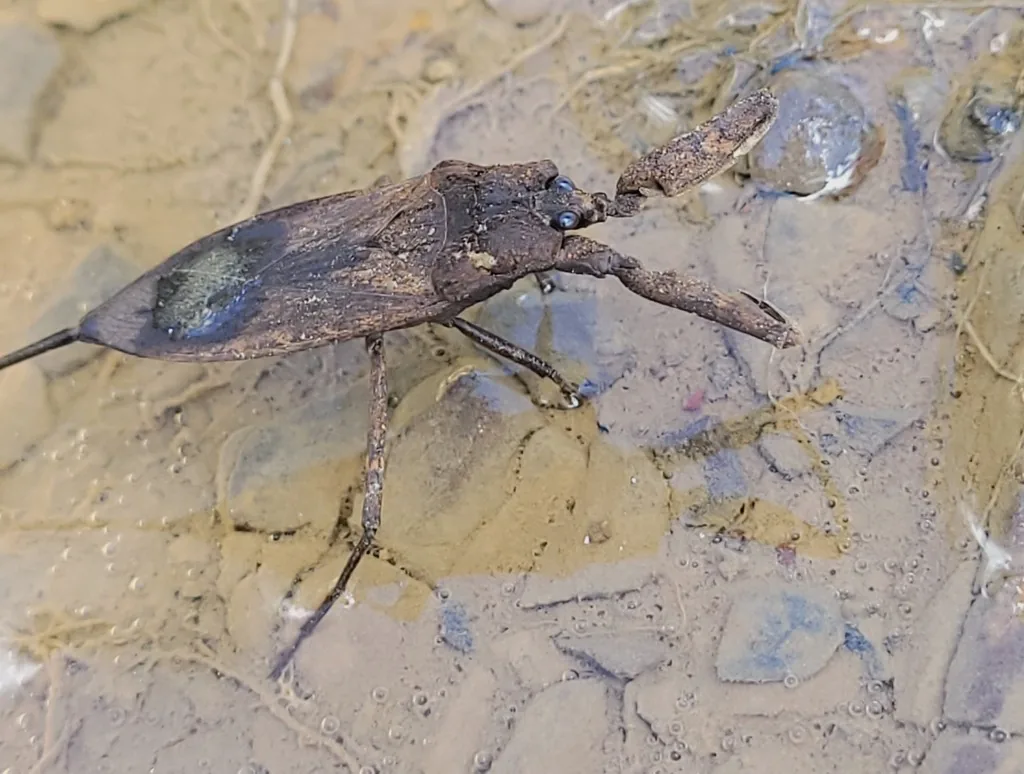
- Six legs, with the first pair enlarged, raptorial and held forward like a mantis; at a glance they look like antennae. A slender two-part filament extends from the tip of the abdomen.[1][2]
- Ranatra species (10 in North America) are slender and stick-like, usually about 1 1/2 inches long and up to 4 inches including the tail; the Utah key gives 15 to 50 mm for the family. Nepa apiculata, the only member of its genus on the continent, is oval, flattened and blackish, to about 3/4 inch, with big grasping forelegs.[1][2]
- They rest head-down among plant stalks with the snorkel tip just above the surface and move slowly, when they move at all, so a Ranatra is easy to mistake for a stalk of grass or debris. In laboratory tests the European Ranatra linearis preferred reeds and upright perches and usually held its body nearly parallel to the stem.[1][3]
- Like most true bugs they have two pairs of wings, the hardened front pair covering a membranous pair that is rarely used for flight, usually at night.[1]
Look-alikes
| Look-alike | How to tell them apart |
|---|---|
| Giant water bugs | Giant water bugs look a little like the flattened Nepa apiculata but have no needle-like breathing tube, and their middle and hind legs are flattened for swimming.[1] |
| Water striders and water measurers | Both are skinny and stick-like, but they walk on top of the water using surface tension; water scorpions rarely come above the surface.[1] |
| Scorpions | True scorpions are arachnids with eight legs and a real stinger and are not related; the water scorpion is a six-legged insect whose tail is a breathing tube.[1] |
Where it lives
Found statewide in Missouri and recorded in ponds of northern Utah; ten Ranatra species occur in North America plus the single Nepa species. GBIF holds US records of the family since 1990 from nearly every state, most of them from Texas and Florida.[1][2][5]
Biology and life cycle
Water scorpions prefer still or slow water with detritus and muddy bottoms, such as ponds, lakes and slow sections of streams, where they lurk among plant stalks and submerged vegetation waiting for prey to pass.[1][2]
They are ambush predators that take aquatic insects and other invertebrates, tadpoles and very small fish. The forelegs grab the prey and a jab from the knife-like beak injects digestive juice that disables it and liquefies its insides, which the tube-like mouthparts then suck out. They are said to eat enormous numbers of mosquito larvae. A study of the Australian Ranatra dispar described feeding in three stages: injecting venom, letting it break down the prey's tissue, then drawing out the food. When prey was plentiful the bugs were more wasteful and dropped prey before they had finished it.[1][4]
The year begins with eggs in spring; the nymphs molt several times, look like small adults with wing buds and never pupate. Most water scorpions apparently live at least a few years.[1]
The stick-like shape and slow movement work as camouflage both for ambushing prey and for hiding from fish, birds and frogs. A disturbed water scorpion may squeak by rubbing its forelegs against roughened patches on its body, then play dead.[1]
Young water scorpions change their taste in perches as they grow: in the French lab study, young nymphs chose floating duckweed, then waterweed, and after the fourth stage switched to reeds, and their favorite perch color shifted from green to brown.[3]
Damage and signs
- Water scorpions do no damage to property or plants; they are predators that help thin aquatic insects, including mosquito larvae, in ponds and slow streams.[1]
Health risk
Like other predatory true bugs (assassin bugs, giant water bugs and backswimmers) a water scorpion can potentially bite a person and deliver a painful dose of digestive saliva. The species in Missouri are not known to be harmful. Handle them with forceps or by the middle of the stiff body, away from the head, so they cannot bite.[1]
Control
Prevention
No control is needed. Water scorpions are rarely noticed, stay below the surface in weedy still water and are part of the normal pond community that eats mosquito larvae. Simply avoid handling them bare-handed.[1]
Common questions
- Does the tail sting?
- No. The needle-like tail is a pair of half-tubes that form a snorkel; the insect hangs head-down with the tip above the water to breathe. The bite comes from the beak at the other end, and it is only a risk if you handle one.[1]
- Is it dangerous in a pond or pool?
- Missouri's species are not known to be harmful to people, although a bite is painful. They prefer weedy, still water with a muddy bottom, so they are far more likely in a pond than a maintained pool.[1]
- How big do they get?
- Ranatra water scorpions are usually about 1 1/2 inches long and up to 4 inches including the breathing tube; the oval Nepa apiculata reaches about 3/4 inch. The Utah key gives 15 to 50 mm for the family.[1][2]
- Should I remove water scorpions from my garden pond?
- There is no need. The Missouri Department of Conservation calls them part of the normal community of shallow water and says they are said to eat enormous numbers of mosquito larvae; just pick them up with forceps or by the middle of the body, not bare-handed near the head.[1]
Sources
- Missouri Department of Conservation, “Water Scorpions (field guide).” mdc.mo.gov/discover-nature/field-guide/water-scorpions (accessed 2026-11-12)
- Utah State University Extension Water Quality Program, “Water Beetles and Bugs: Utah aquatic macroinvertebrate key.” extension.usu.edu/waterquality/resources/macrokey/beetles-bugs.php (accessed 2026-11-12)
- Behav Processes 1988, via PubMed, “Choice of perch by the water stick insect.” pubmed.ncbi.nlm.nih.gov/24897188/ (accessed 2026-11-12)
- Oecologia 1986, via PubMed, “The feeding behaviour of a sit-and wait-predator, Ranatra dispar (Heteroptera: Nepidae): optimal foraging and feeding dynamics.” pubmed.ncbi.nlm.nih.gov/28310142/ (accessed 2026-11-12)
- Global Biodiversity Information Facility (GBIF), “Nepidae (water scorpions): U.S. occurrence records since 1990 by state (GBIF occurrence search).” api.gbif.org/v1/occurrence/search?taxonKey=7892&country=US&hasGeospatialIssue=false&occurrenceStatus=PRESENT&year=1990%2C2026&facet=stateProvince&facetLimit=400&limit=0 (accessed 2026-11-12)
- iNaturalist, “Nepidae taxon page (order and family).” www.inaturalist.org/taxa/119347 (accessed 2026-11-10)