On this page
How to identify it
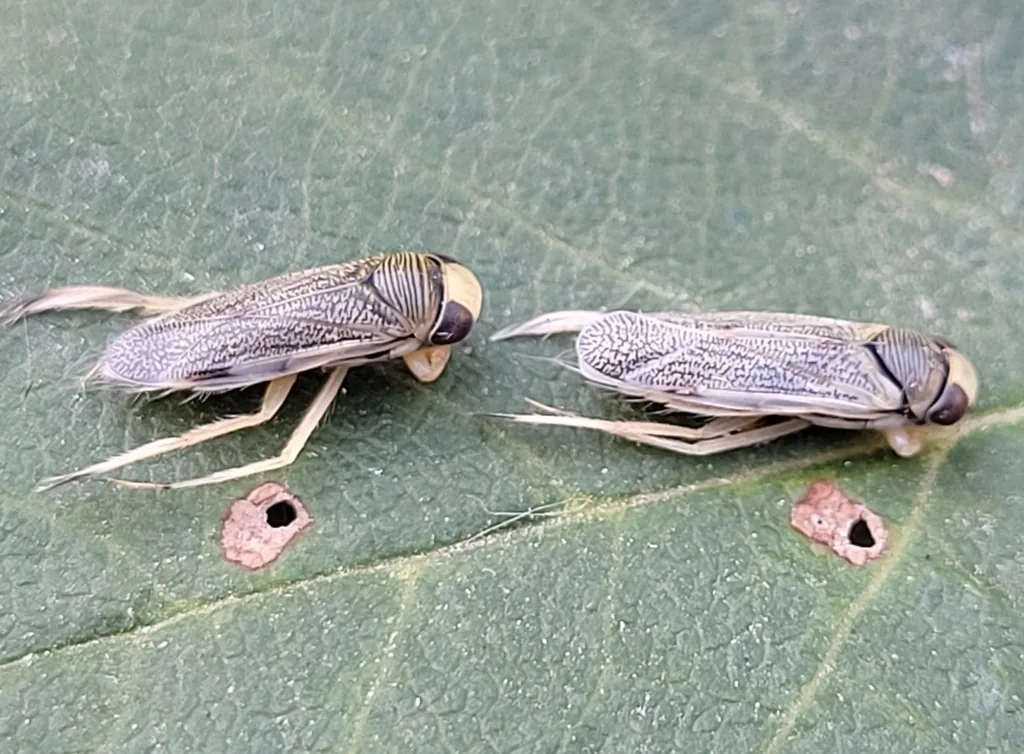
- Slender, oval, streamlined bugs usually under half an inch long (3 to 12 mm), with long oar-like hind legs fringed with fine hairs that they use to swim.[1][2]
- The back is flattened and crossed by several narrow, dark, parallel lines; the Utah key describes dark brown or black striations on the wings.[1][2]
- The 'foot' of each short front leg is a single scoop-shaped segment, which the bug hooks around a plant or object to stay submerged.[1][2]
- They swim right side up, carrying a thin silvery bubble of air against the body like a diving bell.[1]
Look-alikes
| Look-alike | How to tell them apart |
|---|---|
| Backswimmers | Backswimmers swim upside down, have a keeled back that is often light colored and lacks the crosslines, and their front feet are not scoop shaped. They are predators and can deliver a painful bite; water boatmen cannot.[1][2] |
| Giant water bugs | Giant water bugs are much larger predatory bugs with grasping forelegs; water boatmen are under half an inch and feed on algae and detritus.[1] |
Where it lives
About 125 species occur in North America; Missouri records them statewide and the Utah key lists them in still and slow-moving fresh water.[1][2]
Biology and life cycle
Water boatmen are most common in ponds and quiet parts of lakes and streams, where vegetation gives them something to cling to and to eat. They are excellent swimmers.[1][2]
Almost all true bugs have tube-like mouthparts, but water boatmen are among the few aquatic ones that are not predaceous: they suck juices from algae, other plants and detritus. Only a few species eat small aquatic animals such as mosquito larvae.[1]
They are strong fliers and are attracted to artificial lights at night, which is how strays end up in birdbaths and swimming pools; out of water they are clumsy.[1]
Eggs are glued to underwater objects. The young look like miniature wingless adults and gain their wings at the final molt. Fish, other insects and amphibians eat water boatmen in large numbers, and fly-fishers tie lures that imitate their jerky swimming.[1]
Fun fact: the male of a tiny European water boatman, Micronecta scholtzi, sings by rubbing body parts together. Its song was estimated at about 79 decibels on average, peaking near 99, at a meter away, and scaled to its body length that is louder than the calls of marine and land mammals.[4]
Water bugs, the group that includes water boatmen, live in almost all kinds of fresh water, sometimes in high numbers, and help turn over organic material, yet they are left out of most water pollution monitoring.[5]
Adults migrate in spring and fall between their home waters and overwintering sites, and a rainy season that boosts food can lead to a population explosion. They are drawn to shiny surfaces such as windows, cars and pools, which they take for water, so they can seem to fall from the sky onto cars. Eggs are cemented to underwater objects, sometimes in a dense mat.[6]
In California's Coachella Valley the local water boatman is a subspecies, Trichocorixa verticalis saltoni, named in 1948 and common in the brackish and salty water around the Salton Sea and Death Valley.[6]
Damage and signs
- Water boatmen do no damage. In a pool they are harmless strays that arrived by flying to lights; in a pond they turn algae and detritus into food for fish and other animals.[1]
Health risk
Water boatmen do not bite people. The similar-looking backswimmers are predaceous and can deliver a painful bite, so check which one you have before handling it. The Coachella Valley Mosquito and Vector Control District says water boatmen are not dangerous and pose no health threats.[1][6]
Control
Prevention
No control is needed. A stray water boatman in a pool or birdbath flew in overnight toward lights and can simply be netted out; it is harmless and does not bite.[1]
Cover the pool so they cannot land in it, and keep lights off at night so the adults are not drawn toward the pool. The migration is seasonal and should die down as winter temperatures cool.[6]
Sanitation
If many keep landing in a pool: remove algae and check the water chemistry for proper chlorine levels, and take floating objects and debris out of the pool so they have nowhere to lay eggs.[6]
Where sources disagree
Do they eat mosquito larvae? The Missouri Department of Conservation says only a few water boatman species eat small animals such as mosquito larvae. A 2024 study of ditches in a large English wetland counted water boatmen among the abundant predators there, and found nearly all mosquito species were negatively affected by potential predators.[1][7]
Common questions
- There are little swimming bugs in my pool. Will they bite?
- If they swim right side up with a flattened, cross-lined back, they are water boatmen, which do not bite. If they hang upside down under the surface with a pale keeled back, they are backswimmers, which can bite painfully.[1][2]
- How did they get into the pool?
- Water boatmen are strong fliers that are attracted to artificial lights at night and end up as strays in birdbaths and swimming pools after a night's flight.[1]
- What do they eat?
- Mostly the juices of algae, other plants and detritus; only a few species eat small aquatic animals such as mosquito larvae.[1]
- Will mosquito treatments in my pond hurt water boatmen?
- A 2022 review of 300 papers found that recommended field concentrations of mosquito larva treatments were not toxic to water bugs, and that the microbial larvicide Bti appears safe at its recommended rate. Pyrethroid insecticides were more toxic to water bugs than other insecticide groups tested.[5]
- Why are water boatmen landing on my car?
- Adults are drawn to reflective surfaces such as windows, cars and pools, which they mistake for water, especially during their spring and fall migrations.[6]
- How long will they keep showing up in my pool?
- Their migration is seasonal, and the Coachella Valley Mosquito and Vector Control District says activity should die down as winter temperatures cool.[6]
Sources
- Missouri Department of Conservation, “Water Boatmen (field guide).” mdc.mo.gov/discover-nature/field-guide/water-boatmen (accessed 2026-11-12)
- Utah State University Extension Water Quality Program, “Water Beetles and Bugs: Utah aquatic macroinvertebrate key.” extension.usu.edu/waterquality/resources/macrokey/beetles-bugs.php (accessed 2026-11-12)
- iNaturalist, “Corixidae taxon page (order and family).” www.inaturalist.org/taxa/84735 (accessed 2026-11-12)
- PLoS ONE (2011), via PubMed, “So small, so loud: extremely high sound pressure level from a pygmy aquatic insect (Corixidae, Micronectinae).” pubmed.ncbi.nlm.nih.gov/21698252/ (accessed 2026-11-12). Cited from the PubMed abstract.
- Environmental Monitoring and Assessment (2022), via PubMed, “Pollution impacts on water bugs (Nepomorpha, Gerromorpha): state of the art and their biomonitoring potential.” pubmed.ncbi.nlm.nih.gov/35344112/ (accessed 2026-11-12). Cited from the PubMed abstract.
- Coachella Valley Mosquito and Vector Control District (California), “Water Boatman Bug.” cvmvcd.specialdistrict.org/water-boatman-bug (accessed 2026-11-12). California special district (local vector control agency).
- Parasites & Vectors 2024;17(1):201, via PubMed, “Vegetation structure drives mosquito community composition in UK's largest managed lowland wetland.” pubmed.ncbi.nlm.nih.gov/38711091/ (accessed 2026-11-12). Cited from the PubMed abstract.