On this page
How to identify it
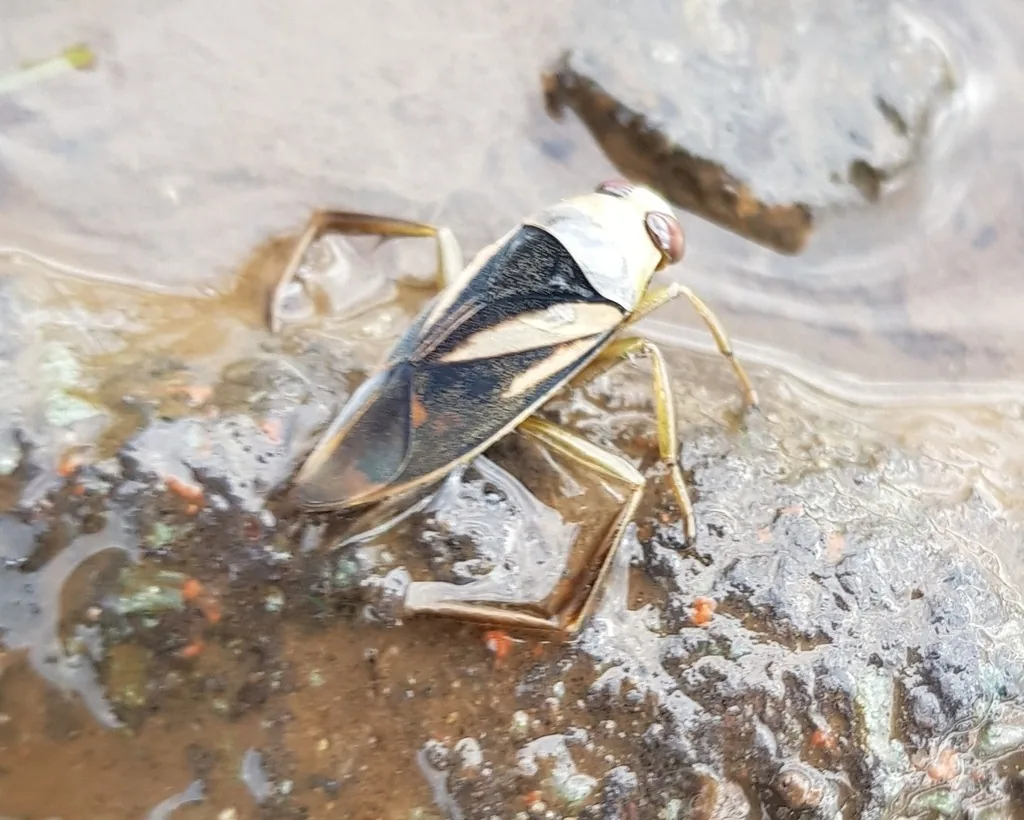
- Adults are slender and streamlined, with a back keeled like the bottom of a boat and long, oar-like hind legs fringed with fine hairs.[1][3]
- They swim belly-up and rest at the surface tilted head-down, with the tip of the abdomen poking out of the water.[1]
- Because they live upside down, their coloring is the reverse of most water animals: a light back and a dark belly. Utah State's key notes the body often has ivory-white coloring.[2][3]
- Each pair of legs has its own job: the front legs catch prey, the middle legs hold it, and the flattened, hairy hind legs row.[2]
- UF/IFAS describes adult Notonecta as having a pale tan head and legs, a darker shield behind the head, tan wing covers and large, dark red eyes. The European common backswimmer, Notonecta glauca, reaches about 16 mm (2/3 in).[9]
- Nymphs look like small adults but lack fully developed wings, have much shorter abdomens and are more uniformly colored, without the darker shield.[9]
- Most of the body is covered in fine hairs that trap a film of air, visible as a silvery sheen; in N. glauca the dense hairs under the wing covers can hold air for up to 130 days.[9]
Look-alikes
| Look-alike | How to tell them apart |
|---|---|
| Water boatmen | Water boatmen swim right side up, have flatter, usually darker bodies with fine parallel crosslines on the back, and are a bit smaller. They lack a piercing beak, feed mostly on algae, diatoms and other small living material, and don't bite.[1][2] |
Where it lives
About 32 species live in North America. They are most common in ponds and quiet parts of lakes and streams where plants give them something to cling to, and UW-Milwaukee adds sewage ponds, swimming pools and birdbaths. GBIF holds US backswimmer records from coast to coast, the most from Utah, California and Virginia. UF/IFAS notes that many Notonecta species occur in North America north of Mexico; its profiled species, the common backswimmer, ranges from northern Africa to western Siberia and northwestern China, and it is unclear whether it could establish in Florida.[1][2][7][9]
Biology and life cycle
Backswimmers wait for prey such as other aquatic insects, tadpoles and small fish, then lunge and deliver a bite that subdues the prey and starts digesting it; they suck out the body fluids of anything they can overpower.[1][2]
In a lab study, adult Notonecta sellata backswimmers ate every larval stage of the northern house mosquito (Culex pipiens). Mosquito larvae raised near the bugs, without contact, developed more slowly and emerged as smaller adults.[4]
In temporary pools around the Mediterranean and Middle East, the backswimmer Notonecta maculata gives off two hydrocarbons that drive egg-laying Culiseta mosquitoes away from the water.[5]
Females glue elongated eggs to the stems of submerged plants. The young look like small adults without wings, which they gain at the last molt.[1]
They carry an air supply in two hair-lined grooves on the underside of the abdomen, and they spend the winter as adults.[2]
Males make scraping sounds (stridulation) that apparently attract females.[1][2]
To fly, a backswimmer has to climb out of the water and flip right side up before it can spread its wings.[2]
Notonecta eggs are white and oblong, attached to water plants. UF/IFAS cites British species that lay in fall and/or spring, have one generation a year and pass through five nymphal stages over the summer.[9]
Notonecta prey mostly on other insects but have been seen taking fish eggs, fry and tadpoles; the common backswimmer also eats water fleas and Culex mosquito larvae. They ambush prey with grasping front or middle legs and suck out its body fluids.[9]
The common backswimmer favors lush vegetation, perching on plant edges about midway up to watch for prey. Below 15°C (59°F) it spends most of its time underwater, above that more time at the surface, and at 5°C (41°F) it stays submerged.[9]
Damage and signs
Health risk
A backswimmer can give a painful bite if it is handled or pressed against skin. For an ordinary insect bite, MedlinePlus advises washing the site with soap and water, applying ice wrapped in a washcloth 10 minutes on and 10 minutes off, and watching over the next several days for signs of infection such as increasing redness, swelling or pain. Call 911 for trouble breathing or swelling of the face or mouth.[1][2][6]
Control
Prevention
In ponds, they are worth leaving alone: backswimmers eat mosquito larvae.[4]
Keep them out
They are drawn to artificial lights at night, so lights left on near a pool can draw more of them in.[1]
Traps and physical control
Scoop them out of pools with a skimmer net rather than by hand, since they can bite.[1]
Where sources disagree
Size: the Missouri Department of Conservation says adults are usually less than 1/2 inch long, and UW-Milwaukee also calls them less than 1/2 inch, while Utah State's key gives 8.5-16 mm (about 1/3 to 5/8 inch).[1][2][3]
UF/IFAS gives about 16 mm (2/3 in) for full-grown common backswimmers, a European species, at the top of Utah State's 8.5-16 mm range and above the under-1/2-inch size MDC and UW-Milwaukee give.[9][3][1][2]
Common questions
- What bit me in the swimming pool?
- Often a backswimmer, a water bug that swims upside down. They fly to lights at night, land in pools, and can bite when pressed against skin.[1][2]
- How do I tell backswimmers from water boatmen?
- Backswimmers swim upside down and have a keeled back without crosslines; water boatmen swim right side up, have fine parallel lines on the back and don't bite.[1][2]
- Are backswimmers good to have in a pond?
- They are predators of mosquito larvae, and in a lab study a backswimmer ate every larval stage of the northern house mosquito.[4]
- Are backswimmers the same as greater water boatmen?
- Yes, UF/IFAS notes that the backswimmer family is sometimes called greater water boatmen. True water boatmen are a different family that swims right side up.[9][1]
Sources
- Missouri Department of Conservation, “Backswimmers (field guide).” mdc.mo.gov/discover-nature/field-guide/backswimmers (accessed 2026-11-11)
- University of Wisconsin-Milwaukee Field Station, “Water Boatmen, Backswimmers (Bug of the Week).” uwm.edu/field-station/bug-of-the-week/water-boatmen-backswimmers/ (accessed 2026-11-11)
- Utah State University Extension Water Quality Program, “Water Beetles and Bugs (Macroinvertebrate Key).” extension.usu.edu/waterquality/resources/macrokey/beetles-bugs.php (accessed 2026-11-11)
- Journal of Vector Ecology, via PubMed, “Predation ability and non-consumptive effects of Notonecta sellata on immature stages of Culex pipiens (Fischer et al. 2012).” pubmed.ncbi.nlm.nih.gov/22548560/ (accessed 2026-11-11)
- Ecology Letters, via PubMed, “Predator-released hydrocarbons repel oviposition by a mosquito (Silberbush et al. 2010).” pubmed.ncbi.nlm.nih.gov/20618841/ (accessed 2026-11-11)
- MedlinePlus, U.S. National Library of Medicine, “Insect bites and stings (Medical Encyclopedia).” medlineplus.gov/ency/article/000033.htm (accessed 2026-11-11)
- Global Biodiversity Information Facility (GBIF), “Notonectidae: US occurrence records since 1990 by state (GBIF occurrence search API).” api.gbif.org/v1/occurrence/search?taxonKey=4322&country=US&hasGeospatialIssue=false&occurrenceStatus=PRESENT&year=1990%2C2026&facet=stateProvince&facetLimit=400&limit=0 (accessed 2026-11-11)
- iNaturalist, “Notonectidae taxon page (order and family).” www.inaturalist.org/taxa/56556 (accessed 2026-11-11)
- University of Florida IFAS Extension, EDIS (Featured Creatures), “Common Backswimmer, Notonecta glauca (Linnaeus 1758), EENY-738/IN1262 (Featured Creatures).” ask.ifas.ufl.edu/publication/IN1262 (accessed 2026-11-14)