On this page
How to identify it
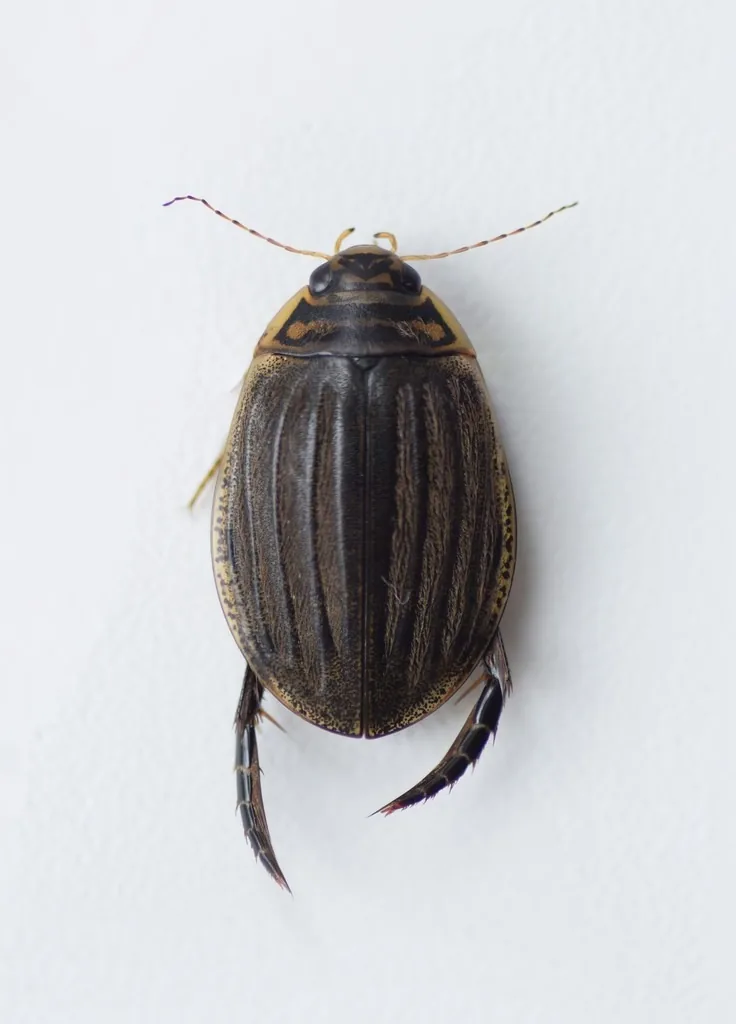
- Adults are smooth, streamlined, oval beetles, narrower at the head end. They are shiny black, brown, olive or greenish, sometimes with yellowish spots or marks, and the wing covers meet in a straight line down the back.[1][2]
- Size varies with species: Utah State gives 10 to 40 mm (about 3/8 to 1-1/2 inches) for the adults it keys, and Missouri up to about 1-1/2 inches. UF/IFAS gives 2.6 to 3.3 cm for the giant diving beetle (Cybister fimbriolatus) and about 1 to 1.5 cm for the sunburst diving beetle (Thermonectus marmoratus).[2][1][3]
- The antennae are long, thin and threadlike. The hind legs are flattened, fringed with hairs and work like paddles, and the beetles swim by kicking both hind legs at the same time.[1][2]
- At rest they hang head down from the water surface with the tip of the abdomen poking out, and before diving they trap air between the wings and body. UF/IFAS says the large air bubble under the wing covers lets them stay underwater for long periods, and their large eyes, with two distinct focal planes like bifocals, help them find water when they fly.[1][3]
- The larvae, or water tigers, are long, flattened, spindle-shaped and up to about 2 inches long, with six legs, a large head on a narrow neck, and big pincer-like jaws. They come to the surface to take in air through breathing pores at the tail end.[1][2]
Look-alikes
| Look-alike | How to tell them apart |
|---|---|
| Water scavenger beetles (Hydrophilidae) | Similar in shape and often confused with diving beetles, but they swim by moving their legs alternately rather than together. Their antennae are short and clubbed, while diving beetles have long, threadlike antennae, and many have a sharp spine or keel running down the underside.[1][4][2] |
Where it lives
Diving beetles are found statewide in Missouri, and Utah State's key places them in slow streams, ponds, wetlands and the shallow edges of lakes. GBIF's public U.S. records since 1990 for the family (about 38,000) come from 49 states on the map, most from California, Texas and Florida. Worldwide there are about 4,000 species, on every continent except Antarctica, according to UF/IFAS.[1][2][5][3]
Biology and life cycle
They prefer quiet water at the edges of ponds and streams, floating among water plants. UF/IFAS says the giant diving beetle turns up in small fishless water such as roadside puddles and cattle tanks, and the sunburst diving beetle in puddles and temporary streams in southwestern North America, even in fairly dry country.[1][2][3]
Both adults and larvae are predators. Adults will attack prey larger than themselves, including small fish, tadpoles and frogs. Their sharp jaws inject digestive enzymes so they can take in the juices of their prey. UF/IFAS calls them scavenger-predators that eat a wide range of high-protein food, living or dead; after a big meal they can go weeks without eating, and the giant diving beetle can live for several years.[1][3]
Water tigers hunt by waiting motionless with jaws open, then striking. Their hollow jaws let them suck the prey's juices while holding it.[1]
The larvae of the sunburst diving beetle (Thermonectus marmoratus) have been studied for their unusual eyes: tube-shaped principal eyes with bifocal lenses, two retinas at different depths, and very narrow fields of view. Larvae bob the whole body up and down before striking to widen that view, and in lab tests they struck targets accurately from about 4.5 mm away. UF/IFAS describes the sunburst diving beetle's larvae as mosquito-eating specialists.[6][7][8][3]
Eggs are laid on submerged plants. How long larvae take to grow varies by species; grown larvae crawl out of the water and burrow into mud to pupate, and about a week later the adults emerge and return to the water.[1]
Adults are strong fliers. They fly to new water when a pond dries up, and electric lights can lure them away from home, which is how they end up in swimming pools and birdbaths. UF/IFAS adds that they usually fly at night and that any bright light may draw them, especially one near fresh water.[1][3]
Fish, birds and mammals eat them, and beetles crawling on land after a night of flying are easy prey for land animals.[1]
Damage and signs
Health risk
They can bite if handled roughly; Missouri's conservation department says the bites are painful though not medically significant. When disturbed, the sunburst diving beetle ejects a milky fluid containing steroid compounds from defensive glands in the front of its body (the prothorax), another reason to use a net rather than bare hands. For a bite, MedlinePlus says to wash the site with soap and water, apply ice wrapped in a cloth, and watch over the next few days for signs of infection such as increasing redness, swelling or pain. UF/IFAS likewise says the large species may bite if provoked and advises handling them with care.[1][9][10][3]
Control
Prevention
Most people count diving beetles as beneficial because they eat other aquatic insects, so no control is needed in ponds and streams. A beetle that lands in a pool or birdbath can be scooped out with a net and released at a pond.[1]
UF/IFAS advises not keeping diving beetles and fish in the same tank, since the beetles may attack fish larger than themselves, and says any beetle aquarium needs a cover because they fly, usually at night.[3]
Keep them out
Electric lights can lure flying adults away from their home ponds at night; Missouri says that is how they end up in pools and birdbaths.[1]
Common questions
- Why is there a big beetle in my swimming pool?
- Diving beetles fly from pond to pond at night, often when their water dries up, and electric lights can lure them away from home. That is why they show up in swimming pools and birdbaths.[1]
- Do diving beetles bite?
- They can. Missouri calls the bite painful but not medically significant, so pick them up with a net rather than your hands.[1]
- Are water tigers dangerous to fish?
- They can be. Diving beetle adults and larvae are fierce predators that take tadpoles and small fish, including prey larger than themselves.[1]
- Can you keep diving beetles as pets?
- Yes. UF/IFAS describes them as easy-to-keep native pets, singles out the sunburst diving beetle as probably the best species for beginners, and says native species can be released back into the wild. Keep them without fish, under a cover, and handle them gently.[3]
Sources
- Missouri Department of Conservation, “Predaceous Diving Beetles (Water Tigers) (Field Guide).” mdc.mo.gov/discover-nature/field-guide/predaceous-diving-beetles-water-tigers (accessed 2026-11-14)
- Utah State University Extension (Water Quality), “Water Beetles and Bugs (Aquatic Macroinvertebrate Key).” extension.usu.edu/waterquality/resources/macrokey/beetles-bugs (accessed 2026-11-14)
- University of Florida/IFAS Extension (EDIS), “Predaceous Diving Beetles as Pets and the Self-Cleaning Aquarium, FOR330/FR398 (C. Bateman and J. Hulcr).” ask.ifas.ufl.edu/publication/FR398 (accessed 2026-11-14). Used for biology, habitat and handling; its line on the defensive fluid being mildly toxic if swallowed is not used.
- Missouri Department of Conservation, “Water Scavenger Beetles (Field Guide).” mdc.mo.gov/discover-nature/field-guide/water-scavenger-beetles (accessed 2026-11-14)
- Global Biodiversity Information Facility (GBIF), “Dytiscidae: occurrence records in the U.S., 1990-2026 (GBIF occurrence search).” api.gbif.org/v1/occurrence/search?taxonKey=7824&country=US&hasGeospatialIssue=false&occurrenceStatus=PRESENT&year=1990%2C2026&facet=stateProvince&facetLimit=400&limit=0 (accessed 2026-11-14). State counts are records reported (iNaturalist research-grade, museum specimens, surveys), not abundance.
- Current Biology, via PubMed, “Biological bifocal lenses with image separation (Stowasser et al. 2010).” pubmed.ncbi.nlm.nih.gov/20691594/ (accessed 2026-11-14). Cited from the PubMed abstract.
- Journal of Comparative Physiology A, via PubMed, “Scanning behavior by larvae of the predacious diving beetle Thermonectus marmoratus enlarges visual field prior to prey capture (Buschbeck et al. 2007).” pubmed.ncbi.nlm.nih.gov/17639412/ (accessed 2026-11-14). Cited from the PubMed abstract.
- Journal of Experimental Biology, via PubMed, “Unilateral range finding in diving beetle larvae (2014).” pubmed.ncbi.nlm.nih.gov/24477608/ (accessed 2026-11-14). Cited from the PubMed abstract.
- Proceedings of the National Academy of Sciences, via PubMed, “Mirasorvone: a masked 20-ketopregnane from the defensive secretion of a diving beetle, Thermonectus marmoratus (Meinwald et al. 1998).” pubmed.ncbi.nlm.nih.gov/9501158/ (accessed 2026-11-14). Cited from the PubMed abstract.
- MedlinePlus, U.S. National Library of Medicine, “Insect bites and stings (Medical Encyclopedia).” medlineplus.gov/ency/article/000033.htm (accessed 2026-11-14)
- iNaturalist, “Dytiscidae taxon page (order and family).” www.inaturalist.org/taxa/57659 (accessed 2026-11-14)