On this page
How to identify it
- They are among the largest insects in the U.S.: Mississippi State gives adults up to 2.5 inches long and the Missouri Department of Conservation about 2 inches, and Utah State's aquatic key gives the family a length of 2 to 12 cm. Some African and Indian species are over 4 inches long. UF/IFAS says the family has the largest body size of any true bugs, with adults of some South American species reaching 4 inches.[1][2][3][4]
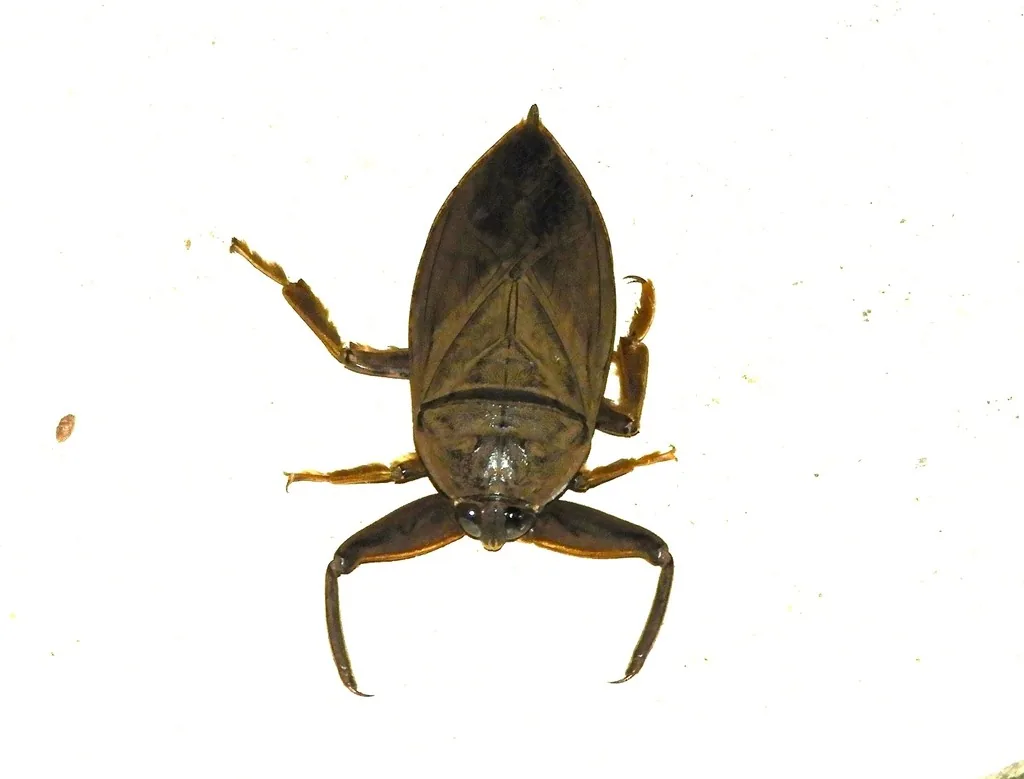
- They are brownish, with oval, flattened, beetle-like bodies, clawlike front legs for grabbing prey and long, somewhat oarlike hind legs for swimming.[2][3]
- They breathe air through snorkel-like, strap-shaped tubes at the hind end, so they rise to the surface from time to time. UF/IFAS describes them hanging just below the surface, breathing through two abdominal appendages that act as siphons.[2][3][4]
- U.S. giant water bugs belong to genera such as Abedus, Belostoma and Lethocerus; Mississippi State names the eastern toe-biter (Benacus griseus) and Lethocerus americanus as two of the more common species.[2][1]
- Size helps separate the genera: in UF/IFAS's key to Florida species, Lethocerus adults are 35 mm or longer, while the pale brown Belostoma testaceum is less than 20 mm long.[4]
Where it lives
Mississippi State says they live in ponds, lakes and streams throughout the country, the Missouri Department of Conservation lists them statewide in Missouri, and Utah State's key includes the family among Utah's aquatic insects. UF/IFAS lists eight species in three genera in Florida. Belostoma flumineum, for example, ranges from Quebec and New England west to Manitoba and Colorado and southwest to Florida, Louisiana and Arizona, and Lethocerus americanus from Newfoundland and Maine to British Columbia, south to Utah, Nevada, Mexico and Florida.[1][2][3][4]
Biology and life cycle
They live in weedy ponds and slow water such as beaver ponds, where they sit still on the bottom or cling to a plant stalk and wait for prey to pass.[2][3]
On summer nights adults sometimes crawl out and fly off to find mates or to escape ponds that are drying up. Like moths, they are drawn to artificial lights and may crash-land near them, which is how they end up on patios, sidewalks and in swimming pools. UF/IFAS says they fly from pond to pond in the mating season, and it is on these flights that they come to lights in large numbers, which earned them the name electric light bugs.[1][2][4]
In some giant water bugs the female glues her eggs onto the male's back, where they stay in a flat cluster until they hatch. The Missouri Department of Conservation notes that an egg-laden male can't fly or mate until then, while females often mate again; researchers have studied this male-only egg care in Abedus and Appasus water bugs. UF/IFAS says this happens in Abedus and Belostoma, and that when there aren't enough large males, eggs have also been found on females' backs. Lethocerus lays its eggs above the water on plants and other objects instead.[2][5][6][4]
Birds and fish eat giant water bugs.[2]
Worldwide there are seven genera and about 60 species; North America has three genera and about 20 species, according to UF/IFAS.[4]
Eggs hatch in one to two weeks and total development takes one to two months; UF/IFAS says adults may overwinter in the mud.[4]
Damage and signs
- They eat only animals. Small nymphs take insects and other small invertebrates; large nymphs and adults also catch minnows, tadpoles, frogs, crayfish, small snakes and turtles, and occasionally young waterfowl. UF/IFAS adds small birds to the list.[1][2][4]
- They seize prey with the front legs, pierce it with the beak and inject saliva that paralyzes it and begins digesting it, then suck out the liquid. UF/IFAS says the enzymes they inject are powerful enough to kill the prey.[1][2][4]
- The Missouri Department of Conservation says they are usually considered beneficial to people because they eat mosquito larvae.[2]
Health risk
Bites are uncommon but extremely painful. In a medical report of seven bite cases, victims had intense, excruciating pain and one had numbness in the forearm; the authors note that no specific treatment is known to work, so avoiding bites matters most. UF/IFAS adds that besides biting with their strong beak, they can pinch with their front legs.[7][4]
Control
Prevention
Don't pick them up or poke them; Mississippi State notes that biologists and children are among the most common bite victims. If one lands in a swimming pool, lift it out with a net.[1][2]
Barefoot waders are sometimes bitten, so wear shoes when wading in weedy ponds and slow water.[1][2]
If you are bitten
MedlinePlus's general steps for insect bites: wash the site with soap and water, then apply ice wrapped in a washcloth for 10 minutes on and 10 minutes off, and watch over the next several days for signs of infection such as increasing redness, swelling or pain.[8]
Call 911 or your local emergency number for trouble breathing or wheezing, swelling of the face or mouth, throat tightness or trouble swallowing, weakness, or turning blue.[8]
Common questions
- What's the huge bug that flew to my porch light?
- If it is a big, flat brown bug with grabbing front legs, it may be a giant water bug, also called an electric light bug; adults fly to lights on summer nights.[1][2]
- Do giant water bugs bite?
- Yes, if handled or stepped on, and the bite is extremely painful.[1][7]
- Why is this water bug carrying eggs on its back?
- It is a male. In some giant water bugs the female glues her eggs onto the male, and he carries them until they hatch.[2][6]
- How many kinds of giant water bugs are there?
- UF/IFAS counts seven genera and about 60 species worldwide, about 20 species in three genera in North America, and eight species in Florida.[4]
- Do people eat giant water bugs?
- Yes, in parts of Asia. UF/IFAS says adult Lethocerus are considered a delicacy there and are eaten both fresh and cooked.[4]
Sources
- Mississippi State University Extension, “Giant Water Bug, Vol. 10, No. 08.” extension.msstate.edu/newsletters/bugs-eye-view/2024/giant-water-bug-vol-10-no-08 (accessed 2026-11-11)
- Missouri Department of Conservation, “Giant Water Bugs (Field Guide).” mdc.mo.gov/discover-nature/field-guide/giant-water-bugs (accessed 2026-11-11)
- Utah State University Extension Water Quality Program, “Water Beetles and Bugs: Utah aquatic macroinvertebrate key.” extension.usu.edu/waterquality/resources/macrokey/beetles-bugs.php (accessed 2026-11-11)
- University of Florida IFAS Extension (EDIS), “Giant Water Bugs, Electric Light Bugs, Lethocerus, Abedus, Belostoma, EENY-301/IN578 (P. M. Choate; Featured Creatures).” ask.ifas.ufl.edu/publication/IN578 (accessed 2026-11-14)
- Ecological and Evolutionary Physiology, via PubMed, “Aparicio-Moreno C et al. (2026), Proximate costs of male-exclusive parental care in the giant water bug, Abedus ovatus (Hemiptera: Belostomatidae), Ecological and Evolutionary Physiology.” pubmed.ncbi.nlm.nih.gov/42361112/ (accessed 2026-11-11). Cited from the PubMed abstract.
- Royal Society Open Science, via PubMed, “Ohba SY, Okuda N, Kudo S (2016), Sexual selection of male parental care in giant water bugs, Royal Society Open Science 3:150720.” pubmed.ncbi.nlm.nih.gov/27293778/ (accessed 2026-11-11). Cited from the PubMed abstract.
- Wilderness & Environmental Medicine, via PubMed, “Haddad, Schwartz, Schwartz and Carvalho (2010), Bites caused by giant water bugs belonging to Belostomatidae family (Hemiptera, Heteroptera) in humans: a report of seven cases, Wilderness Environ. Med. 21(2):130-133.” pubmed.ncbi.nlm.nih.gov/20591375/ (accessed 2026-11-11)
- MedlinePlus, U.S. National Library of Medicine, “Insect bites and stings (Medical Encyclopedia 000033).” medlineplus.gov/ency/article/000033.htm (accessed 2026-11-11)
- iNaturalist, “Belostomatidae taxon page (order and family).” www.inaturalist.org/taxa/81570 (accessed 2026-11-11)