On this page
How to identify it
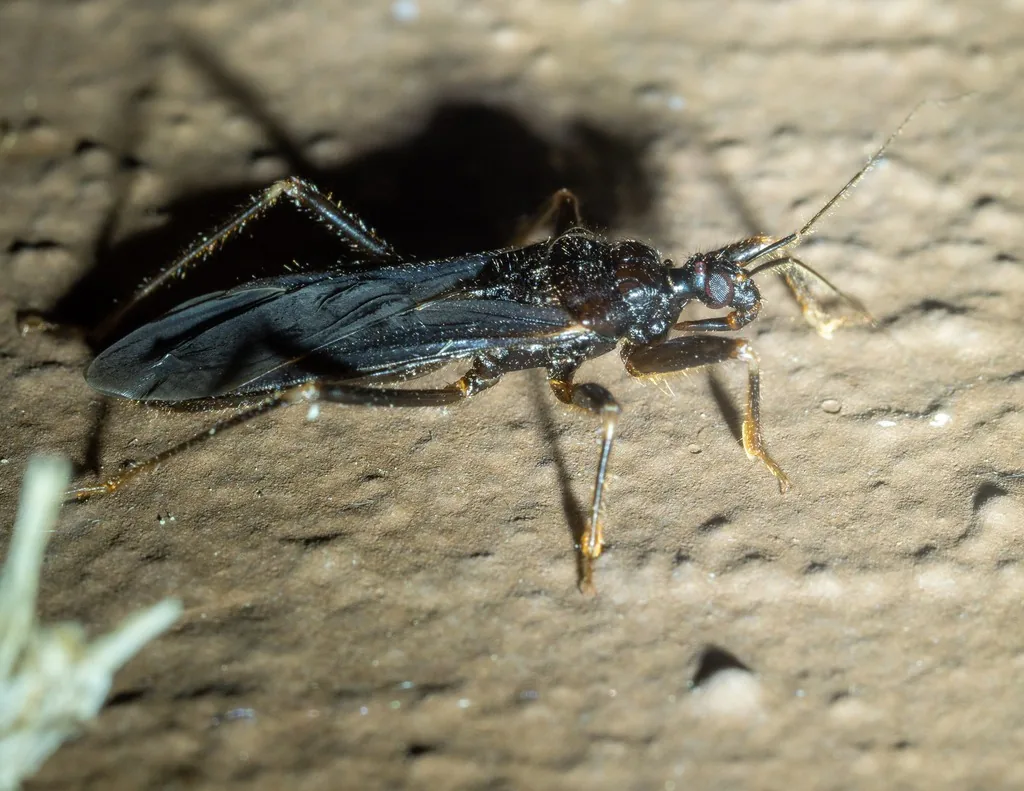
- Adults are elongate, glossy black or very dark brown, and about 3/4 inch (17 to 22 mm) long, with wings folded flat over the back.[1][4][2]
- The head is small with wide-set eyes and a narrow neck, and a short, stout, curved beak tucks into a groove between the front legs.[1][2]
- Nymphs coat themselves in dust, lint, sand and insect fragments held on by sticky hairs, so they look like little walking balls of fluff.[1][2][5]
- A nymph without its debris coating is smaller than an adult, lacks full wings and is light brown.[2][4]
Look-alikes
| Look-alike | How to tell them apart |
|---|---|
| Kissing bug (conenose bug) | Kissing bugs feed on blood and most have an orange- or red-striped band around the body edge; masked hunters are plain dark, don't take blood meals and don't spread Chagas disease.[7][1][2][12] |
| Wheel bug | A larger gray assassin bug, about 1 1/4 inches long, with a cog-like crest on top of the thorax; the masked hunter is about 3/4 inch, dark brown to black and has no crest.[6][2] |
Where it lives
Native to Europe and western Asia, it now ranges across the United States and southern Canada; in colder northern areas it survives only indoors.[1]
Biology and life cycle
Masked hunters hunt at night and spend the day in dry hiding places such as under heat registers and cabinets, inside wall voids and in attics.[1][4]
Indoors they prey on silverfish, booklice, house centipedes, carpet beetles, bed bugs and overwintering insects such as lady beetles and cluster flies.[1]
Eggs are laid in small masses in crevices; first-stage nymphs start by hunting small flies, springtails and other prey they can overpower.[5]
Sources differ on the life cycle: Wisconsin says there is normally one generation a year, while Colorado State suggests a two-year cycle there. Adults are seen mostly in midsummer but also in winter.[4][5][1]
Adults have working wings, fly, and are attracted to lights, which is one way they end up indoors.[5][2]
Adults usually live 65 to 90 days, though one was recorded living 217 days.[1]
Damage and signs
Health risk
Predatory assassin bugs, the family the masked hunter belongs to, can give people painful bites; a review of Australian cases suggested the reactions may come from an injected toxin, and assassin bug venoms are known to cause pain in animals that attack them. CDC's NIOSH says insect bites and stings may cause mild discomfort or pain, and people allergic to venom can have anaphylaxis, which needs immediate emergency care.[9][10][11]
Control
Keep them out
Caulk, screen and seal openings, add door sweeps to outside and garage doors, and consider switching outdoor lights to sodium vapor bulbs.[4][3]
Sanitation
Find and get rid of the indoor insects they feed on; once that prey is gone, masked hunters die out from hunger or old age.[1][4]
Traps and physical control
When only one or a few appear, trap each one in a jar and release it outdoors, or vacuum it up, taking care not to touch it barehanded.[2]
Vacuum cracks and crevices regularly, and set sticky glue boards in corners and under furniture to catch insects that get inside.[4][3]
Pesticides
Insecticides usually aren't necessary. Where an underlying pest is being treated, broad-spectrum products such as pyrethroids may also reduce masked hunters; follow the label.[2][1][4]
Common questions
- What should I do if a masked hunter bites me?
- CDC has no masked hunter-specific advice. Its NIOSH first aid for bee and wasp stings is to wash the site with soap and water, apply ice to reduce swelling, avoid scratching, and have someone watch for an allergic reaction; get emergency care for signs such as loss of breath, serious swelling or slurred speech.[11]
- Can a masked hunter give me Chagas disease?
- No. Masked hunters are related to kissing bugs, which can carry Chagas disease, but they don't feed on blood and don't transmit any disease.[2][3][1][12]
- Does finding a masked hunter mean I have bed bugs?
- Not necessarily. It is sometimes nicknamed the bed bug hunter, but it eats many kinds of insects, so it simply means some indoor prey is available.[5][1]
Sources
- Penn State Extension, “Masked Hunter (updated January 19, 2026).” extension.psu.edu/masked-hunter (accessed 2026-11-12)
- University of Minnesota Extension, “Masked hunters (reviewed 2024).” extension.umn.edu/household-insects/masked-hunters (accessed 2026-11-12)
- Utah State University Extension, “Masked Hunter (IPM nuisance pest notes).” extension.usu.edu/planthealth/ipm/notes_nuisance/masked-hunter (accessed 2026-11-12)
- University of Wisconsin-Madison Extension, Wisconsin Horticulture, “Masked Hunter Bug (XHT1184, revised January 20, 2009).” hort.extension.wisc.edu/articles/masked-hunter-bug/ (accessed 2026-11-12)
- Colorado State University, Department of Agricultural Biology, “Masked Hunter (Colorado Insect of Interest, revised 2017).” webdoc.agsci.colostate.edu/bspm/Hexapoda%20(Insects)/MaskedHunterRevised2017.pdf (accessed 2026-11-12)
- Texas A&M AgriLife Extension Service, “Wheel bugs and other assassin bugs (Insects in the City, ENT-1003).” citybugs.tamu.edu/factsheets/landscape/others/ent-1003/ (accessed 2026-11-12)
- Texas A&M University Kissing Bug Community Science Program, “Kissing Bugs: Frequently Asked Questions.” kissingbug.tamu.edu/faq/ (accessed 2026-11-12)
- iNaturalist, “Reduvius personatus taxon page (order and family).” www.inaturalist.org/taxa/56521 (accessed 2026-11-12)
- Medical Journal of Australia (via PubMed), “Cook ML, Lee DJ. Effects on humans of bites of Australian non-bloodsucking reduviid bugs. Med J Aust 1977 (abstract).” pubmed.ncbi.nlm.nih.gov/613198/ (accessed 2026-11-12)
- Toxins (via PubMed), “Walker AA et al. Missiles of Mass Disruption: composition and glandular origin of venom used as a projectile defensive weapon by the assassin bug Platymeris rhadamanthus. Toxins 2019 (abstract).” pubmed.ncbi.nlm.nih.gov/31752210/ (accessed 2026-11-12)
- CDC, National Institute for Occupational Safety and Health, “Insects and Scorpions at Work.” www.cdc.gov/niosh/outdoor-workers/about/insects-and-scorpions.html (accessed 2026-11-12)
- Centers for Disease Control and Prevention, “About Chagas Disease.” www.cdc.gov/chagas/about/index.html (accessed 2026-11-12)