The short answer
- Most house bugs are harmless visitors. Cellar spiders, jumping spiders and pill bugs are not a danger to people.[12][14][21]
- A few need a grown-up right away. Bed bugs bite people at night, and cockroach droppings and body parts can trigger asthma.[24][6]
- Some bugs eat your stuff. Carpet beetle larvae eat wool, leather and silk, silverfish eat paper and book bindings, and pantry moth caterpillars get into dry foods.[15][9][16]
- When you are not sure what a bug is, look but don't touch. Use the three clues on each card to name it.[25][13]
Meet these house bugs
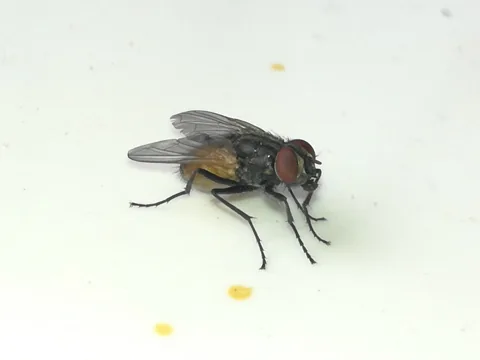 House Fly
Musca domestica
The house fly is a worldwide companion of people and domestic animals; it breeds in garbage, manure and other moist organic matter and is most numerous in hot summer months.
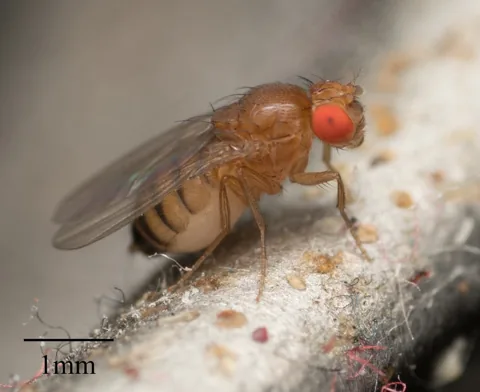 Fruit Fly
Drosophila melanogaster
Fruit flies, also called vinegar or pomace flies, are tiny flies drawn to ripe and fermenting fruits and vegetables. They can show up any time of year, but they are most common from summer into fall.
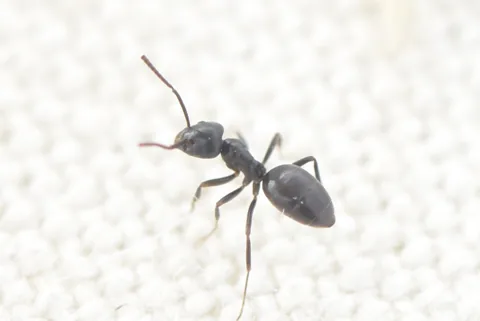 Odorous House Ant
Tapinoma sessile
The odorous house ant is a small native ant found across most of the United States that trails into homes for sweets and gives off a strong, rotten odor when crushed. Texas A&M says it ranges from Canada to Mexico but is rarely found in the southwestern deserts.
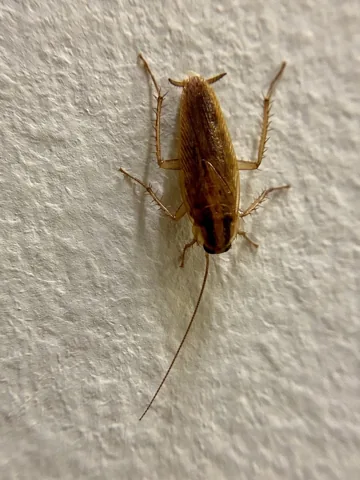 German Cockroach
Blattella germanica
The German cockroach is the most common cockroach living indoors in California and perhaps worldwide, especially in apartment buildings, and it has the fastest reproductive cycle of the common pest cockroaches. Penn State and Kentucky call it the most common cockroach in homes, apartments and other buildings, and Kentucky says it does not live outdoors.
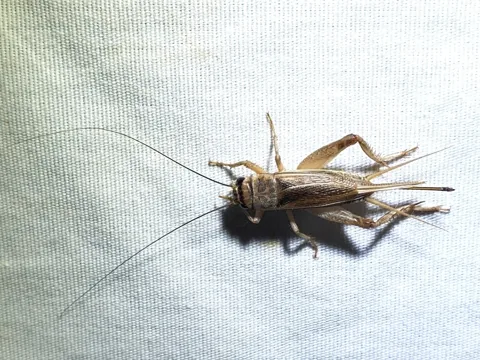 House Cricket
Acheta domesticus
The house cricket is a light brown cricket that is common outdoors, strongly attracted to light and often found inside houses, especially in late summer and fall.
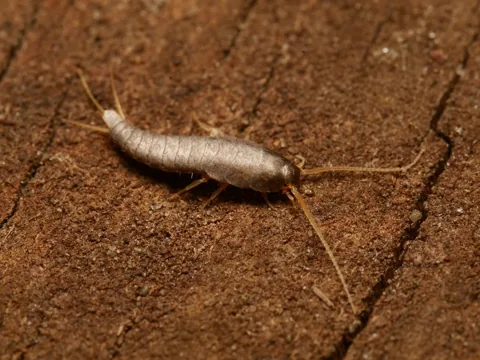 Silverfish
Lepisma saccharinum
Silverfish are nocturnal, wingless insects that hide by day and graze at night on paper, book bindings, starch in clothing and dry foods, preferring damp, warm places such as laundry rooms.
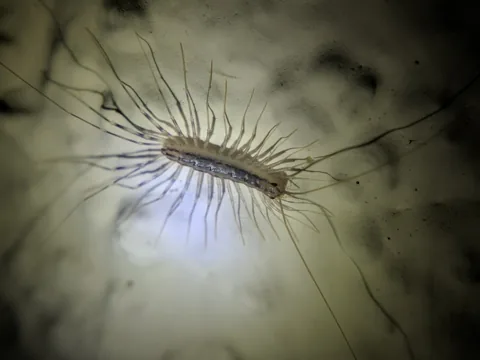 House Centipede
Scutigera coleoptrata
House centipedes are fast, long-legged predators that live in damp parts of buildings and feed on silverfish, cockroaches, carpet beetle larvae and other small arthropods; they are largely harmless.
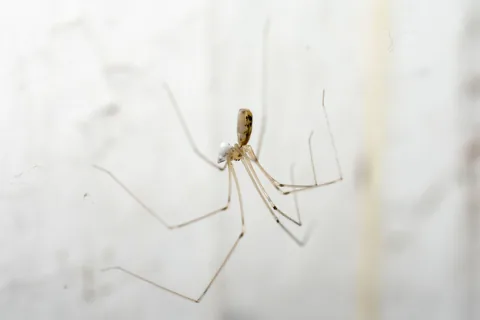 Longbodied Cellar Spider
Pholcus phalangioides
The longbodied cellar spider is the most common cellar spider in the United States: a small, pale spider with extremely long legs that lives in buildings all year. Penn State says it isn't known to be harmful in any way; its main offense is messy webbing.
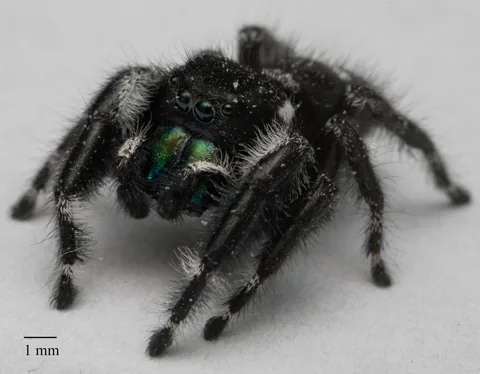 Bold Jumping Spider
Phidippus audax
Jumping spiders are compact, day-active hunters that build no web; they stalk prey by sight and pounce from a short distance. They live on plants, bark and walls and only occasionally wander indoors.
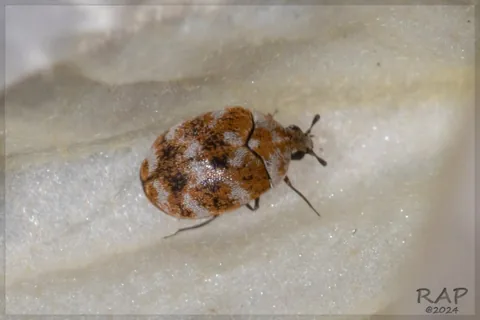 Varied Carpet Beetle
Anthrenus verbasci
Carpet beetles are small beetles whose larvae damage wool, silk, fur, feathers, leather and other animal products; the adults feed on pollen outdoors and often fly in through windows.
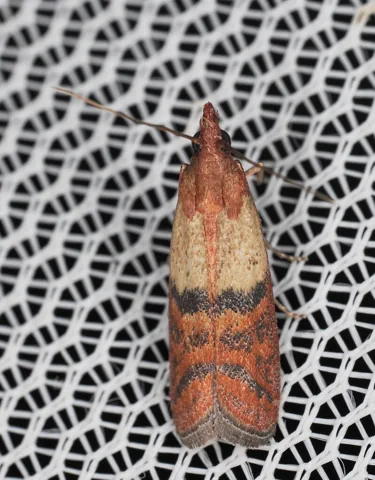 Indianmeal Moth
Plodia interpunctella
The Indianmeal moth is the most common moth infesting stored food in the home; all damage is done by the larvae, which feed in cereals, flour, nuts, dried fruit, chocolate and pet food.
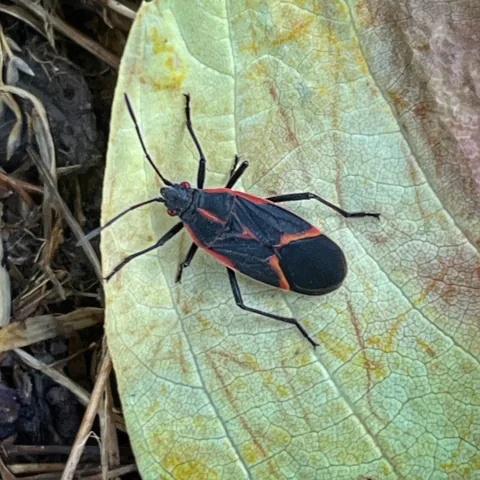 Boxelder Bug
Boisea trivittata
Boxelder bugs feed mainly on the seeds of female boxelder trees and become a nuisance in fall, when large numbers gather on and around homes looking for a place to spend the winter. Indoors they can stain fabrics and smell when crushed, but they don't damage the structure and don't breed inside.
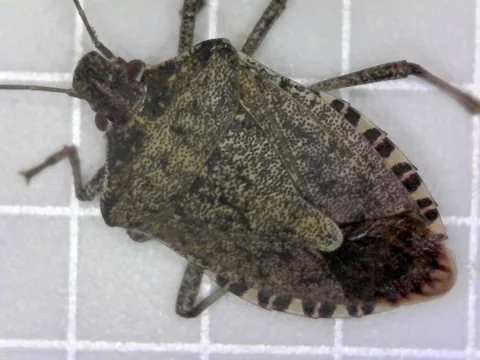 Brown Marmorated Stink Bug
Halyomorpha halys
The brown marmorated stink bug is an invasive insect from east Asia that damages fruit and vegetable crops and invades homes in fall looking for overwintering sites. Minnesota Extension says it feeds on about 200 plant species and, unlike the native stink bugs there, prefers to spend the winter in homes. Clemson notes that the bugs gather on outside walls before they move in.
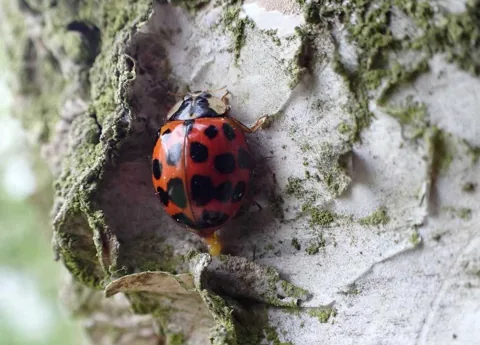 Multicolored Asian Lady Beetle
Harmonia axyridis
The multicolored Asian lady beetle is a beneficial aphid predator outdoors but becomes a nuisance when it flies to buildings in fall to overwinter and ends up indoors. Clemson and Colorado State extension both describe it as a valuable aphid predator on crops, trees and shrubs.
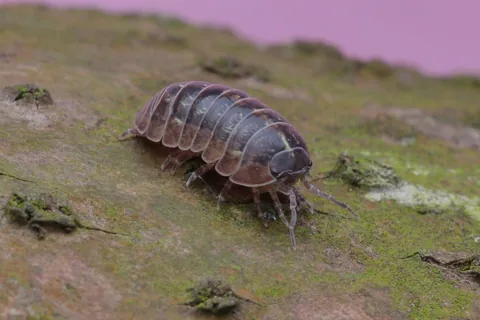 Common Pillbug
Armadillidium vulgare
Sowbugs and pillbugs are land-living crustaceans, more closely related to shrimp and crayfish than to insects, that feed mostly on decaying plant matter. They are harmless indoors, and finding many inside usually points to dampness, a large population outdoors or a gap at a door or window.
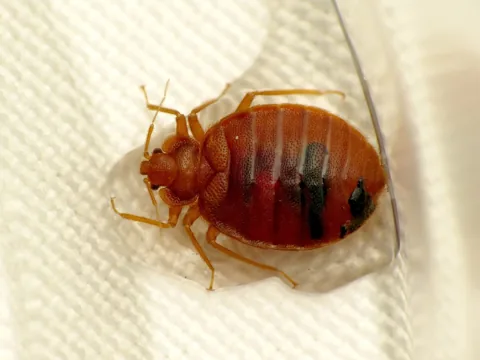 Bed Bug
Cimex lectularius
Bed bugs are wingless, blood-feeding insects that feed on sleeping or resting people, mostly at night; they have resurged worldwide and now turn up even in the finest hotels. CDC says they turn up in five-star hotels and resorts, and how clean a place is does not determine whether bed bugs are present.
How to use this sheet
Print this page, or keep it open on a tablet. When you spot a bug, don't squish it. Some, like stink bugs and odorous house ants, give off a strong smell when crushed, and a squished bug is much harder to name.[18][3]
Match the bug to a card. Each card has three look-for clues, the places in the house where that bug usually shows up, whether it's safe to touch, and whether to tell a grown-up. Look at its size, its color, how many legs it has and where you found it.[1][21][9]
- Count the legs. Insects have 6 legs. Spiders have 8. Pill bugs have 14 (seven pairs), because they are crustaceans, closer to shrimp than to insects. A house centipede has 15 pairs of long, striped legs.[21][22][11]
- Check the room. Bugs that need water, like silverfish, house centipedes and pill bugs, turn up in damp bathrooms and basements. Bugs that eat food, like fruit flies, cockroaches and pantry moths, turn up in the kitchen.[9][10][21][2][5][16]
- Check the season. Boxelder bugs, brown marmorated stink bugs and multicolored Asian lady beetles crowd onto houses in the fall, looking for a place to spend the winter.[20][17][19]
When to tell a grown-up
Some indoor bugs mean the house has a problem that grown-ups need to fix. Tell a grown-up if you find any of these.[24][4][15]
- Bed bugs. They hide in the seams of mattresses and box springs and bite people at night while they sleep. CDC says bed bugs are not known to spread diseases, but their bites can cause itching and loss of sleep.[23][24]
- Cockroaches. German cockroaches live and breed indoors near food. UC IPM says indoor cockroach infestations are a source of allergens and a risk factor for asthma in children. EPA says proteins in cockroach droppings and saliva can cause allergic reactions or trigger asthma symptoms.[4][6]
- Carpet beetle larvae and pantry moths. These eat things in your house: carpet beetle larvae chew wool, leather, silk and other animal products, and pantry moth caterpillars feed on grain, dried fruit, nuts, crackers, bird seed and dry pet food.[15][16]
- Lots of pill bugs. A few are no big deal, but many indoors can mean a damp spot or cracks around doors, windows or the foundation that a grown-up can fix.[21][22]
- Any bite or sting that makes it hard to breathe. CDC says a person who is allergic to venom can have a severe reaction that needs emergency care right away. Call for help.[25]
Printable ID sheet: 16 house bugs
Each card gives three clues, where to look, and two quick answers: safe to touch, and tell a grown-up. Sizes are for grown adults of each bug.[1][9]
- HOUSE FLY. Clues: less than 3/8 inch long; four dark stripes on its back behind the head; mops up food with sponge-like mouthparts. Where: anywhere indoors; they get in through cracks around windows and doors and through poorly fitting screens. Safe to touch? No. Flies can carry disease germs. Tell a grown-up? Only if there are lots of them.[1]
- FRUIT FLY. Clues: about 1/8 inch long; usually red eyes; tan front half, black back half. Where: around ripe fruit, drains, garbage disposals, trash cans and empty bottles. Safe to touch? No. Tell a grown-up? Yes, so old fruit and drains can be cleaned. A whole life cycle takes only about a week.[2]
- ODOROUS HOUSE ANT. Clues: tiny, about 1/8 inch; dark brown to shiny black; very strong smell when crushed. Where: in trails along baseboards, looking for sweets; nests can be in wall voids and around water pipes. Safe to touch? No. Tell a grown-up? Yes, if you see a trail.[3]
- GERMAN COCKROACH. Clues: 1/2 to 5/8 inch long; tan to light brown; two dark lines running from behind the head toward the wings. Babies are smaller and have no wings. Where: kitchens near the dishwasher, stove and sink, and bathrooms. Safe to touch? No. Tell a grown-up? Yes, right away.[5][4][6]
- HOUSE CRICKET. Clues: light brown or tan; three dark bands across the head; big hind legs for jumping. Males chirp by rubbing their wings together. Where: warm spots near fireplaces, kitchens, water heaters and furnaces. Safe to touch? Yes, gently, with a grown-up's OK. House crickets are sold as fish bait and pet food, and people keep them as pets. Tell a grown-up? No.[7][8]
- SILVERFISH. Clues: no wings; flat, carrot-shaped silver or gray body with scales; three long tails at the back end. Where: bathrooms, basements and bookshelves. Safe to touch? No need. Tell a grown-up? Yes, if you see chewed paper or book bindings.[9]
- HOUSE CENTIPEDE. Clues: very long legs with light and dark bands; yellowish-gray body with three dark stripes; runs very fast. Where: basements and bathrooms. It can live its whole life indoors. Safe to touch? No. It is generally harmless, but centipedes have fang legs, and its legs break off easily. Tell a grown-up? No.[10][11]
- CELLAR SPIDER. Clues: extremely long, thin legs; small gray, tan or whitish body; shakes so fast in its web that it blurs. Where: garages, basements and ceiling corners, hanging upside down in a messy web. Safe to touch? Look only. It is harmless, but fragile. Tell a grown-up? No.[12][13]
- JUMPING SPIDER. Clues: small, about 1/6 to 1/2 inch; two big eyes in the middle of the face; jumps on its prey instead of building a web. Where: hunting in daytime; some kinds wander into homes. Safe to touch? Look only. They are not a threat to people, but don't pick up any spider. Tell a grown-up? No.[13][14]
- CARPET BEETLE LARVA. Clues: looks like a tiny fuzzy or hairy maggot; slightly longer than the adult beetle; varied carpet beetle larvae have light and dark brown stripes and raise their hair tufts into a plume when disturbed. Where: dark, hidden spots near wool, fur, feathers or other fabric. The adults, tiny round beetles, gather near windows. Safe to touch? No. Tell a grown-up? Yes.[15]
- PANTRY MOTH (INDIANMEAL MOTH). Clues: about 1/2 inch across the wings; front wings reddish brown with a copper shine and gray near the body; flies in an irregular path in the kitchen a few hours after sunset. Its caterpillars are dirty white or pinkish and may crawl on counters, walls or ceilings. Where: the kitchen and pantry. Safe to touch? No. Tell a grown-up? Yes, so the food can be checked.[16]
- BOXELDER BUG. Clues: about 1/2 inch long; charcoal gray to black; three reddish lines behind the head and red eyes. Where: crowds on the south sides of buildings in fall, then comes inside through small openings. Safe to touch? No. If handled, they sometimes bite, which can irritate skin, and crushed bugs smell bad. Tell a grown-up? Only if lots get inside.[17]
- BROWN MARMORATED STINK BUG. Clues: 1/2 to 3/4 inch long; mottled brown back; white bands on the antennae and legs. Where: inside homes in fall and winter, when large numbers come in to spend the winter. Safe to touch? No. It does not bite, but it gives off a stinky smell when scared or crushed. Tell a grown-up? Only if lots get inside.[18][20]
- MULTICOLORED ASIAN LADY BEETLE. Clues: oval, about 1/4 inch; tan, orange or red with many spots or none; a dark M or W mark on the white area behind the head. Where: windows, walls and attics in fall. Safe to touch? Better not. They can pinch, and they leak a smelly yellow fluid. Don't touch your eyes after handling one. Tell a grown-up? Only if lots get inside.[19][20]
- PILL BUG (ROLY-POLY). Clues: gray to brown, 1/4 to 5/8 inch, with armor-like plates; 14 legs; rolls into a tight ball when touched. Its cousin the sowbug can't roll up and has two little tails. Where: damp basements, crawlspaces and ground floors. Safe to touch? Yes, gently. Pill bugs don't bite and are harmless to people and pets. Tell a grown-up? Only if you see a lot, which can mean a damp spot.[21][22]
- BED BUG. Clues: flat, oval and rusty red; about 1/5 inch, the size of Lincoln's head on a penny; no wings. Young ones are smaller and paler. Where: seams of mattresses, box springs, and cracks in furniture near beds. Safe to touch? No. Tell a grown-up? Yes, right away.[23][24]
Tricky look-alikes
Some house bugs look a lot like other bugs. Here are a few to check twice.[5][9][21]
- Pill bug or sowbug? Both are gray crustaceans with 14 legs. Only the pill bug can roll into a ball. The sowbug has two tail-like parts at its back end.[21]
- Asian lady beetle or a native ladybug? Look for the M- or W-shaped mark on the whitish area behind the head. Asian lady beetles are the kind that fly to buildings in fall looking for a place to spend the winter.[19][20]
- House fly or another fly? House flies have four dark stripes on the back. Stable flies look similar but have a pointed mouthpart sticking out of the front of the head and lack those four stripes.[1]
- Silverfish or something else with tails? Silverfish have three long tails at the back end and two long antennae at the front.[9]
Common questions
- What is the most common bug kids find in the house?
- It depends on the house and the season. Flies are most common in hot summer months, while boxelder bugs, stink bugs and Asian lady beetles show up in fall, and house crickets often move toward warm spots in winter.[1][20][8]
- Which house bugs bite?
- Bed bugs bite people while they sleep. Boxelder bugs and Asian lady beetles sometimes give a small pinch if they are handled. Most spiders' jaws are too small to bite people, and pill bugs don't bite at all.[24][17][19][13][21]
- Are house centipedes dangerous?
- Ohio State University Extension says house centipedes look scary but are generally considered harmless. They hunt other bugs. Big centipedes can bite, but that is rare and usually causes only short-lasting swelling or pain.[10]
- Why do so many bugs come inside in the fall?
- As the weather cools, boxelder bugs, brown marmorated stink bugs and multicolored Asian lady beetles look for protected places to spend the winter. They gather on the sides of buildings and squeeze through cracks, sometimes ending up inside walls and attics.[20][17][19]
- Should I squish a bug I find inside?
- Better not. Stink bugs and boxelder bugs smell bad when crushed, and Asian lady beetles leave a yellow stain. Ask a grown-up for help, especially with pests like bed bugs and cockroaches.[18][17][19]
Photo credits
- House Fly: ivan_humljani, public domain (CC0), via iNaturalist
- Fruit Fly: Jesse Rorabaugh, public domain (CC0), via iNaturalist
- Odorous House Ant: Thompson Hyggen, public domain (CC0), via iNaturalist
- German Cockroach: (c) Sandra H Statner, some rights reserved (CC BY) — via iNaturalist, CC BY 4.0
- House Cricket: (c) Bob Miller, some rights reserved (CC BY) — via iNaturalist, CC BY 4.0
- Silverfish: (c) Alexis Tinker-Tsavalas, some rights reserved (CC BY) — via iNaturalist, CC BY 4.0
- House Centipede: Danijel Ostović, public domain (CC0), via iNaturalist
- Longbodied Cellar Spider: (c) Kyle Elshoff, some rights reserved (CC BY) — via iNaturalist, CC BY 4.0
- Bold Jumping Spider: Jesse Rorabaugh, public domain (CC0), via iNaturalist
- Varied Carpet Beetle: (c) RAP, some rights reserved (CC BY) — via iNaturalist, CC BY 4.0
- Indianmeal Moth: (c) Rosario Douglas, some rights reserved (CC BY) — via iNaturalist, CC BY 4.0
- Boxelder Bug: (c) Alfonso Benítez-Mora, some rights reserved (CC BY) — via iNaturalist, CC BY 4.0
- Brown Marmorated Stink Bug: (c) Stan Rullman, some rights reserved (CC BY) — via iNaturalist, CC BY 4.0
- Multicolored Asian Lady Beetle: (c) Sascha Nunheim, some rights reserved (CC BY) — via iNaturalist, CC BY 4.0
- Common Pillbug: (c) Carlos Alexandre Mattos Raposo, some rights reserved (CC BY) — via iNaturalist, CC BY 4.0
- Bed Bug: (c) Katja Schulz, some rights reserved (CC BY) — via iNaturalist, CC BY 4.0
Sources
- University of California Statewide IPM Program, “Flies (Pest Notes 7457).” ipm.ucanr.edu/PMG/PESTNOTES/pn7457.html (accessed 2026-11-15)
- University of Kentucky Entomology, “ENTFACT-621: Fruit Flies.” entomology.mgcafe.uky.edu/ef621 (accessed 2026-11-15)
- University of California Statewide IPM Program, “Odorous house ant (Key to Identifying Common Household Ants).” ipm.ucanr.edu/TOOLS/ANTKEY/odorous.html (accessed 2026-11-15)
- University of California Statewide IPM Program, “Pest Notes: Cockroaches.” ipm.ucanr.edu/home-and-landscape/cockroaches/ (accessed 2026-11-15)
- Penn State Extension, “German Cockroaches.” extension.psu.edu/german-cockroaches (accessed 2026-11-15)
- U.S. Environmental Protection Agency, “Asthma Triggers: Gain Control.” www.epa.gov/asthma/asthma-triggers-gain-control (accessed 2026-11-15)
- Missouri Department of Conservation, “House Cricket (Field Guide).” mdc.mo.gov/discover-nature/field-guide/house-cricket (accessed 2026-11-15)
- Clemson Cooperative Extension Home & Garden Information Center, “House and Field Crickets, HGIC 2425.” hgic.clemson.edu/factsheet/house-and-field-crickets/ (accessed 2026-11-15)
- NC State Extension, “Silverfish and Firebrats.” content.ces.ncsu.edu/silverfish-and-firebrats (accessed 2026-11-15)
- Ohio State University Extension (Ohioline), “Centipedes (ENT-50).” ohioline.osu.edu/factsheet/ENT-50 (accessed 2026-11-15)
- Missouri Department of Conservation, “Centipedes (Field Guide).” mdc.mo.gov/discover-nature/field-guide/centipedes (accessed 2026-11-15)
- Missouri Department of Conservation, “Cellar Spiders (Field Guide).” mdc.mo.gov/discover-nature/field-guide/cellar-spiders (accessed 2026-11-15)
- University of California Statewide IPM Program, “Spiders (Home and Landscape).” ipm.ucanr.edu/home-and-landscape/spiders/ (accessed 2026-11-15)
- Colorado State University Agricultural Biology, “Spiders in the Home.” agsci.colostate.edu/agbio/ipm-pests/spiders-in-the-home (accessed 2026-11-15)
- University of California Statewide IPM Program, “Pest Notes: Carpet Beetles.” ipm.ucanr.edu/home-and-landscape/carpet-beetles/ (accessed 2026-11-15)
- Clemson Cooperative Extension Home and Garden Information Center, “Indian Meal Moth.” hgic.clemson.edu/factsheet/indian-meal-moth/ (accessed 2026-11-15)
- Clemson Cooperative Extension Home & Garden Information Center, “Boxelder Bugs.” hgic.clemson.edu/factsheet/boxelder-bugs/ (accessed 2026-11-15)
- Missouri Department of Conservation, “Brown Marmorated Stink Bug (Field Guide).” mdc.mo.gov/discover-nature/field-guide/brown-marmorated-stink-bug (accessed 2026-11-15)
- University of Kentucky Entomology, “Asian Lady Beetle Infestation of Structures (ENTFACT-416).” entomology.mgcafe.uky.edu/ef416 (accessed 2026-11-15)
- University of Illinois Extension, “Fall house guests (news release, September 23, 2019).” extension.illinois.edu/news-releases/fall-house-guests (accessed 2026-11-15)
- Clemson Cooperative Extension Home & Garden Information Center, “HGIC 2444: Sowbugs & Pillbugs (revised 2026).” hgic.clemson.edu/factsheet/sowbugs-pillbugs/ (accessed 2026-11-15)
- Iowa State University Extension and Outreach, “Sowbugs and Pillbugs (Yard and Garden, 2016).” hortnews.extension.iastate.edu/sowbugs-and-pillbugs (accessed 2026-11-15)
- University of California Statewide IPM Program, “Pest Notes: Bed Bugs.” ipm.ucanr.edu/home-and-landscape/bed-bugs/ (accessed 2026-11-15)
- U.S. Centers for Disease Control and Prevention, “About Bed Bugs.” www.cdc.gov/bed-bugs/about/index.html (accessed 2026-11-15)
- U.S. Centers for Disease Control and Prevention (NIOSH), “Insects and Scorpions at Work.” www.cdc.gov/niosh/outdoor-workers/about/insects-and-scorpions.html (accessed 2026-11-15)