The short answer
- Complete metamorphosis has four stages: egg, larva, pupa and adult. Butterflies, moths, beetles, flies, mosquitoes, fleas, ants, bees and wasps grow up this way.[1][4][15][11][16][17][12]
- Incomplete metamorphosis has three stages: egg, nymph and adult. A nymph looks a lot like the adult but has no full wings yet. Grasshoppers, cockroaches, bed bugs, stink bugs and dragonflies grow up this way.[9][8][18][19][10][3]
- Spiders and ticks are not insects, but they also grow by molting. A tick goes from egg to larva to nymph to adult.[5][30][29]
- Knowing the baby stage helps you find a pest. Lawn grubs are baby beetles in the soil, and mealworms in old grain are baby beetles too.[27][26]
Meet these critters
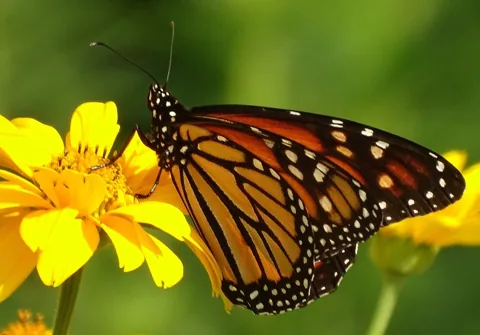 Monarch Butterfly
Danaus plexippus
The monarch is a large orange-and-black butterfly whose caterpillars feed only on milkweeds. North America has two migratory populations: eastern monarchs overwinter in mountain forests of central Mexico and western ones in groves on the California coast.
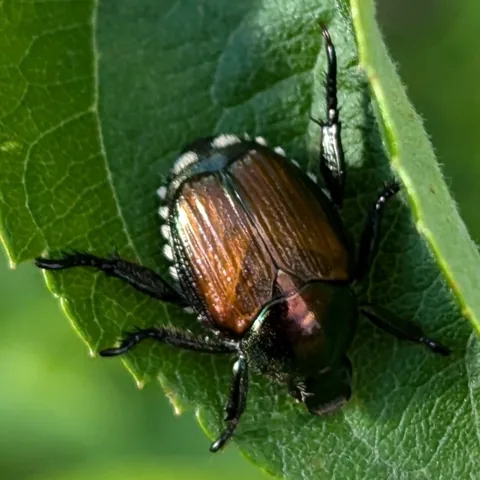 Japanese Beetle
Popillia japonica
The Japanese beetle damages landscapes twice: metallic green adults chew the leaves, flowers and fruit of hundreds of plants in early summer, and their white grubs feed on grass roots underground. A review of its biology calls it the most widespread and destructive insect pest of turf, landscapes and nursery crops in the eastern United States.
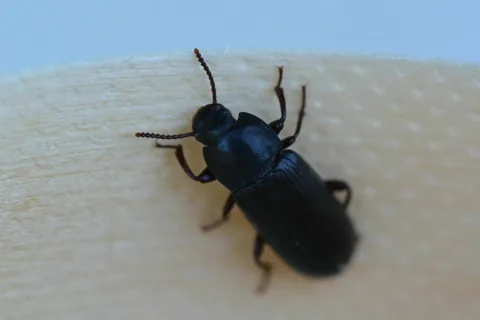 Yellow Mealworm
Tenebrio molitor
The yellow mealworm is one of the largest insects that infest stored cereal products. Its yellowish larvae feed on grain and meal that is damp or in poor condition, usually in undisturbed places such as basements. USDA's stored-grain handbook does not consider it a serious pest.
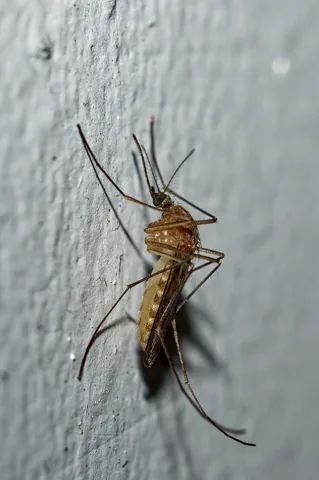 Mosquito
Culicidae (shown: Culex pipiens complex)
Mosquitoes are small, delicate flies whose females feed on blood and can pass on viruses such as West Nile; the control that works best goes after the larvae in standing water.
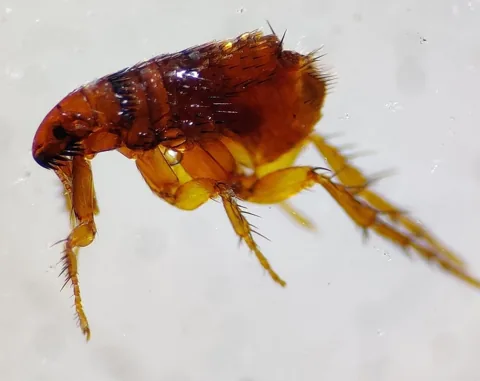 Cat Flea
Ctenocephalides felis
The cat flea is the most common external parasite of domestic cats and dogs, and the flea most often found on both. Adults spend most of their time on the pet, while eggs, larvae and pupae build up wherever the pet rests.
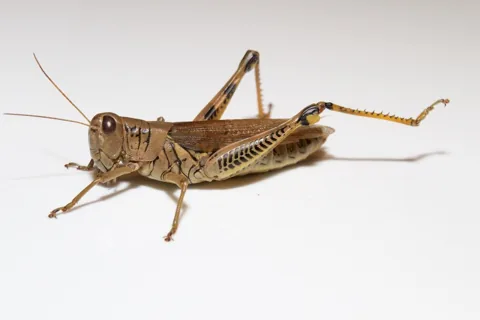 Grasshoppers
Acrididae (e.g., differential grasshopper, Melanoplus differentialis)
Grasshoppers are sporadic garden pests that build up in weedy, uncultivated land and move into yards as nearby vegetation dries out. The differential grasshopper is one of the common, large species that often shows up in gardens first.
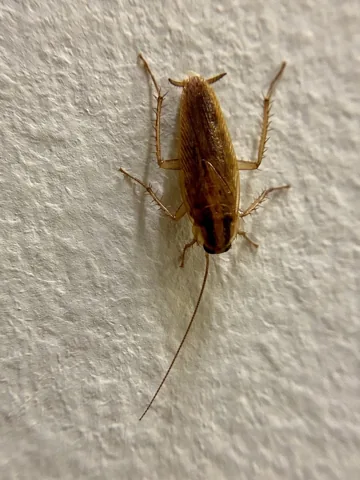 German Cockroach
Blattella germanica
The German cockroach is the most common cockroach living indoors in California and perhaps worldwide, especially in apartment buildings, and it has the fastest reproductive cycle of the common pest cockroaches. Penn State and Kentucky call it the most common cockroach in homes, apartments and other buildings, and Kentucky says it does not live outdoors.
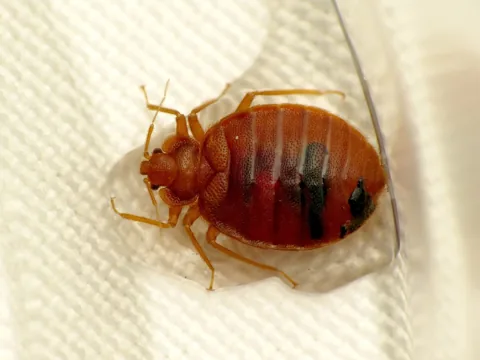 Bed Bug
Cimex lectularius
Bed bugs are wingless, blood-feeding insects that feed on sleeping or resting people, mostly at night; they have resurged worldwide and now turn up even in the finest hotels. CDC says they turn up in five-star hotels and resorts, and how clean a place is does not determine whether bed bugs are present.
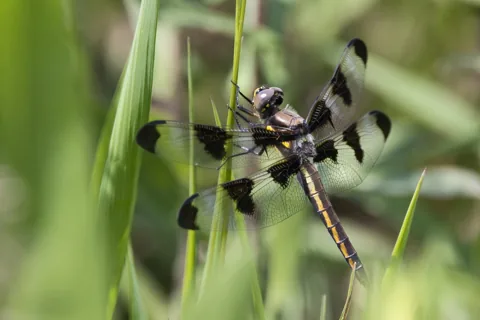 Dragonflies
Anisoptera (shown: Libellula pulchella)
Dragonflies are harmless to people and catch mosquitoes and other small insects on the wing. Their aquatic young eat mosquito larvae too, but sources disagree on how much they can do about a mosquito problem.
Why bugs have to molt
Insects and spiders have a hard covering on the outside of their bodies called an exoskeleton. It can't stretch much. The Illinois Department of Natural Resources explains that this hard cuticle must be molted, or shed, for the animal to be able to grow.[4][5]
Right after a molt, the new skin is soft and pale. A cockroach that just molted is white, and its new covering darkens as it hardens, usually within a few hours.[18]
Each time a young insect grows and molts, it moves to a new stage. Scientists call the way an insect changes as it grows its metamorphosis. There are two main kinds, and the big difference is whether the baby looks like its parents.[9][8]
Complete metamorphosis: egg, larva, pupa, adult
In complete metamorphosis, the baby looks nothing like the grown-up. The Missouri Department of Conservation describes the larvae of butterflies and beetles as wormlike and strikingly different from the adults.[9]
Stage 1 is the egg. Stage 2 is the larva, the eating and growing stage. A larva may molt several times. Stage 3 is the pupa. The pupa looks like it is resting, but inside, its body is being rebuilt into an adult. Stage 4 is the adult.[1][2]
Larvae have different names in different bug families. Butterfly and moth larvae are caterpillars. Beetle larvae in lawns are called grubs. Fly larvae are called maggots, and mosquito larvae are called wrigglers.[1][27][15][11]
Meet the complete-metamorphosis crew
Here are six groups that change shape completely as they grow up. Notice how different each larva is from its adult.[1][4][15]
- Butterflies and moths: egg, caterpillar, pupa (a butterfly pupa is called a chrysalis), then adult. Monarch eggs hatch in about 4 days. After about 2 weeks the caterpillar becomes a chrysalis, and the butterfly comes out about 2 weeks after that.[1][2][6]
- Beetles: egg, larva, pupa, adult. Ladybug larvae are long, soft and bristly, a bit like tiny lizards with six legs. They go into a shell-covered pupa and later come out as the round, spotted beetles you know.[4][14]
- Flies: egg, maggot, pupa, adult. House fly maggots eat in manure, dead animals or other moist, rotting stuff. A full-grown maggot turns its last skin into a hard case called a puparium, and the adult fly pops off the end of it. In warm summer weather this can take as little as 7 days.[15]
- Mosquitoes: egg, larva, pupa, adult. The larvae and pupae live in water. The larvae (wrigglers) hang just under the surface and breathe through a tube. The pupae (tumblers) are curled like a comma. CDC says an Aedes mosquito can go from egg to adult in 7 to 10 days.[11][21]
- Fleas: egg, larva, pupa, adult. Cat flea eggs fall off the pet onto bedding and carpets. The larvae are hairy and wormlike with no eyes or legs, and they eat dried blood that adult fleas leave behind. Then each larva spins a small silk cocoon and turns into an adult.[16][25]
- Ants, bees and wasps: egg, larva, pupa, adult. Ant larvae are white, legless and wormlike, and worker ants feed and care for them. In a honeybee hive, one queen lays the eggs. Whether a female larva becomes a worker or a new queen depends on what she is fed as she grows.[17][12][13]
Incomplete metamorphosis: egg, nymph, adult
In incomplete metamorphosis (also called simple or gradual metamorphosis), there is no pupa. The young are called nymphs. They hatch from eggs, molt through several nymph stages, and after a final molt come out as winged adults that can have babies of their own.[9][8][18]
A nymph looks a lot like its parents and usually eats the same food. The big differences are size and wings. Cockroach nymphs, for example, do not have fully developed wings yet.[18][8]
Meet the nymph crew
These insects skip the pupa. Their young are nymphs that look more and more like the adults with every molt.[9][18]
- Grasshoppers: eggs are laid in the soil in pods of 20 to more than 100 eggs. When the soil warms in spring, the nymphs hatch and start eating plants. Most kinds molt five or six times before they are adults.[20][8]
- Cockroaches: the mother makes an egg case called an ootheca. A German cockroach mother carries hers for most of the roughly 30 days until the eggs hatch. Nymphs are usually the most common stage people see.[18]
- Bed bugs: egg, then five nymph stages, then adult. A nymph needs at least one blood meal before it can molt to the next stage. Bed bug nymphs look like adults, only smaller and lighter in color. The EPA's life-cycle chart shows the first nymph is about 1.5 mm long.[19][24]
- True bugs, like stink bugs and assassin bugs: the eggs hatch into nymphs that molt through several stages. The last molt makes a winged adult. Stink bug eggs are often laid in neat rows under leaves, and young assassin bugs can look like ants.[10][9]
- Dragonflies: the life cycle is egg, nymph, adult, and the nymphs live underwater. They breathe with gills and hunt other water animals with jaws that shoot forward. A dragonfly spends most of its life as a nymph, and some kinds live underwater for as long as 5 years. When it is ready, the nymph crawls out of the water, sheds its skin and comes out as an adult. Sometimes you can find the empty skins it leaves behind.[3][7]
Spiders and ticks grow by molting too
Spiders and ticks are arachnids, not insects, so they don't have a pupa stage. Baby spiders, called spiderlings, hatch from an egg sac. A spider molts again and again as it grows, usually 8 to 12 times before it is an adult. One that eats a lot may molt every few weeks.[5]
Ticks have four stages: egg, larva, nymph and adult. University of Kentucky entomologists group this with incomplete metamorphosis. The tiny larva has six legs and is smaller than 2 mm. It feeds on a host, often a small mammal, for a few days and then molts into a nymph. The nymph feeds again and molts into an adult. From the nymph stage on, a tick has eight legs.[30][29]
Most ticks feed on three different animals in their lifetime. Some kinds stay on one animal as a larva and nymph, and a few spend their whole life on just one animal.[30]
Why life cycles help you find pests
For some pests, the young live in a different place than the adults, and the young do the damage. Knowing the life cycle tells you where to look.[27][15]
- Lawn grubs: white grubs are the larvae of beetles such as Japanese beetles, masked chafers and June beetles. They live in the soil and eat grass roots. When there are a lot of them, the grass can lift right off the soil, because the grubs have eaten the roots.[27]
- Pantry mealworms: mealworm is the name for the larvae of several beetles in the family Tenebrionidae. USDA says they breed in old grain, cereal and meal that collects in dark corners. A yellow mealworm grows to about 1 inch long and is yellow, which is how it got its name.[26]
- Flies: maggots grow in manure, garbage and other moist, rotting stuff. UC IPM says removing that material breaks the fly's life cycle, so fewer adult flies show up.[15]
- Fruit flies: they lay eggs on the surface of fermenting fruit and other moist food. The whole life cycle can take about a week, and one female can lay about 500 eggs. That is how fruit flies build up so fast around fermenting fruit.[31]
- Fleas: adult cat fleas stay on the pet, but their eggs fall off. The eggs, larvae and cocoons end up in carpet, furniture and pet bedding. That is why grown-ups vacuum often and wash pet bedding when a pet has fleas.[16][25]
- Mosquitoes: every mosquito starts life in water. Aedes mosquitoes glue their eggs to the inside walls of containers that hold water, and the eggs can survive drying out for up to 8 months.[11][21]
Safe life-cycle watching
Watching a caterpillar, a ladybug larva or a dragonfly nymph is a great science project. Some bugs bite or sting, though, so ask a grown-up before you touch anything.[23][22]
- Bees, wasps, hornets and fire ants can sting or bite. CDC says a person who is allergic to the venom can have a severe reaction that needs emergency care right away.[23]
- Ticks of every stage live in grassy, brushy and wooded places. CDC says to walk in the middle of trails, check your body for ticks when you come in, even from your own backyard, and shower soon after being outdoors. Any tick you find should be removed, so ask a grown-up to help.[22]
Printable life-cycle ID cards
Print this page and use these cards when you find a young bug. Each card gives the life cycle, three clues for the baby stage, and whether it's OK to touch. When in doubt, look but don't touch.[1][9][23]
- BUTTERFLY OR MOTH (complete). Egg, caterpillar, pupa, adult. Baby clues: soft caterpillar body; eats plants; may molt several times. Touch? Look only. Some, like swallowtail caterpillars, can give off a bad smell.[1][2]
- BEETLE GRUB (complete). Egg, grub, pupa, adult. Baby clues: white grub curled in a C shape in the soil; brownish head; 3 pairs of legs. Touch? Yes, gently, with a grown-up's OK.[27][28]
- LADYBUG LARVA (complete). Egg, larva, pupa, adult. Baby clues: long, soft body; bristles; 6 legs; looks like a tiny lizard. Touch? Gently, with a grown-up's OK.[14]
- MOSQUITO WRIGGLER (complete). Egg, wriggler, tumbler, adult. Baby clues: lives in still water; hangs just under the surface; breathes through a tube. Touch? Just watch.[11]
- FLY MAGGOT (complete). Egg, maggot, pupa, adult. Baby clues: cream colored; blunt back end; narrows to a point at the head. Touch? No. Maggots live in garbage and manure.[15]
- GRASSHOPPER NYMPH (incomplete). Egg, nymph, adult. Baby clues: looks like a small adult; no full wings yet; eats plants in spring. Touch? Gently, with a grown-up's OK.[8][20][18]
- DRAGONFLY NYMPH (incomplete). Egg, nymph, adult. Baby clues: lives underwater; 6 legs; small wing buds. Touch? Look only. Nymphs hunt with grabbing jaws.[7][3]
- COCKROACH NYMPH (incomplete). Egg case, nymph, adult. Baby clues: shaped like an adult; no full wings; white right after a molt. Touch? No. Tell a grown-up.[18]
- TICK (molts, not an insect). Egg, larva, nymph, adult. Baby clues: tiny larva smaller than 2 mm; 6 legs as a larva, 8 legs later. Touch? No. A grown-up should remove it.[30][29][22]
Common questions
- What is the difference between a larva and a nymph?
- A larva looks very different from its parents, like a caterpillar or a grub, and later goes through a pupa stage. A nymph looks like a small version of its parents without full wings, and it has no pupa stage.[9][8]
- What happens inside a pupa?
- A pupa looks like it isn't doing anything. Illinois DNR explains that inside, its tissues are being rebuilt to form the adult.[1][2]
- Are grubs and mealworms worms?
- No. They are beetle larvae. White grubs in lawns grow into scarab beetles such as Japanese beetles and June beetles, and mealworms grow into beetles in the family Tenebrionidae.[27][26]
- Is a tick larva a baby insect?
- No. Ticks are arachnids. A tick larva has only six legs, which fools people, but it grows into an eight-legged nymph and adult.[29][30]
- Do dragonflies really start life underwater?
- Yes. Dragonfly nymphs are aquatic and breathe with gills. When a nymph is ready, it crawls out of the water, sheds its skin and comes out as a young adult.[3][7]
Photo credits
- Monarch Butterfly: (c) Shirley Zundell, some rights reserved (CC BY) — via iNaturalist, CC BY 4.0
- Japanese Beetle: (c) Emmett Collins-Sussman, some rights reserved (CC BY) — via iNaturalist, CC BY 4.0
- Yellow Mealworm: Ruebezahl, public domain (CC0), via iNaturalist
- Mosquito: (c) Donald Davesne, some rights reserved (CC BY) — via iNaturalist, CC BY 4.0
- Cat Flea: (c) Thomas Gyselinck, some rights reserved (CC BY) — via iNaturalist, CC BY 4.0
- Grasshoppers: (c) Brian Gratwicke, some rights reserved (CC BY) — via iNaturalist, CC BY 4.0
- German Cockroach: (c) Sandra H Statner, some rights reserved (CC BY) — via iNaturalist, CC BY 4.0
- Bed Bug: (c) Katja Schulz, some rights reserved (CC BY) — via iNaturalist, CC BY 4.0
- Dragonflies: (c) Lauren McLaurin, some rights reserved (CC BY) — via iNaturalist, CC BY 4.0
Sources
- Illinois Department of Natural Resources, “Wild About Illinois Butterflies!.” dnr.illinois.gov/education/wildaboutpages/wildaboutinvertebrates/wildaboutbutterflies.html (accessed 2026-11-15)
- Illinois Department of Natural Resources, “Wild About Illinois Moths!.” dnr.illinois.gov/education/wildaboutpages/wildaboutinvertebrates/wildaboutmoths.html (accessed 2026-11-15)
- Illinois Department of Natural Resources, “Wild About Illinois Dragonflies!.” dnr.illinois.gov/education/wildaboutpages/wildaboutinvertebrates/wildaboutdragonflies.html (accessed 2026-11-15)
- Illinois Department of Natural Resources, “Wild About Illinois Beetles!.” dnr.illinois.gov/education/wildaboutpages/wildaboutinvertebrates/wildaboutbeetles.html (accessed 2026-11-15)
- Illinois Department of Natural Resources, “Wild About Illinois Spiders!.” dnr.illinois.gov/education/wildaboutpages/wildaboutinvertebrates/wildaboutspiders.html (accessed 2026-11-15)
- Missouri Department of Conservation, “Monarch (Field Guide).” mdc.mo.gov/discover-nature/field-guide/monarch (accessed 2026-11-15)
- Missouri Department of Conservation, “Dragonflies (Field Guide).” mdc.mo.gov/discover-nature/field-guide/dragonflies (accessed 2026-11-15)
- Missouri Department of Conservation, “Short-Horned Grasshoppers (Field Guide).” mdc.mo.gov/discover-nature/field-guide/short-horned-grasshoppers (accessed 2026-11-15)
- Missouri Department of Conservation, “Assassin Bugs (Field Guide).” mdc.mo.gov/discover-nature/field-guide/assassin-bugs (accessed 2026-11-15)
- Missouri Department of Conservation, “Stink Bugs (Field Guide).” mdc.mo.gov/discover-nature/field-guide/stink-bugs (accessed 2026-11-15)
- Missouri Department of Conservation, “Mosquitoes (Field Guide).” mdc.mo.gov/discover-nature/field-guide/mosquitoes (accessed 2026-11-15)
- Missouri Department of Conservation, “Yellowjackets (Vespula Wasps) (Field Guide).” mdc.mo.gov/discover-nature/field-guide/yellowjackets-vespula-wasps (accessed 2026-11-15)
- Missouri Department of Conservation, “Honeybee (Field Guide).” mdc.mo.gov/discover-nature/field-guide/honeybee (accessed 2026-11-15)
- Missouri Department of Conservation, “Lady Beetles (Ladybird Beetles; Ladybugs) (Field Guide).” mdc.mo.gov/discover-nature/field-guide/lady-beetles-ladybird-beetles-ladybugs (accessed 2026-11-15)
- University of California Statewide IPM Program, “Flies (Pest Notes).” ipm.ucanr.edu/home-and-landscape/flies/ (accessed 2026-11-15)
- University of California Statewide IPM Program, “Fleas (Pest Notes).” ipm.ucanr.edu/home-and-landscape/fleas/ (accessed 2026-11-15)
- University of California Statewide IPM Program, “Ants (Pest Notes).” ipm.ucanr.edu/home-and-landscape/ants/ (accessed 2026-11-15)
- University of California Statewide IPM Program, “Cockroaches (Pest Notes).” ipm.ucanr.edu/home-and-landscape/cockroaches/ (accessed 2026-11-15)
- University of California Statewide IPM Program, “Bed Bugs (Pest Notes).” ipm.ucanr.edu/home-and-landscape/bed-bugs/ (accessed 2026-11-15)
- University of California Statewide IPM Program, “Grasshoppers (Pest Notes).” ipm.ucanr.edu/home-and-landscape/grasshoppers/ (accessed 2026-11-15)
- U.S. Centers for Disease Control and Prevention, “Life Cycle of Aedes Mosquitoes.” www.cdc.gov/mosquitoes/about/life-cycle-of-aedes-mosquitoes.html (accessed 2026-11-15)
- U.S. Centers for Disease Control and Prevention, “Preventing Tick Bites.” www.cdc.gov/ticks/prevention/index.html (accessed 2026-11-15)
- U.S. Centers for Disease Control and Prevention (NIOSH), “Insects and Scorpions at Work.” www.cdc.gov/niosh/outdoor-workers/about/insects-and-scorpions.html (accessed 2026-11-15)
- U.S. Environmental Protection Agency, “Bed Bugs Appearance and Life Cycle.” www.epa.gov/bedbugs/bed-bugs-appearance-and-life-cycle (accessed 2026-11-15)
- National Pesticide Information Center, “Fleas.” npic.orst.edu/pest/flea.html (accessed 2026-11-15)
- USDA Agricultural Research Service, “Stored-Grain Insects (Agriculture Handbook No. 500, issued 1978, revised 1986).” www.ars.usda.gov/ARSUserFiles/2863/pdfdocuments/StoredGrainInsects.pdf (accessed 2026-11-15)
- Clemson Cooperative Extension Home & Garden Information Center, “White Grub Management in Turfgrass.” hgic.clemson.edu/factsheet/white-grub-management-in-turfgrass/ (accessed 2026-11-15)
- NC State Extension, “White Grubs in Turf.” content.ces.ncsu.edu/white-grubs-in-turf (accessed 2026-11-15)
- Clemson Cooperative Extension Home & Garden Information Center, “Ticks Around Your Home (HGIC 2484).” hgic.clemson.edu/factsheet/ticks/ (accessed 2026-11-15)
- University of Kentucky Entomology, “Ticks and Disease in Kentucky (ENTFACT-618).” entomology.mgcafe.uky.edu/ef618 (accessed 2026-11-15)
- University of Kentucky Entomology, “Fruit Flies (ENTFACT-621).” entomology.mgcafe.uky.edu/ef621 (accessed 2026-11-15)