The short answer
- Wings at rest: a dragonfly holds its wings out flat to the sides. Most damselflies fold theirs together above the body. The exception is the spreadwing damselflies, which perch with their wings partly open in a V.[1][2][3][7][4]
- Eyes: a dragonfly's eyes are huge, nearly cover the head and usually touch. A damselfly's eyes are set far apart, separated by more than the width of one eye.[2][3][4][5]
- Build and flight: dragonflies are robust, with hindwings wider at the base than the forewings, and fly strong and fast. Damselflies are slimmer and more delicate, with fore and hind wings about the same shape, and have a simpler, fluttering flight.[2][3][4][5]
- Both are harmless and helpful: neither can sting, and adults and aquatic young of both eat mosquitoes and other small insects.[1][2][3][9]
Related profiles on this site
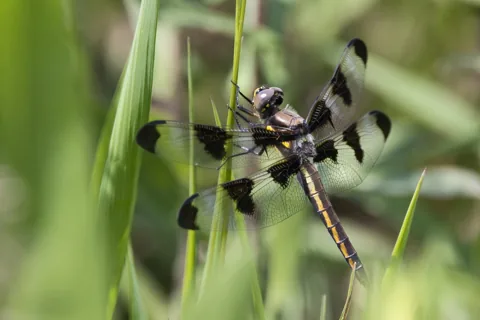 Dragonflies
Anisoptera (shown: Libellula pulchella)
Dragonflies are harmless to people and catch mosquitoes and other small insects on the wing. Their aquatic young eat mosquito larvae too, but sources disagree on how much they can do about a mosquito problem.
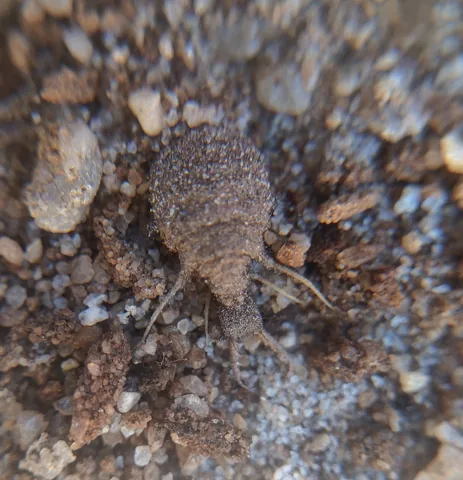 Antlions
Myrmeleontidae (e.g., Myrmeleon species)
Antlions are predatory insects that eat ants and other small insects. Their larvae, called doodlebugs, leave winding trails in loose sand and many dig cone-shaped pits to trap prey, while the adults look like drab damselflies with clubbed antennae.
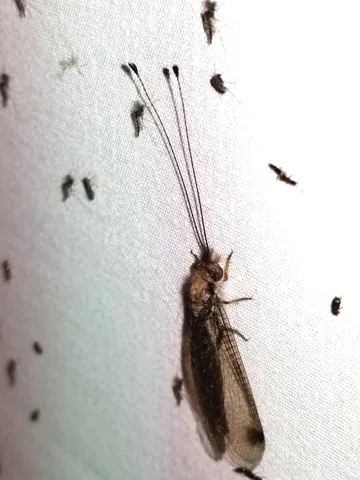 Owlflies
Ascalaphidae (owlflies, e.g., Ululodes and Ascaloptynx; iNaturalist places them as subfamily Ascalaphinae of Myrmeleontidae)
Owlflies are lacewing relatives that look like dragonflies with long, clubbed antennae and large, bulging eyes. They are harmless predators: adults snatch insects in flight at dusk and dawn, and the larvae wait in leaf litter with their jaws held open.
Side by side
Wing position at rest is the quickest field mark, and the eye spacing confirms it. Check both, because one group of damselflies breaks the wing rule.[1][4][7]
- Group: dragonfly, suborder Anisoptera. Damselfly, suborder Zygoptera; Missouri counts 4 North American damselfly families, and Florida alone has more than 150 species of the two groups combined in 3 damselfly and 6 dragonfly families.[4][3]
- Wings at rest: dragonfly, held out horizontally to the sides. Damselfly, typically held together over the body; spreadwings (family Lestidae) hold theirs open at an angle.[1][2][3][6][7][8]
- Wing shape: dragonfly, hindwing wider at the base than the forewing. Damselfly, fore and hind wings about the same size and shape.[2][3][4][6]
- Eyes: dragonfly, large, adjoining each other and covering nearly the whole head; where they don't touch, they are no farther apart than the width of one eye. Damselfly, large but usually not touching, separated by more than the width of a single eye on a head that looks flat from above.[2][3][4]
- Body: dragonfly, slender abdomen on a robust body built around the large muscles that drive its broad wings. Damselfly, very slender, delicate body, with an abdomen much longer than the wings.[2][3][4][1]
- Size: dragonflies 1 to 3 1/2 inches long (Missouri Department of Conservation); Iowa State says the largest U.S. dragonflies are about 3 inches with wingspans up to 7 inches. Damselflies 1 to 2 1/2 inches.[2][1][3]
- Flight: dragonfly, strong, fast and agile; UF/IFAS calls them unmatched as fliers. Damselfly, a simple fluttering flight; they spend more time in shoreline plants and are easier to approach.[2][4][5]
- Nymphs: dragonfly, gills hidden inside the tip of the abdomen; the nymph breathes by pumping water in and out and can shoot forward by forcing it out. Damselfly, three leaflike gills sticking out like a three-part tail.[2][3][6]
- Adult life span: Iowa State says up to six weeks for a dragonfly and three or four weeks for a damselfly; the University of Nebraska State Museum gives a few weeks to a few months for adult damselflies.[1][5]
- Sting or bite: neither can sting. Missouri says large dragonflies can give a pinching bite when handled and damselflies may try to bite, but it is merely a pinch; Iowa State and Texas A&M say dragonflies do not bite or sting.[2][3][1][9]
Wings at rest, and the spreadwing exception
Most damselflies you see along a pond edge, such as the narrow-winged damselflies (Coenagrionidae) and broad-winged damselflies like the ebony jewelwing (Calopterygidae), perch with their wings closed together over the back.[6][4]
Spreadwing damselflies (Lestidae) perch with their wings held open in a V when seen from above, a habit UF/IFAS says is more common to dragonflies than damselflies. The National Park Service contrasts the two: dragonflies hold their wings stiffly straight out to the side, while spreadwings angle theirs. NC State describes spreadwings as fairly large damselflies, usually marked with metallic bronze or green, around slow backwaters, marshes and temporary pools.[7][4][8]
Telling the nymphs apart
Both groups spend most of their lives underwater as nymphs, also called naiads. Iowa State says the eggs hatch in three to five weeks and naiads live in the mud or on submerged plants for several months to as long as three years; Missouri says some species live underwater for five years before becoming adults.[1][2][3]
Damselfly nymphs are slender and carry three leaflike gills at the tip of the abdomen. Dragonfly nymphs have no visible tail gills; their gills sit inside the rectum, and forcing water out lets them move by jet propulsion.[3][2][6]
Do they really control mosquitoes?
Adults of both groups catch mosquitoes, gnats, winged ants and other small insects in flight, holding their spiny legs in a basket shape to scoop prey from the air.[1][2][3]
The nymphs may do more. A 2023 meta-analysis of 31 studies found that a single dragonfly or damselfly naiad ate on average 40 mosquito larvae a day in experimental containers, equal to a 45% daily cut in larval numbers, with no significant difference among Aedes, Anopheles and Culex mosquitoes.[10]
- Texas A&M AgriLife cautions that dragonflies are not likely to solve a yard mosquito problem: many fly by day, when mosquitoes are less active, and released dragonflies leave if there is no water nearby. For mosquitoes it points to draining standing water, Bti in water that can't be drained, repellents and local extension advice.[9]
How to confirm which one you have
Take a photo from above while the insect is perched. That view shows how the wings are held, whether the eyes meet across the top of the head and whether the hindwings flare at the base.[4][7][2]
For damselflies, a hand lens helps because their small size makes features hard to see. Species-level ID in both groups usually means checking wing vein patterns and the colors on wings and body, and males and females often look different.[5][7][2][3]
- Iowa State University's Plant and Insect Diagnostic Clinic identifies insects for Iowa residents; your state extension office can point you to a similar service.[1]
What to do about either one
Nothing. Iowa State says dragonflies and damselflies do no harm to people, crops, landscape plants or houses and are entirely beneficial, as part of the aquatic food chain and as predators of mosquitoes and other pests.[1]
To see more of them, Texas A&M suggests building a water garden, which soon draws aquatic insects including dragonflies and damselflies. Both lay their eggs in or near water, so adults stay close to ponds and streams.[9][2][3]
Common questions
- What is the fastest way to tell a dragonfly from a damselfly?
- Watch it land. Wings spread flat to the sides mean a dragonfly; wings folded together over the back mean a damselfly. If the wings are half open in a V, it is probably a spreadwing damselfly, so check that the eyes are set well apart.[1][2][3][7][4]
- Can dragonflies or damselflies sting?
- No. Neither has a stinger. Missouri notes that big dragonflies may pinch when handled and damselflies may try to bite, but they cannot harm people.[2][3][1]
- Which one eats more mosquitoes?
- Sources don't rank them. The 2023 meta-analysis pooled dragonfly and damselfly naiads and found an average of 40 mosquito larvae eaten per naiad per day in lab containers.[10]
- What is the bug with three little tails in my pond?
- A slender aquatic insect with three leaflike flaps at the tail end is likely a damselfly nymph; those flaps are its gills. Dragonfly nymphs lack them; their gills are inside the abdomen.[3][2][6]
Photo credits
- Dragonflies: (c) Lauren McLaurin, some rights reserved (CC BY) — via iNaturalist, CC BY 4.0
- Antlions: (c) Bartosz Czołczyński, some rights reserved (CC BY) — via iNaturalist, CC BY 4.0
- Owlflies: TheMongrelKoi, public domain (CC0), via iNaturalist
Sources
- Iowa State University Extension and Outreach, “Dragonflies and Damselflies (Yard and Garden).” hortnews.extension.iastate.edu/dragonflies-and-damselflies (accessed 2026-11-14)
- Missouri Department of Conservation, “Dragonflies field guide.” mdc.mo.gov/discover-nature/field-guide/dragonflies (accessed 2026-11-14)
- Missouri Department of Conservation, “Damselflies field guide.” mdc.mo.gov/discover-nature/field-guide/damselflies (accessed 2026-11-14)
- University of Florida IFAS Extension (EDIS), “Dragonflies and Damselflies (Insecta: Odonata), EENY-355 (Featured Creatures).” journals.flvc.org/edis/article/download/115163/113466/163645 (accessed 2026-11-14)
- University of Nebraska State Museum, Department of Entomology, “Nebraska Dragonflies and Damselflies: Damselflies (Suborder Zygoptera).” unsm-ento.unl.edu/Odonata/zygo.html (accessed 2026-11-14)
- Illinois Department of Natural Resources, “Wild About Illinois Damselflies!.” dnr.illinois.gov/education/wildaboutpages/wildaboutinvertebrates/wildaboutdamselflies.html (accessed 2026-11-14)
- U.S. National Park Service, Mississippi National River and Recreation Area, “Spreadwing Damselflies (Lestes spp.).” www.nps.gov/miss/learn/nature/spreadwingdamselflies.htm (accessed 2026-11-14)
- NC State University Department of Entomology, “Family Lestidae (ENT 425 General Entomology).” genent.cals.ncsu.edu/?p=5226 (accessed 2026-11-14)
- Texas A&M AgriLife Research, “Questions from our Readers (Digital Dragonflies).” agrilife.org/dragonfly/questions-from-our-readers/ (accessed 2026-11-14)
- Journal of Animal Ecology (PubMed 37272224), “Priyadarshana TS, Slade EM. A meta-analysis reveals that dragonflies and damselflies can provide effective biological control of mosquitoes. J Anim Ecol 2023;92(8):1589-1600.” pubmed.ncbi.nlm.nih.gov/37272224/ (accessed 2026-11-14)