The short answer
- Wings: a resting mayfly holds its wings straight up over its back, together like a butterfly's or a triangular sail. A caddisfly folds its wings down over its body like a tent or roof, so it looks like a small moth.[1][6][2][5]
- Tails: a mayfly trails long, threadlike tails from the tip of its abdomen, as long as or longer than its body. A caddisfly has no tails; its long feature is its antennae, usually as long as the body or longer.[1][6][4][2][5]
- Wing surface: caddisfly forewings are hairy, which separates them from moths, whose wings are scaly. Mayfly wings are clear and heavily veined.[2][1][4]
- Lifespan: adult mayflies cannot eat and live only a day or two. Adult caddisflies usually live a few weeks; many never feed and the ones that do sip nectar.[8][6][1][2]
Insects on this page
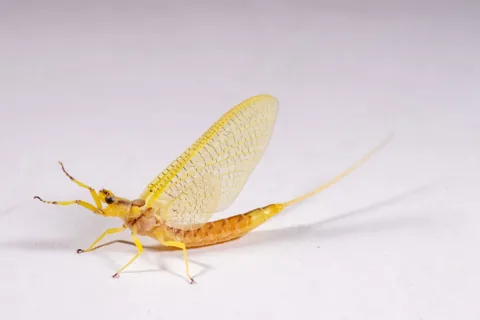 Mayflies
Order Ephemeroptera (e.g., Hexagenia limbata, the giant mayfly)
Mayflies spend most of their lives as aquatic nymphs, then emerge as winged adults that live only a few days at most. Big hatches near lakes and rivers can coat walkways, roads and lit buildings.
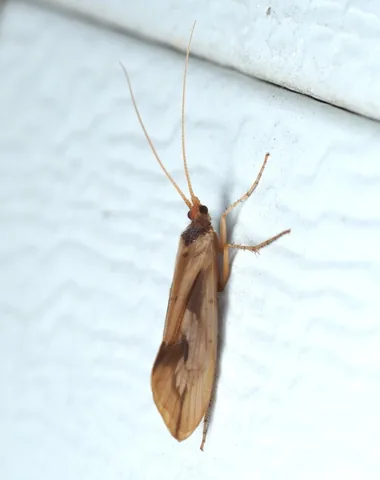 Caddisflies
Order Trichoptera (many species)
Caddisflies are moth-like insects whose young live in water; adults gather around lights near rivers, lakes and wetlands and are a harmless, temporary nuisance.
Side by side
Mayflies are the insect order Ephemeroptera, with more than 600 species north of Mexico. Caddisflies are the order Trichoptera, with about 1,500 species north of Mexico. Both are big groups, so size and color vary a lot; wing posture, tails and antennae hold up across the species you are likely to see.[1][2]
- Wings at rest, mayfly: four clear, extensively veined wings held upright and together. The forewings are much longer than the hindwings and often overlap them; Minnesota Extension calls them triangular.[1][4][6]
- Wings at rest, caddisfly: held rooflike, or tent-like, over the back. The forewings are hairy, and the hindwings, usually hidden underneath, are often clear.[2][5]
- Tail end, mayfly: Missouri Conservation and Penn State say adults have two long, threadlike tails (cerci); Minnesota Extension says two or three. Penn State says the tails are as long as or longer than the body. Caddisflies have none.[1][6][4]
- Antennae: short on mayflies. Long and threadlike on caddisflies, as long as the body or longer.[1][6][2][5]
- Size, mayfly: 1/4 to 1 1/4 inch long by Minnesota's measure; Missouri gives up to 1 1/4 inches.[4][1]
- Size, caddisfly: 1/16 to 1 1/2 inch, most between 1/4 and 1 inch (Minnesota). Iowa State describes the ones swarming its river towns as about one-half inch long.[5][7][2]
- Color: fresh mayflies that have just left the water look ghostly white; after one more molt they are usually tan or brown. Caddisflies are drab, usually brown, gray or tan.[6][2][5][7]
- Posture: a perched mayfly often holds its front legs out forward. A caddisfly sits low and flat like a moth.[1][2]
- Mouthparts: adult mayflies have only remnant mouthparts and cannot eat or drink. Iowa State says caddisflies have no mouthparts and cannot bite or feed on plants; Missouri Conservation says many adults do not eat and those that do sip nectar.[1][6][7][2]
- Young: mayfly nymphs live on rocks and plants in streams and lakes, with gills along the abdomen and usually three tails. Caddisfly larvae live in water too, most inside portable cases they build from plant bits, sand grains or other debris.[1][6][2]
- Season: Minnesota lists mayflies from May into September. On the upper Mississippi, the large Hexagenia mayflies emerge in late June to early July. Iowa State reported a caddisfly swarm at its Bettendorf office on May 15, 2012, which it called about 2-3 weeks earlier than usual.[4][9][7]
How long each one lives
Mayflies are the only insects with two winged stages. The nymph floats to the surface and molts into a dull subadult, called a dun by anglers, and often within hours it molts again into the reproductive adult, which lives only hours or days.[1][6]
Measured in the lab, adult Hexagenia limbata mayflies had a life expectancy of about 2.6 days, and the last one died on day 8. For a second species, Ephemera simulans, life expectancy was 1.6 days for males and 2.0 days for females, and none lived past day 3.[11]
The short adult life is only the end of the story. Mississippi State points out that most mayflies spend about a year as nymphs in the water, and a few species take several years.[8][6]
Caddisflies go through a pupal stage inside their sealed case, swim to the surface and molt into adults. Missouri Conservation says the adults usually live a few weeks and spend that time reproducing.[2]
The third look-alike: stoneflies
Stoneflies (order Plecoptera) also grow up in streams and turn up near water. Their four narrow, finely veined wings lie flat down the back, the forewings covering the hindwings, rather than standing up like a mayfly's or forming a tent like a caddisfly's. The antennae are long and threadlike, and the color is usually dull brown, yellow or sometimes green.[3][6][1][2]
Missouri Conservation gives a body length of usually 1/2 to 2 inches and says the adults are poor fliers that stay near water in shady places such as the undersides of leaves or under bridges. Some fly at night and many come to artificial lights.[3]
Penn State calls them harmless. Most stoneflies do not feed as adults, though some eat nectar, pollen or algae, and they live a few days to a few weeks on land.[6][3]
Do they bite, and can they cause allergies?
Neither one bites. Iowa State and Minnesota Extension say caddisflies do not harm people or property, and Minnesota says the same of mayflies. Adult mayflies cannot even eat, and Iowa State says caddisflies cannot bite.[7][5][4][1]
Large numbers of either can cause allergy symptoms in some people. A West Virginia University team skin-tested 200 rural patients with asthma or allergic rhinitis against five insects; mayfly was the most common positive reaction among those insects, and caddis fly was third.[12]
At a hydroelectric plant where workers were exposed to large numbers of caddisflies, about half the workers surveyed reported work-related eye, nose and sinus symptoms and wheezing, and symptoms were linked to working in the more heavily exposed areas. The authors called occupational caddisfly allergy a significant health problem at that site.[13]
On the lower Colorado River in Bullhead City, Arizona, a 2026 survey of riverfront residents found some reported asthma-like symptoms from meeting large caddisfly swarms or sweeping up dead, dried caddisflies. The author lists asthma and dermatitis among the public health concerns of nuisance caddisflies.[15]
Why they end up at your door
Caddisflies rest in shrubs by day and fly at night, and like moths they are drawn to artificial lights. Iowa State describes piles of them on sidewalks and glass doors under outside and vestibule lights.[2][7]
Mayflies are drawn to lights too. The National Weather Service office in La Crosse, Wisconsin, says Mississippi River mayflies can fly several miles inland and pile up and die on the pavement under lights, leaving a slippery mess; bridges have had to be cleared with snowplows.[9][4]
Lit bridges can be a double trap for mayflies. On the Danube, researchers found bridge lights drew mating swarms away from the river, and females laid eggs on the asphalt road, which reflects light polarized the way a water surface does. Millions swarmed the bridge lights for two weeks.[14]
Big emergences can show up on weather radar. Mississippi State compares heavy mayfly flights on radar to a light to moderate thunderstorm, and the La Crosse office tracks emergences on Doppler radar.[8][9][1]
What to do about either one
Change the lighting first. Iowa State says there is no repellent for caddisflies and the best step is to shut off exterior lights. Mississippi State lists light management first among the measures that work for mass mayfly emergences.[7][8]
When you need a light, keep it on only as long as needed. University of Georgia Extension says soft yellow lights attract the fewest insects, and LED light filtered to yellow or amber draws fewer flying insects too. Our porch-light guide covers bulb choices in more detail.[10]
Close blinds and curtains at night. Iowa State suggests it during caddisfly swarms, and Georgia notes that light shining through windows draws insects as well.[7][10]
Sweep, vacuum or blow them away rather than spraying. Iowa State says dead caddisflies can be swept up and put in the trash or compost. Mississippi State says leaf blowers, vacuums, brooms and dust pans, light management and exclusion usually work better than insecticides for mayflies, and Georgia calls spraying a home for flying insects probably the least effective approach.[7][8][10]
Wait it out. Mississippi State says mayfly emergences usually last a week or so, and Iowa State says caddisfly emergences are temporary and the annoyance will pass. Caddisfly numbers swing from year to year without an obvious reason.[8][7]
Where swarms come back for months, the fixes are on the river, not the porch. In Bullhead City, residents named staying inside as the best way to avoid the caddisfly swarms, and after three years of river flow changes most described conditions as tolerable.[15]
Why a swarm is good news for the river
Both groups need clean water. Iowa State says caddisflies do not survive and reproduce well in polluted or low-oxygen water, so big numbers point to a healthy river. Missouri Conservation says caddisflies are sensitive to pollution and serve as an indicator of water quality.[7][2]
The La Crosse weather office notes mayflies are sensitive to gross organic pollution, so their presence means sewage is not present in large amounts. Mississippi State calls healthy mayfly populations a sign of a healthy aquatic ecosystem.[9][8]
Penn State calls stoneflies and mayflies indicator species whose numbers reflect the health of our streams; their nymphs do best in clear, fast-flowing streams with a high level of dissolved oxygen.[6]
Common questions
- Is the bug with long tails on my screen door a mayfly?
- Most likely. Long threadlike tails off the tip of the body and wings held straight up are the mayfly marks. Caddisflies have no tails and fold their wings like a tent.[1][6][2]
- Are caddisflies just moths?
- No. They look like moths and come to lights like moths, but they are a separate order, Trichoptera. Their forewings are covered in hairs rather than the scales moths have.[2][5]
- Why do dead mayflies pile up under my lights?
- Georgia Extension says soft yellow lights are the least attractive to most insects and yellow or amber LEDs draw fewer flying insects. The La Crosse weather office says mayflies drawn to lights pile up and die on the pavement below.[10][9]
- Should I spray the swarm?
- Mississippi State says light management and cleanup tools usually work better than insecticides for mass mayfly emergences, and Iowa State knows of no repellent for caddisflies. The adults are gone in days to weeks.[8][7][2]
- How can I tell a stonefly from the other two?
- Look at the wings. Stoneflies lay theirs flat down the back, one pair over the other. Mayflies hold them upright, and caddisflies fold them into a tent.[3][6][1][2]
Photo credits
- Mayflies: (c) DiegoH, some rights reserved (CC BY) — via iNaturalist, CC BY 4.0
- Caddisflies: Brighton Lee, public domain (CC0), via iNaturalist
Sources
- Missouri Department of Conservation, “Mayflies (Field Guide).” mdc.mo.gov/discover-nature/field-guide/mayflies (accessed 2026-11-14)
- Missouri Department of Conservation, “Caddisflies (Field Guide).” mdc.mo.gov/discover-nature/field-guide/caddisflies (accessed 2026-11-14)
- Missouri Department of Conservation, “Stoneflies (Field Guide).” mdc.mo.gov/discover-nature/field-guide/stoneflies (accessed 2026-11-14)
- University of Minnesota Extension, “Mayflies (What insect is this?).” apps.extension.umn.edu/garden/diagnose/insect/general-curiosity-insects/flies/small/mayflies.html (accessed 2026-11-14)
- University of Minnesota Extension, “Caddisflies (What insect is this?).” apps.extension.umn.edu/garden/diagnose/insect/general-curiosity-insects/flies/small/caddisflies.html (accessed 2026-11-14)
- Penn State Extension, “Indicator Insects: Stoneflies and Mayflies.” extension.psu.edu/indicator-insects-stoneflies-and-mayflies (accessed 2026-11-14)
- Iowa State University Extension and Outreach, “Caddisflies: Another One of Life's Frustrations (Yard and Garden).” yardandgarden.extension.iastate.edu/article/2012/5-16/caddisflies.html (accessed 2026-11-14)
- Mississippi State University Extension Service, “Mayfly, Bug's Eye View Vol. 4 No. 11.” extension.msstate.edu/newsletters/bugs-eye-view/2018/mayfly-vol-4-no-11 (accessed 2026-11-14)
- National Weather Service, La Crosse, WI, “Tracking Mayflies.” www.weather.gov/arx/mayfly_tracking (accessed 2026-11-14)
- University of Georgia Cooperative Extension, “Don't be bugged by insects seeing the light.” fieldreport.caes.uga.edu/news/dont-be-bugged-by-insects-seeing-the-light/ (accessed 2026-11-14)
- Carey JR (PubMed 11830359), “Longevity minimalists: life table studies of two species of northern Michigan adult mayflies (Exp Gerontol, 2002).” pubmed.ncbi.nlm.nih.gov/11830359/ (accessed 2026-11-14)
- Smith TS, Hogan MB, Welch JE, et al. (PubMed 16450569), “Modern prevalence of insect sensitization in rural asthma and allergic rhinitis patients (Allergy Asthma Proc, 2005).” pubmed.ncbi.nlm.nih.gov/16450569/ (accessed 2026-11-14)
- Kraut A, Sloan J, Silviu-Dan F, et al. (PubMed 8044233), “Occupational allergy after exposure to caddis flies at a hydroelectric power plant (Occup Environ Med, 1994).” pubmed.ncbi.nlm.nih.gov/8044233/ (accessed 2026-11-14)
- Szaz D, Horvath G, Barta A, et al. (PubMed 25815748), “Lamp-lit bridges as dual light-traps for the night-swarming mayfly, Ephoron virgo (PLoS One, 2015).” pubmed.ncbi.nlm.nih.gov/25815748/ (accessed 2026-11-14)
- Cavallaro MC (PubMed 41259252), “Nuisance status of a net-spinning caddisfly: survey responses of residents on the Colorado River in Bullhead City, Arizona (J Med Entomol, 2026).” pubmed.ncbi.nlm.nih.gov/41259252/ (accessed 2026-11-14)