The short answer
- Crane flies look like giant mosquitoes, but they don't bite and are harmless to people.[4]
- Periodical cicadas can't sting and don't harm people, livestock or pets, though egg-laying females can damage young trees.[2]
- Velvet ants are wingless female wasps with an excruciating sting; giant water bugs, robber flies and stag beetles can bite or pinch if handled.[17][13][16][15]
- Blister beetles carry cantharidin, which blisters skin. Beetles baled into hay can poison livestock; horses appear especially susceptible and can die.[19][20][21]
Occasional invaders with full profiles
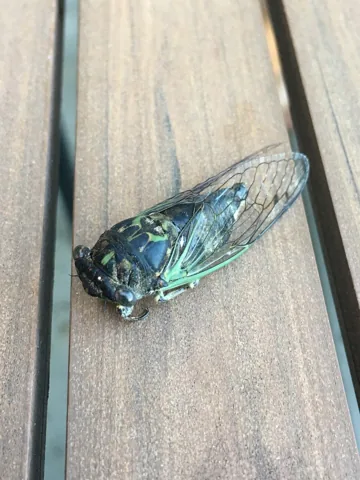 Annual Cicadas (dog-day cicadas)
Neotibicen species (e.g., N. canicularis)
Annual cicadas, also called dog-day cicadas, are the large cicadas heard droning from trees every summer. Their life cycles overlap, so some adults come out every year. They can't bite or sting, and Clemson and Minnesota extension both say they pose no danger to people or pets.
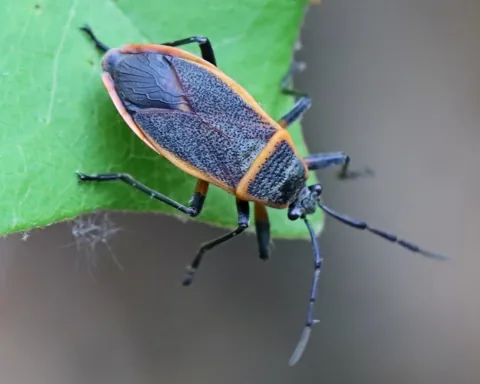 Bordered Plant Bug (Largus Bug)
Largus succinctus
Bordered plant bugs, also called largus bugs, are dark true bugs with bright orange edges that Southern gardeners often notice around homes and yards in startling numbers. Despite the crowds, they are not serious pests of lawns, gardens or homes.
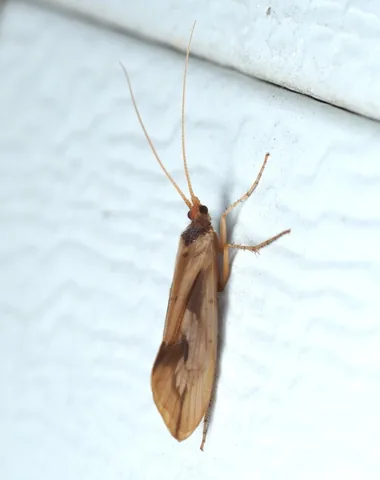 Caddisflies
Order Trichoptera (many species)
Caddisflies are moth-like insects whose young live in water; adults gather around lights near rivers, lakes and wetlands and are a harmless, temporary nuisance.
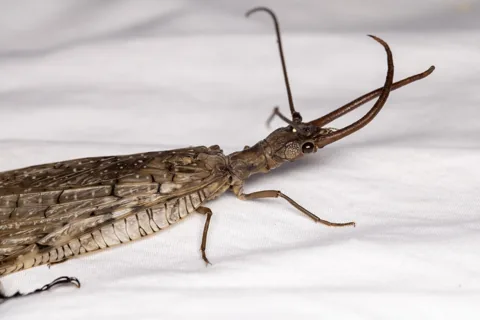 Eastern Dobsonfly
Corydalus cornutus
The eastern dobsonfly is one of the largest aquatic insects in the country. Despite the male's scary-looking tusks, only the female's short jaws can give a painful pinch.
 Giant Water Bugs
Belostomatidae (Lethocerus, Abedus, Belostoma)
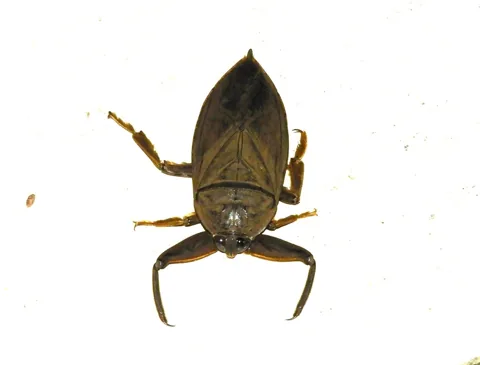
Giant water bugs are large, flattened aquatic predators also called toe-biters and electric light bugs. On summer nights adults leave the water to find mates and fly to lights, so they turn up on sidewalks and in pools; if handled or stepped on, they can give an extremely painful bite.
 Horsehair Worms
Nematomorpha (horsehair or Gordian worms)
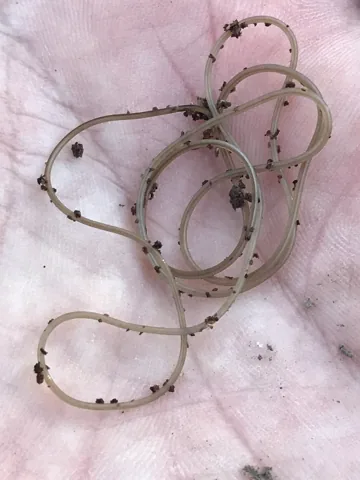
Horsehair worms (phylum Nematomorpha) are long, thread-thin worms, not insects, that show up in water after leaving the crickets or other insects they grew inside. A 2022 medical case report found no evidence that they are parasites of humans. University of Kentucky sees no need for control: worms in a container, toilet or shower usually mean a cricket or other host got in and died there, and UC IPM advises caulking or sealing entryways to keep crickets out.
 Household Casebearer
Phereoeca uterella
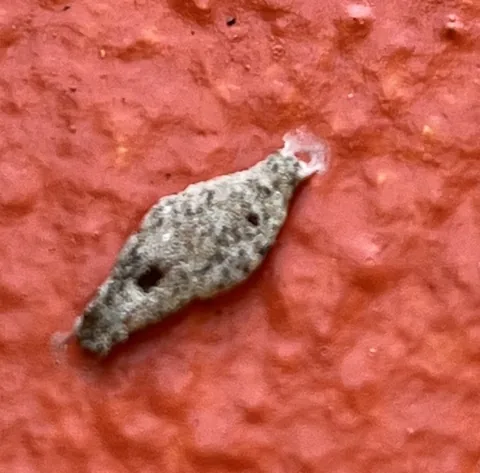
Those small, flat, seed-like cases crawling up walls and garage ceilings are made by household casebearer larvae, also called plaster bagworms. They belong to the same family as clothes moths. UF/IFAS says what people usually find on house walls in south and central Florida are the empty larval or pupal cases.
 Jerusalem Crickets
Stenopelmatidae; e.g., Ammopelmatus fuscus (formerly Stenopelmatus fuscus)
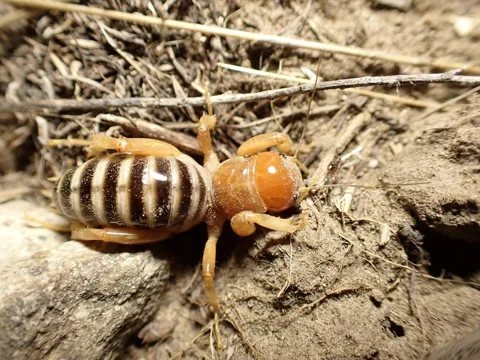
Jerusalem crickets are big, wingless, slow-moving crickets of the West with a bald, humanlike head and a striped abdomen. The Bohart Museum says they can bite, so take some care handling them, but that much of their dangerous reputation is mythology. They are not garden pests, and UC IPM says no control is needed: scoop one into a box and remove it.
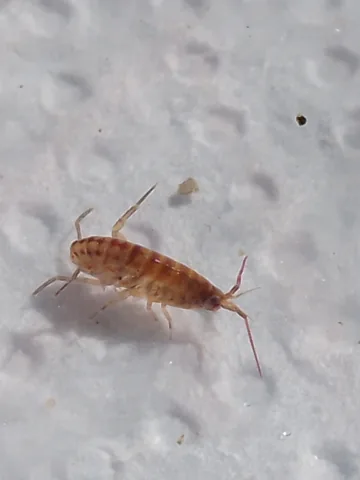 Lawn shrimp (terrestrial amphipods)
Talitridae (e.g., Talitroides topitotum)
Lawn shrimp are tiny land-dwelling crustaceans called amphipods, in the same family as the beach fleas that live under seaweed on the shore. They live in damp ground under ivy and other plants, and after rain or long watering they may move out and wander into houses. They don't live long indoors: most are found dead and red the next day, and UC Riverside describes them only as accidental intruders. UF/IFAS adds that they are crustaceans, neither shrimp nor insects, named for their resemblance to true shrimp.
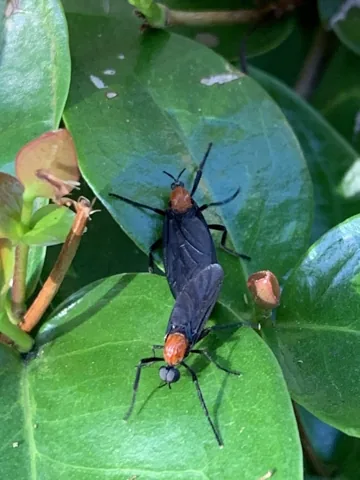 Lovebug
Plecia nearctica
Lovebugs are small black-and-orange flies that show up in huge numbers for a few weeks each spring and late summer across the South. They don't bite, sting or carry disease; the trouble is their sheer numbers on roads, cars and buildings.
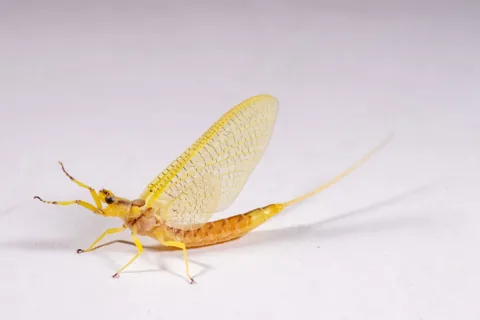 Mayflies
Order Ephemeroptera (e.g., Hexagenia limbata, the giant mayfly)
Mayflies spend most of their lives as aquatic nymphs, then emerge as winged adults that live only a few days at most. Big hatches near lakes and rivers can coat walkways, roads and lit buildings.
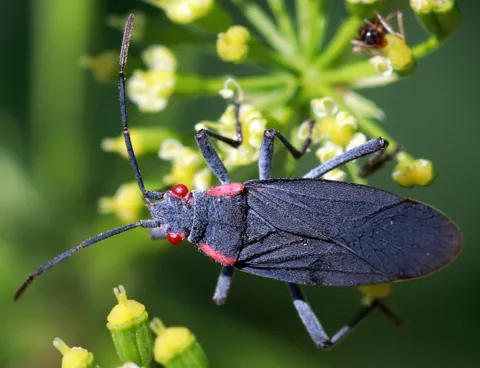 Red-shouldered bug (Jadera bug)
Jadera haematoloma
Red-shouldered bugs are seed-feeding true bugs that gather, sometimes by the hundreds or thousands, on the trunks of goldenrain trees and other soapberry-family hosts and on the fallen seeds beneath them. They are a nuisance, not a threat to the tree.
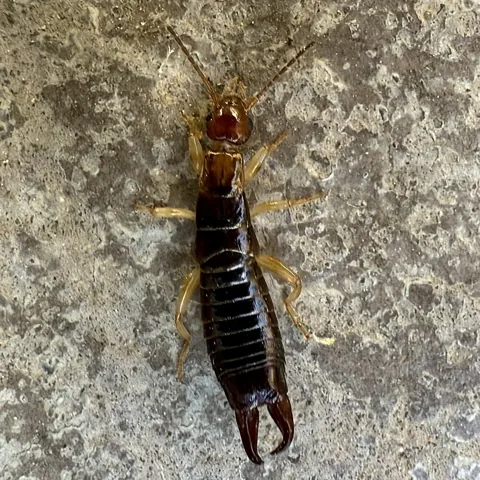 Ringlegged Earwig
Euborellia annulipes
The ringlegged earwig is a wingless earwig found in the South and well beyond. It is both a predator of garden pests and an occasional minor plant feeder, so it is mostly a nuisance. UF/IFAS calls it the most common earwig in Florida and probably the only one there that could be considered a pest, though it rarely builds to very high numbers.
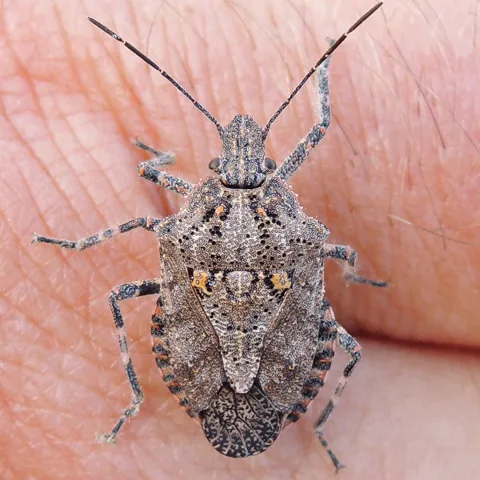 Rough Stink Bugs
Brochymena species
Rough stink bugs are commonly mistaken for the invasive brown marmorated stink bug, but they are partly predatory and aren't tied to significant plant damage.
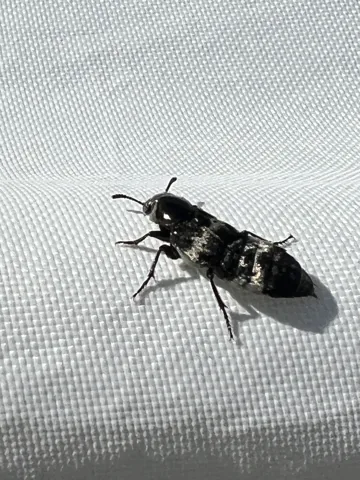 Rove Beetles
Staphylinidae (e.g., Creophilus maxillosus, the hairy rove beetle)
Rove beetles are the largest beetle family in North America, and most are beneficial predators and scavengers in soil, compost and leaf litter. They sometimes show up in homes, often drawn by lights or by something dead nearby, and indoors they are usually only a nuisance.
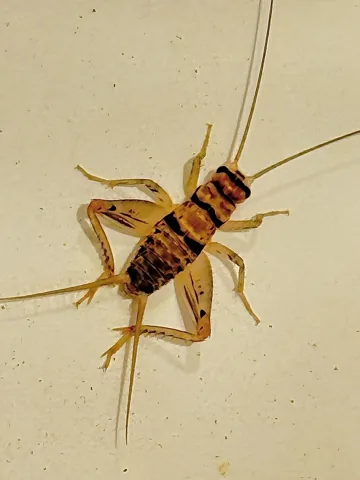 Tropical House Cricket
Gryllodes sigillatus
The tropical house cricket is an introduced cricket of warm places and cities, often found around broken concrete and masonry. Arizona Extension says it readily comes indoors through cracks and is the only cricket there that may live and breed inside. UF/IFAS says that in Florida it is found mostly outdoors in or near paved areas, coming out at night from crevices between pavement blocks to forage and sing, and that when it moves into buildings its song gives it away.
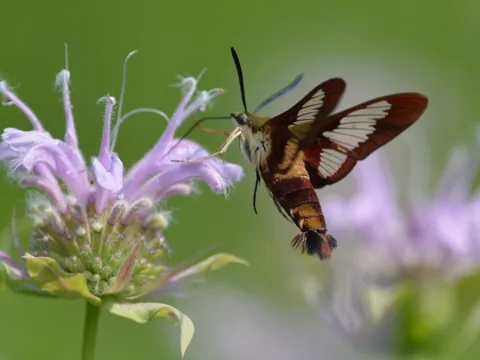 Hummingbird Moths
Hemaris species (mainly H. thysbe, hummingbird clearwing, and H. diffinis, snowberry clearwing or bumblebee moth)
Hummingbird moths are sphinx moths that hover at flowers in daylight and sip nectar through a long tongue, looking like small hummingbirds or bumble bees. The ones usually meant are the clearwing moths in the genus Hemaris, chiefly the hummingbird clearwing and the snowberry clearwing. They have no stinger and are completely harmless.
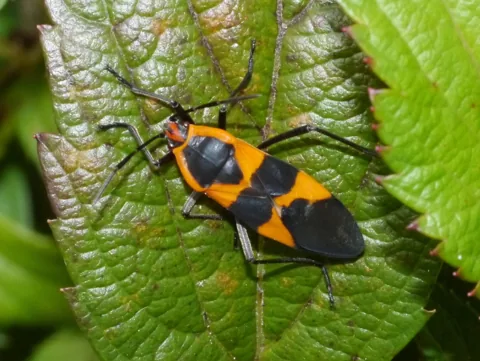 Large Milkweed Bug
Oncopeltus fasciatus
Large milkweed bugs are reddish-orange and black bugs that gather on milkweed seed pods in late summer. They feed mainly on the seeds, do little harm to the plants and don't bother monarch caterpillars.
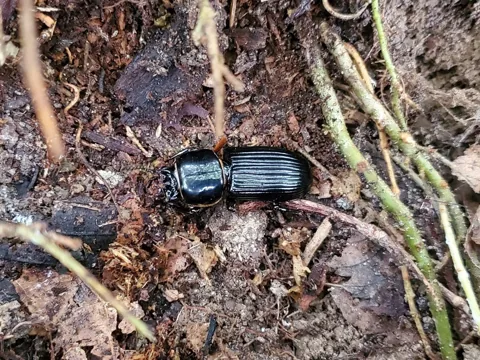 Horned Passalus
Odontotaenius disjunctus
The horned passalus, also called betsy beetle or bessbug, is a large, glossy black beetle that lives in families inside rotting hardwood logs. NC State calls betsy beetles harmless to humans and says they are not a pest of urban structures; Missouri's conservation department says one can deliver a genuine pinch but cannot harm you.
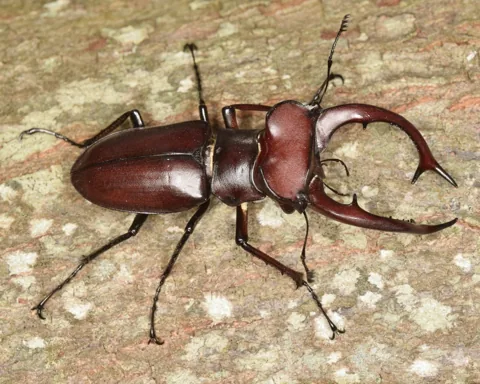 Stag Beetles
Lucanidae (e.g., Lucanus elaphus, giant stag beetle; Lucanus mazama, southwestern stag beetle)
Stag beetles are large, dark beetles. The males carry long, antler-like jaws that they use to push, pull and throw rival males, not to attack people, though one may pinch if you pick it up. The grubs spend years in rotting wood, breaking down fallen trees and stumps, and the adults live only a few months.
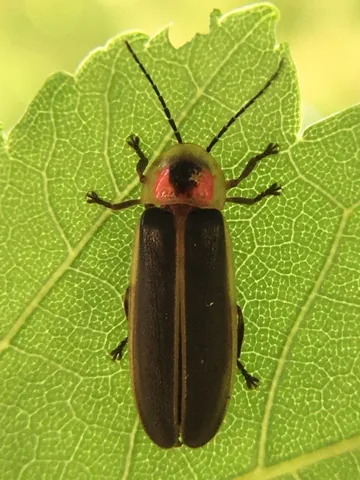 Fireflies
Lampyridae (e.g., Photinus pyralis, the big dipper firefly)
Fireflies, also called lightning bugs, are neither flies nor bugs but soft-bodied beetles. Many flash light to find mates, and their larvae prey on snails, slugs and other soft-bodied animals.
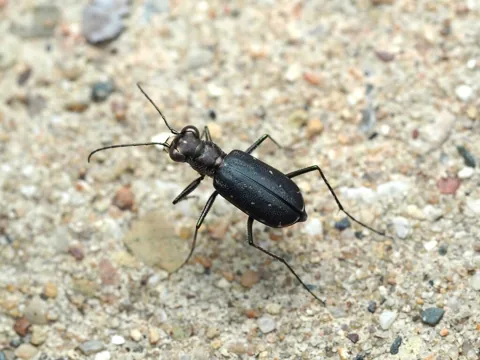 Punctured Tiger Beetle
Cicindelidia punctulata (formerly Cicindela punctulata)
The punctured tiger beetle (Cicindelidia punctulata), often called the sidewalk tiger beetle, is a fast-running, long-legged beetle most often seen on pathways and sidewalks in summer. Adults run down other insects, and the larvae ambush them from burrows in dry, hard-packed soil.
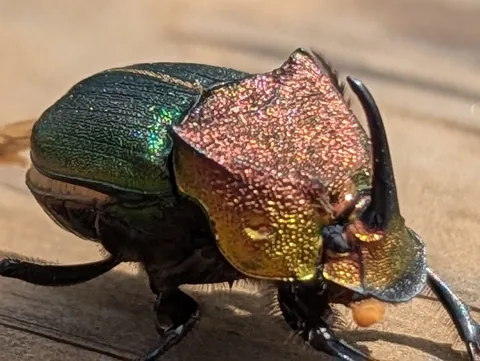 Rainbow Scarab
Phanaeus vindex
The rainbow scarab is a native dung beetle with metallic green or blue-green wing covers and an iridescent red and gold thorax. It buries animal dung under the pat to feed its young, which helps return nutrients to the soil.
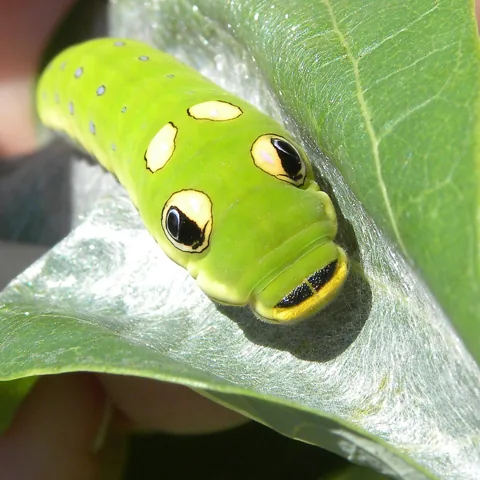 Spicebush Swallowtail
Papilio troilus
The spicebush swallowtail is a black swallowtail butterfly whose green caterpillars carry big fake eyespots and look like a tiny snake or tree frog. They feed on spicebush, sassafras, sweet bay and tulip tree, and NC State says their feeding is usually minor enough to go unnoticed.
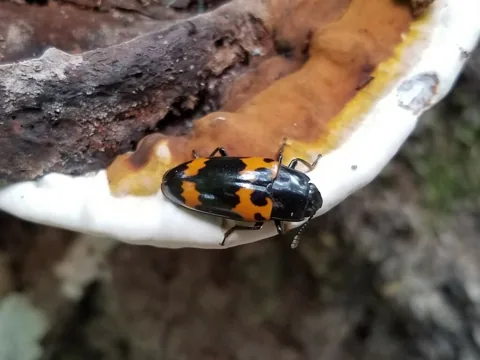 Pleasing Fungus Beetles
Erotylidae (e.g., Megalodacne, Tritoma, Triplax; Gibbifer californicus in the West)
Pleasing fungus beetles (family Erotylidae) are shiny, often brightly marked beetles that feed and breed in bracket fungi and other fungi growing on dead trees, stumps and logs. They feed on the fungus itself.
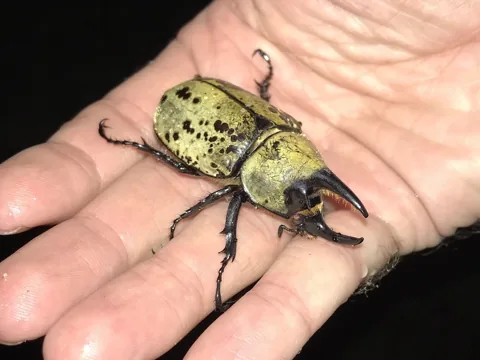 Eastern Hercules Beetle
Dynastes tityus
The eastern Hercules beetle is one of the largest and heaviest insects in the U.S.: a greenish-tan, black-spotted scarab whose males carry long horns. It is not a pest and is harmless to people, and its grubs help turn rotting wood into soil.
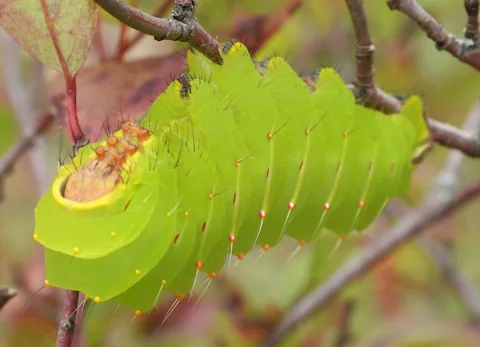 Polyphemus Moth
Antheraea polyphemus
The polyphemus moth is a giant silk moth, the second largest moth in Missouri, with a very large eyespot in the middle of each hind wing. Its plump, bright green caterpillar eats the leaves of many trees but is rarely numerous enough to need control.
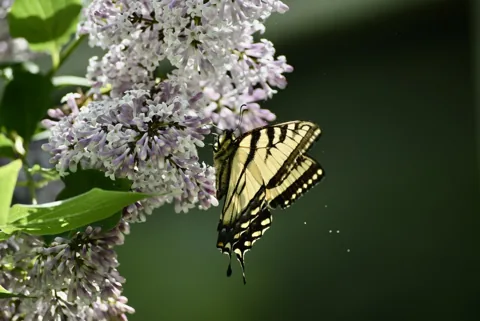 Eastern Tiger Swallowtail
Papilio glaucus
The eastern tiger swallowtail is a large yellow butterfly with black tiger stripes. Its smooth green caterpillars carry a pair of false eyespots and feed on the leaves of trees such as tulip tree, cherry and ash; MU Extension counts very few swallowtails as important pests.
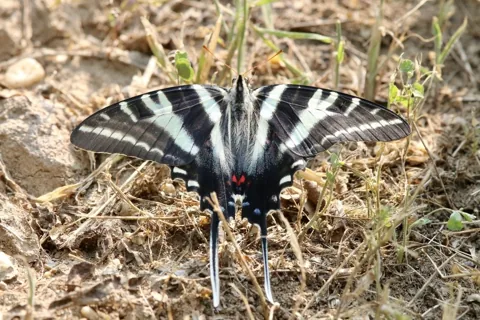 Zebra Swallowtail
Protographium marcellus (iNaturalist: Eurytides marcellus)
The zebra swallowtail is a pale butterfly with black stripes and long hindwing tails. Its caterpillars feed only on pawpaw, usually without harming the shrub much, so it isn't treated as a pest. It is harmless to people and pets, and gardeners who want to see it are encouraged to plant pawpaw.
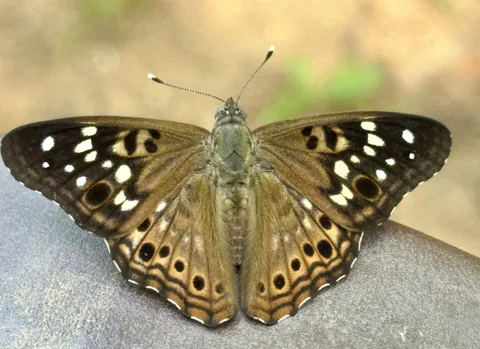 Hackberry Emperor
Asterocampa celtis
The hackberry emperor is a brown, spotted butterfly that is always found near hackberry trees, the only plants its green, two-horned caterpillars eat. The adults are fast, erratic fliers that often land on people to sip salt from their sweat.
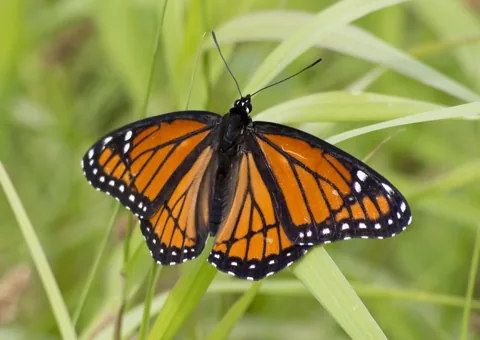 Viceroy
Limenitis archippus
The viceroy is an orange-and-black butterfly that closely resembles the monarch. Its caterpillars look like bird droppings and feed on willows, poplars, wild cherry and related trees.
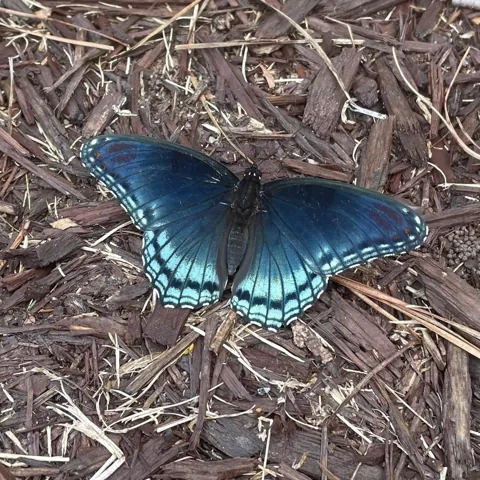 Red-spotted Purple
Limenitis arthemis astyanax
The red-spotted purple is a large black-and-blue butterfly that lives in and near woods, parks and suburban neighborhoods. Its caterpillars look like bird droppings and feed on cherry, willow, apple and other trees without causing real harm.
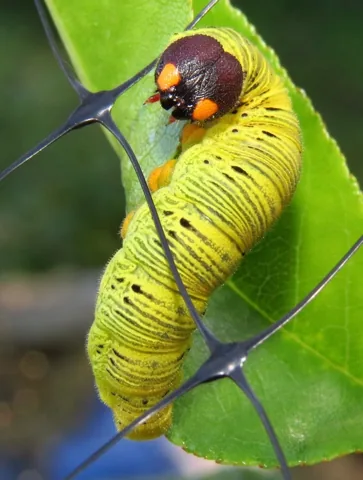 Silver-spotted Skipper
Epargyreus clarus
The silver-spotted skipper is a large, dark brown skipper with gold forewing spots and a silvery-white patch under the hindwing; Missouri's conservation department calls it the largest skipper in that state. Its yellow-green caterpillars with orange eyespots on the head feed on locusts, wisteria and other legumes, hiding in shelters of folded or silked-together leaves.
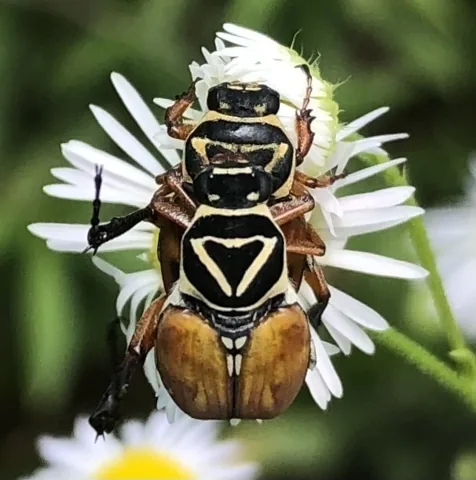 Delta Flower Scarab
Trigonopeltastes delta
The delta flower scarab is a small flower scarab named for the bright yellow triangle on the plate behind its head (delta is the Greek letter shaped like a triangle). Its yellow markings resemble those of stinging bees and wasps, which may help protect it from predators, but the beetle itself is not described as stinging or biting. It visits wildflowers for pollen and nectar and its larvae live in rotting wood, so it is not a garden pest and needs no control.
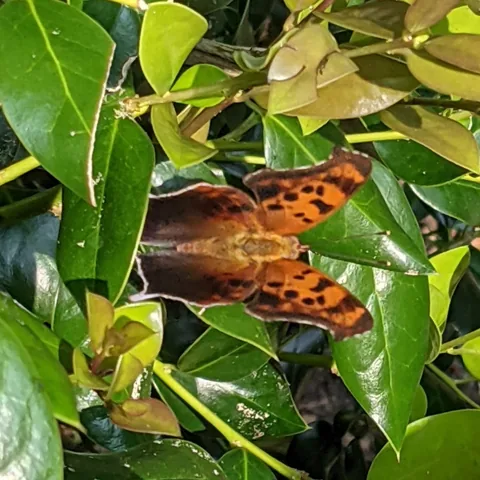 Question Mark
Polygonia interrogationis
The question mark is an orange-and-black butterfly with ragged wing edges and a small silver question-mark symbol under each hindwing. Its spiny caterpillars feed on elm, hackberry, hops and nettles.
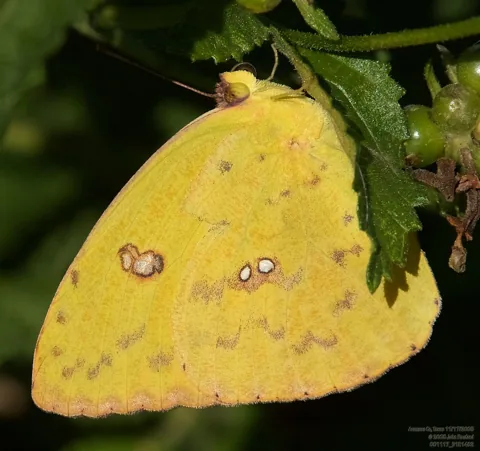 Cloudless Sulphur
Phoebis sennae
The cloudless sulphur is a large, bright yellow butterfly, bigger than other sulphurs in Missouri, often seen flying rapidly south in late summer and fall. Its caterpillars feed on partridge pea, wild senna and other legumes.
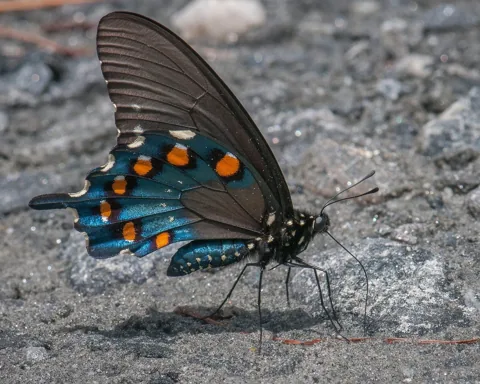 Pipevine Swallowtail
Battus philenor
The pipevine swallowtail is a black swallowtail with iridescent blue hind wings. Its caterpillars feed only on pipevines (Aristolochia, also called Dutchman's pipe) and store the plant's toxins, which make both caterpillars and adults distasteful and toxic to birds.
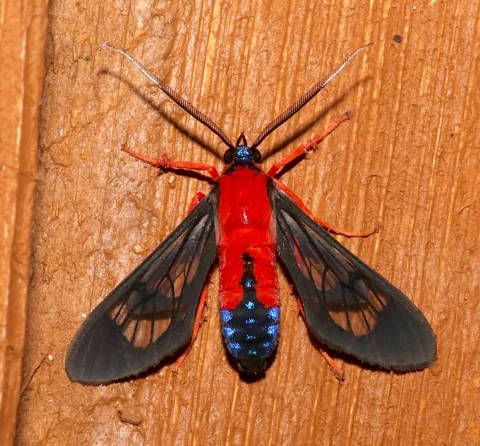 Scarlet-bodied Wasp Moth
Cosmosoma myrodora
The scarlet-bodied wasp moth is a colorful moth with a velvety red body, blue and black markings and clear, black-tipped wings that mimics a wasp. It is harmless, and its caterpillars feed only on climbing hempvine.
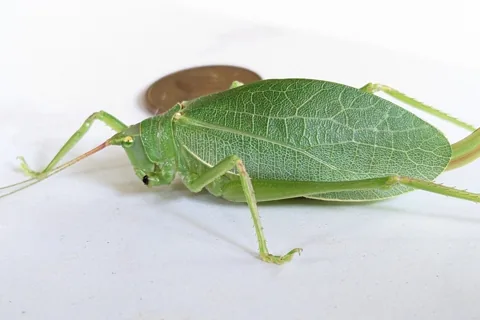 Common True Katydid
Pterophylla camellifolia
The common true katydid is a large leaf-green insect that lives high in trees and fills summer nights with its rasping 'Katy did, Katy didn't' call. It eats tree leaves but rarely causes noticeable damage, it is rarely seen, and no control is needed.
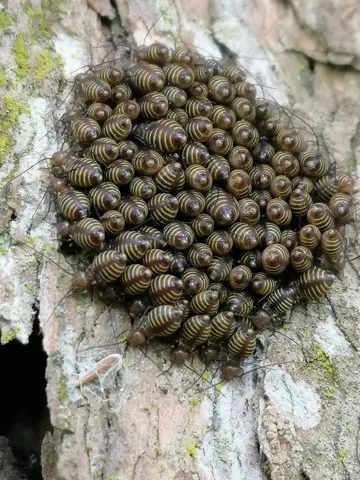 Barklice
Archipsocus nomas, Cerastipsocus venosus and other bark-dwelling psocids (order Psocodea)
Barklice are tiny, soft-bodied insects that live on tree bark. Some species blanket trunks and limbs in silky webbing or move over the bark in herds, but they feed on lichens, fungi and debris and do not harm the tree.
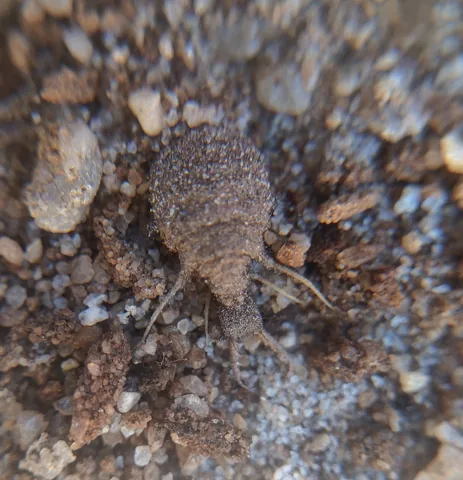 Antlions
Myrmeleontidae (e.g., Myrmeleon species)
Antlions are predatory insects that eat ants and other small insects. Their larvae, called doodlebugs, leave winding trails in loose sand and many dig cone-shaped pits to trap prey, while the adults look like drab damselflies with clubbed antennae.
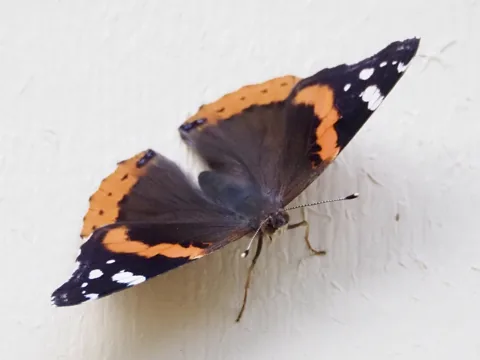 Red Admiral
Vanessa atalanta
The red admiral is a common black butterfly with an orange-red band across each forewing, an orange-red border on the hindwings and white spots near the wingtips. Its spiny caterpillars hide in folded leaf shelters on nettles and don't feed on most garden plants.
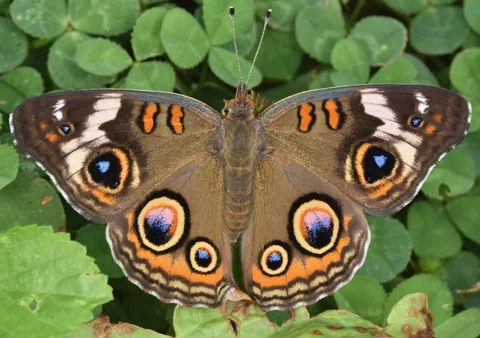 Common Buckeye
Junonia coenia
The common buckeye is a brown butterfly with bold eyespots on all four wings, two orange bars and an off-white band on each forewing. It lives in open, sunny places with low plants and some bare ground.
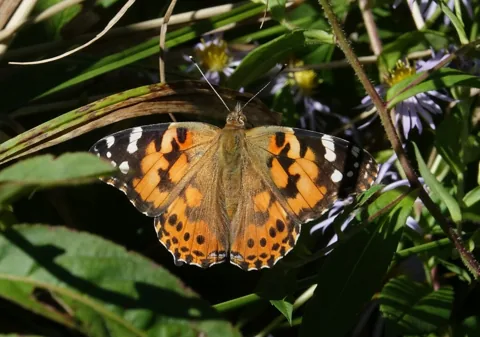 Painted Lady
Vanessa cardui
The painted lady is an orange-and-black butterfly with white-spotted wingtips that migrates north each spring and some years appears in huge numbers; its spiny caterpillars chew and web the leaves of thistles and many other plants.
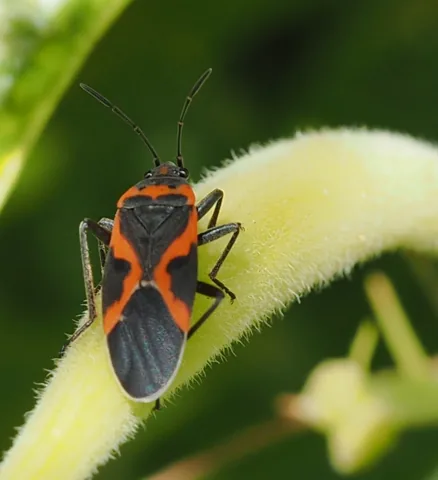 Small Milkweed Bug
Lygaeus kalmii
The small milkweed bug is a half-inch black bug with a reddish-orange X across its back and a reddish-orange band behind the head. It is one of the most common bugs on garden milkweeds.
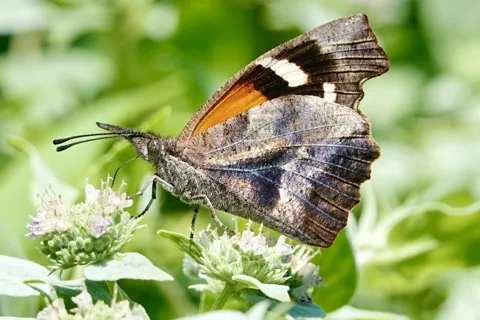 American Snout
Libytheana carinenta
The American snout is a small butterfly with long, forward-pointing mouthparts (labial palps) that look like a nose, squared-off forewing tips, and an orange-and-brown upper side with white spots. Its caterpillars eat hackberry leaves, and MDC calls their feeding relatively benign.
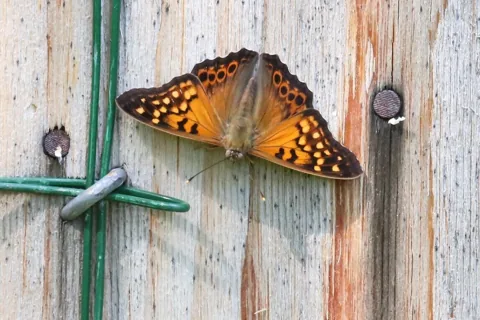 Tawny Emperor
Asterocampa clyton
The tawny emperor is a rust-colored butterfly whose caterpillars feed on the leaves of hackberry trees (Celtis). Adults seldom visit flowers, and they often land on people to take up sodium from sweat.
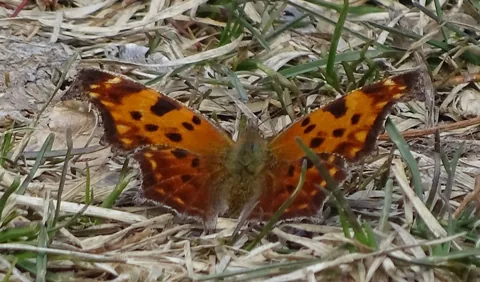 Eastern Comma
Polygonia comma
The eastern comma is an orange-and-black butterfly with ragged wing edges and a small pale comma mark under each hindwing. It spends the winter as an adult, so it can be seen flying on warm, sunny winter days.
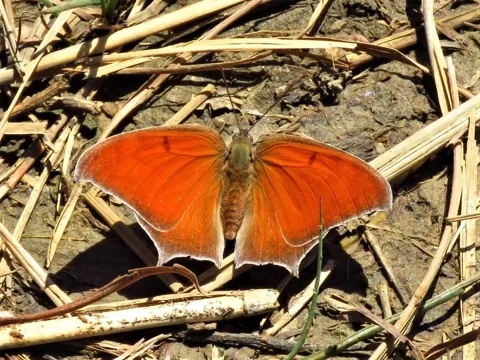 Goatweed Leafwing
Anaea andria
With its wings closed, the goatweed leafwing mimics a dry dead leaf; in flight it flashes bright rusty orange. Its gray-green caterpillars feed on goatweed and other Croton plants.
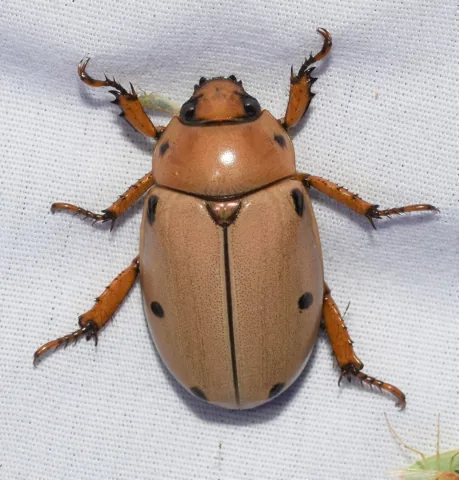 Grapevine Beetle
Pelidnota punctata
The grapevine beetle (spotted pelidnota) is a robust, one-inch, tan to reddish-brown scarab beetle, usually with three black spots on each wing cover. It feeds on grape leaves, comes to lights at night and is not usually considered a pest; its grubs live in rotting stumps and logs.
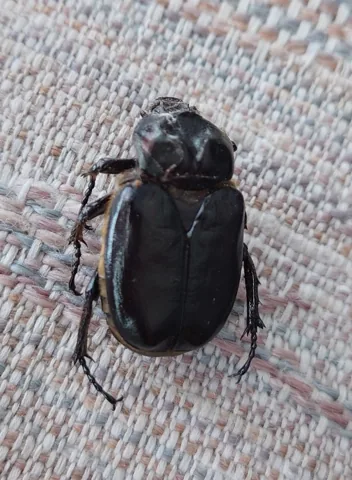 Hermit Flower Beetle
Osmoderma eremicola
The hermit flower beetle is a one-inch, dark brown to mahogany scarab that comes to lights in midsummer. Its big C-shaped grubs live in the rotting wood of dead or dying trees, and Minnesota Extension calls it a beneficial insect that helps decompose wood.
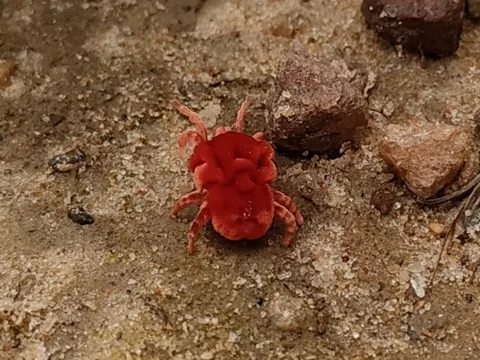 Velvet Mites
Trombidiidae (velvet mites)
Velvet mites are tiny, bright red, velvety mites seen scurrying over patios, brick walls and soil in spring. The adults prey on small insects and insect eggs, and they are harmless to people.
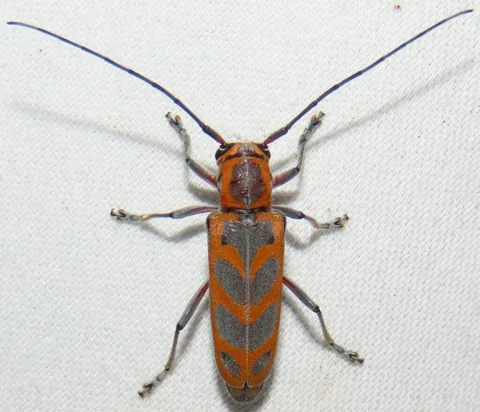 Elm Borer
Saperda tridentata
The elm borer is a gray-haired longhorned beetle with orange markings whose larvae bore under the bark of American and slippery elms, mostly trees or branches that are already weakened. Severe infestations can kill stressed elms, and the Missouri Department of Conservation says the beetle can transmit the Dutch elm disease fungus, though it is not the main carrier. A beetle that turns up indoors near the firewood most likely came out of the wood; the University of Kentucky says firewood borers have very low potential to infest structural wood, and it and NPIC both say not to spray firewood.
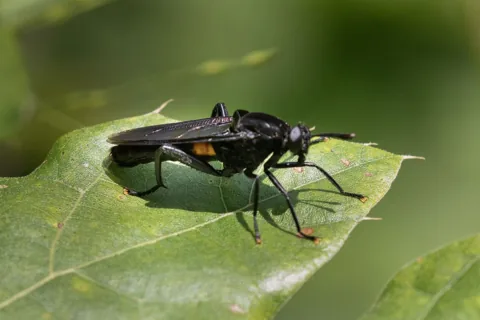 Mydas Flies
Mydidae
Mydas flies are large, harmless flies that mimic wasps. The eastern Mydas clavatus is velvety black with a bright orange or reddish mark on the second abdominal segment.
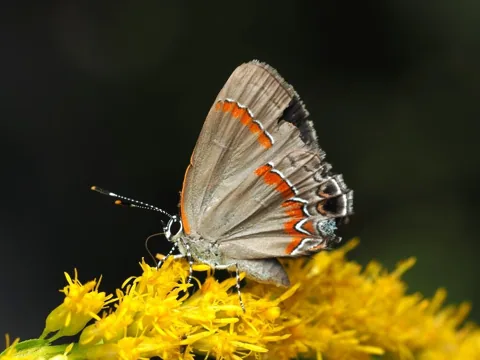 Red-Banded Hairstreak
Calycopis cecrops
The red-banded hairstreak is a small gray-brown butterfly with a white line edged by a red-orange band across the underside of the wings and threadlike tails on each hindwing. Its caterpillars live in leaf litter and eat fallen leaves.
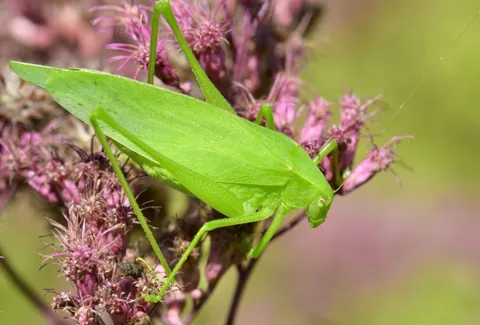 Oblong-Winged Katydid
Amblycorypha oblongifolia
The oblong-winged katydid is a false katydid that is usually leaf-green, though some individuals and whole populations are pink, yellow, orange or tan.
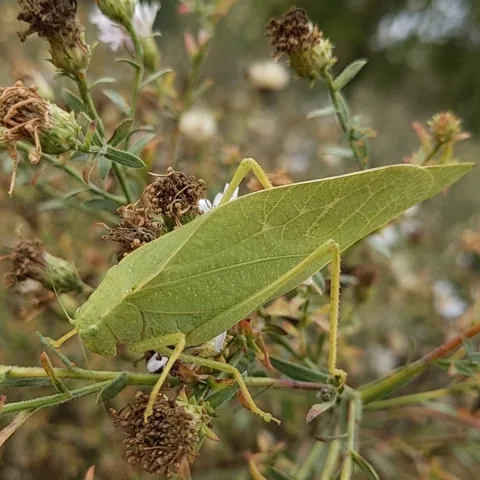 Greater Angle-Winged Katydid
Microcentrum rhombifolium
The greater angle-winged katydid is a large green false katydid whose broad wings make it look like a leaf. Like most katydids it is heard far more often than seen, and it rarely does noticeable harm to plants.
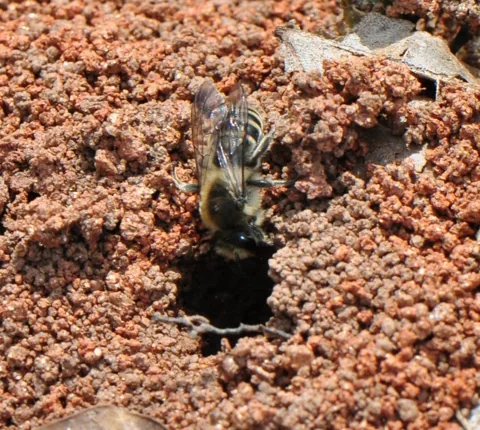 Cellophane Bees
Colletes
Cellophane bees are solitary, ground-nesting bees that line their underground brood cells with a clear, waterproof membrane. Chemically it is a polyester the female makes from her own gland secretions.
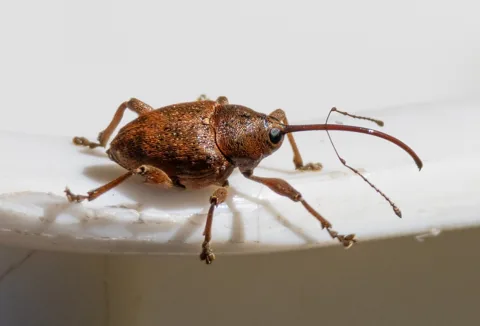 Acorn Weevils
Curculio
Acorn weevils are brown weevils with very long, slender snouts whose grubs develop inside acorns.
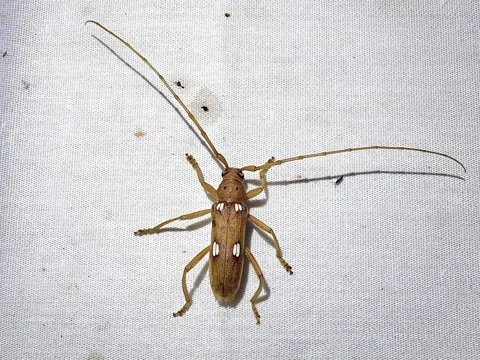 Ivory-Marked Borer
Eburia quadrigeminata (iNaturalist: Coeleburia quadrigeminata)
The ivory-marked borer is a golden-brown longhorned beetle, about 1/2 inch long, with four pairs of ivory spots, whose grubs bore into the heartwood of dead hardwood trees. It is harmless to people and pets. It surprises homeowners when an adult chews out of a hardwood floor or piece of furniture, sometimes many years after the wood was milled; NC State says no chemical control is necessary.
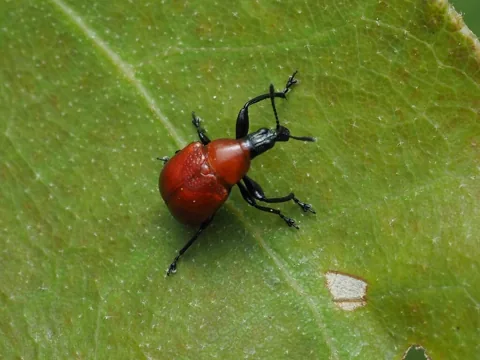 Leaf-Rolling Weevils
Homoeolabus analis
Leaf-rolling weevils are small, shiny, chunky weevils that cut and roll oak leaves into tight bundles with an egg inside; the grub grows up inside the roll. UF/IFAS Featured Creatures calls the finished roll a nidus, Latin for "nest," and the rolling a complex, genetically determined behavior.
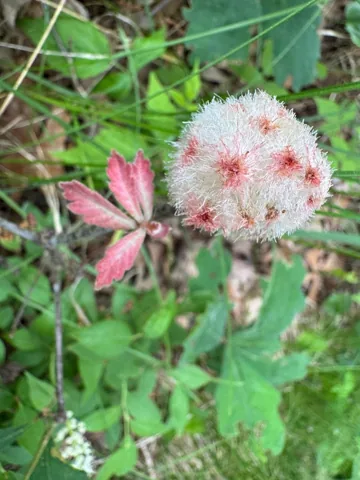 Wool Sower Gall Wasp
Callirhytis seminator
The wool sower gall wasp is a tiny gall wasp whose larvae make white oak twigs grow fluffy, cotton-ball galls in spring. The galls look odd, but NC State, Clemson and Illinois Extension all say they rarely harm the tree.
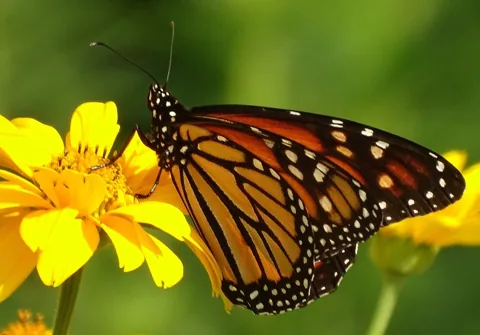 Monarch Butterfly
Danaus plexippus
The monarch is a large orange-and-black butterfly whose caterpillars feed only on milkweeds. North America has two migratory populations: eastern monarchs overwinter in mountain forests of central Mexico and western ones in groves on the California coast.
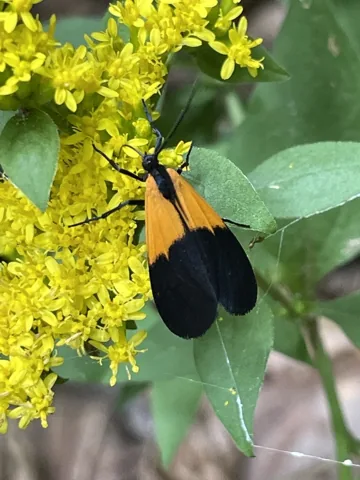 Black-and-Yellow Lichen Moth
Lycomorpha pholus
The black-and-yellow lichen moth is a small moth that flies by day, often seen on goldenrod and other flowers. Its caterpillars feed on lichens growing on tree bark and rocks.
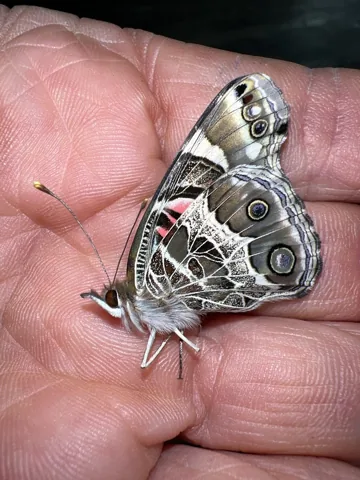 American Lady
Vanessa virginiensis
The American lady is an orange-and-black butterfly closely related to the painted lady; look for two large eyespots under each hindwing. It lives year-round in the southern United States and south to Colombia, and spreads north each year into the northern U.S. and southern Canada. Is it harmful? No: its caterpillars nibble pussytoes, everlastings and other aster-family plants, and BAMONA lists no management needs. Nothing needs to be done; many gardeners plant pearly everlasting or pussytoes to attract it.
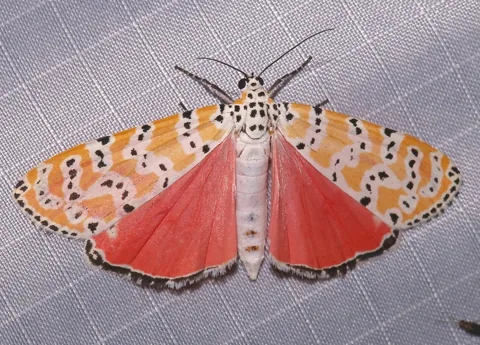 Ornate Bella Moth
Utetheisa ornatrix
The ornate bella moth is a colorful day-flying tiger moth whose caterpillars feed on toxic rattlebox plants and store the plant's alkaloids, which make every life stage distasteful to predators.
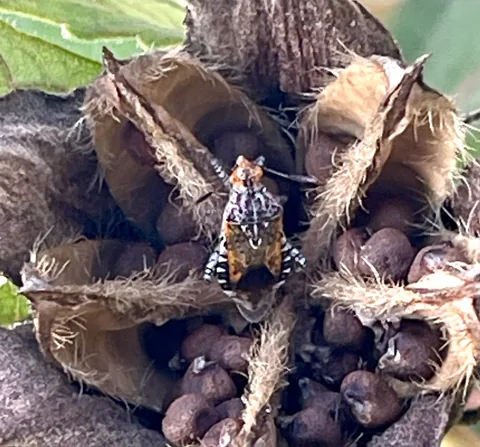 Hibiscus Scentless Plant Bug
Niesthrea louisianica
The hibiscus scentless plant bug is a small white-to-gray bug with black markings and a yellow-to-orange head that feeds on the buds and seeds of rose of Sharon, hibiscus, hollyhock and other mallows. Crowds of them on dry seed pods in late summer and fall can be startling, but they seldom hurt the plant, and control is usually not needed; picking them off by hand works if they bother you.
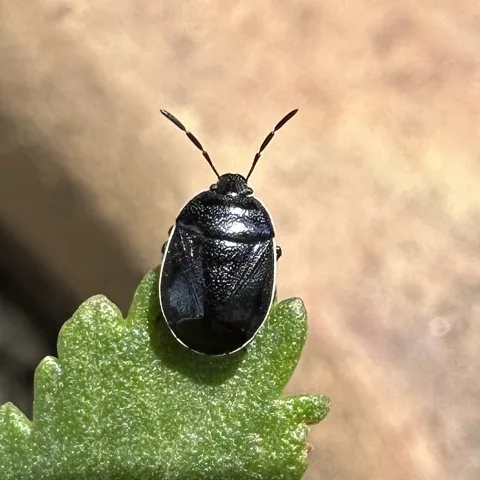 White-margined burrower bug
Sehirus cinctus
The white-margined burrower bug is a small black true bug that goes unnoticed for years, then appears by the thousands on lawns, driveways, buildings and plants. It doesn't bite or harm garden plants, and an outbreak fades on its own.
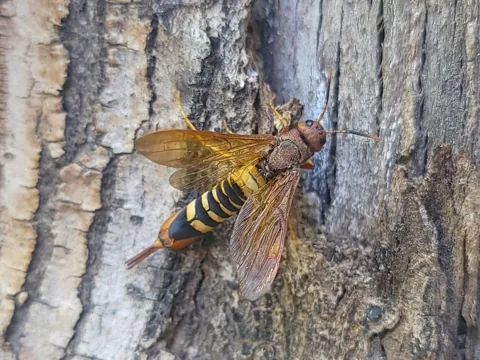 Pigeon tremex
Tremex columba
The pigeon tremex is a large, non-stinging wood wasp, a horntail, whose larvae tunnel in hardwood trees that are already dying or recently dead. It can't sting people or pets. Finding it, or its round exit holes, means that tree or limb is already in serious decline and may be a hazard. There is no spray that reaches the larvae and none is recommended: keep trees healthy, and have dead or dying limbs checked and removed if they could fall.
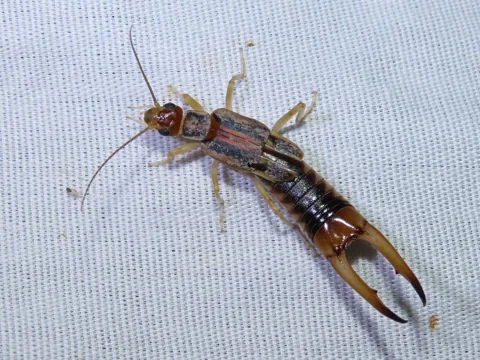 Striped earwig
Labidura riparia
The striped earwig, also called the shore earwig, is a predatory earwig of the South. It hunts small insects and doesn't damage plants, but it can annoy people when it is drawn to lights, and it smells very bad when crushed.
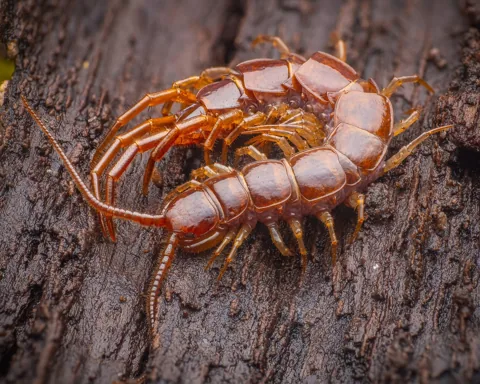 Outdoor centipedes (stone, soil and bark centipedes)
Class Chilopoda: stone centipedes (Lithobiomorpha), soil centipedes (Geophilomorpha) and large centipedes (Scolopendromorpha) (shown: brown centipede, Lithobius forficatus)
Besides the house centipede, homes get visits from outdoor species: the stone, soil and bark centipedes that hunt under rocks, mulch and logs. They wander in through cracks and gaps, especially in wet weather, but most die soon after because they dry out easily, so fixing moisture and entry points works better than spraying indoors.
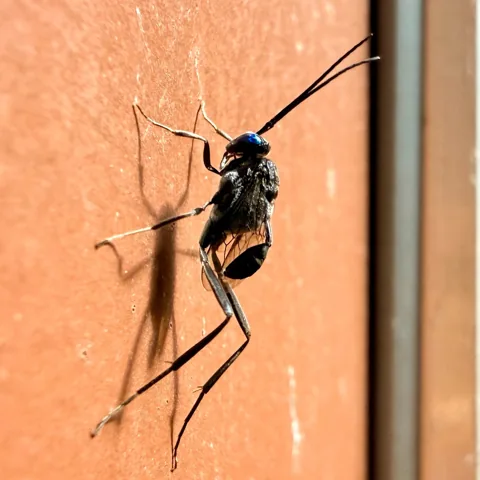 Ensign wasp
Evania appendigaster
The ensign wasp is a small black wasp that turns up now and then in homes and other buildings. It does not sting or bite. It is a parasite of cockroach egg cases, so seeing one usually means one of the larger cockroaches, such as the American cockroach, is breeding somewhere in the building.
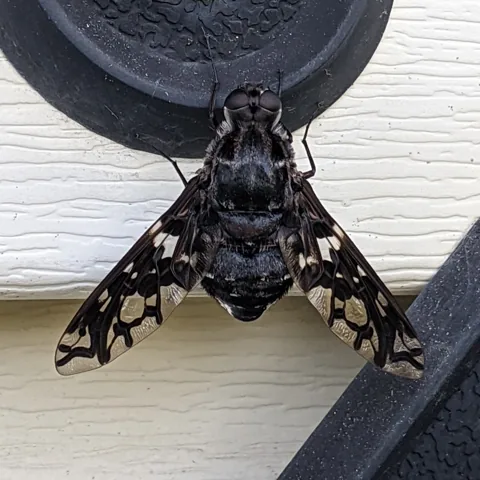 Tiger Bee Fly
Xenox tigrinus
The tiger bee fly is a large, fuzzy black fly with boldly patterned wings that hovers around decks, fences and other wood around homes. It can't sting or bite, and its larvae feed on carpenter bee larvae, which makes it a natural enemy of the carpenter bees that bore into wood.
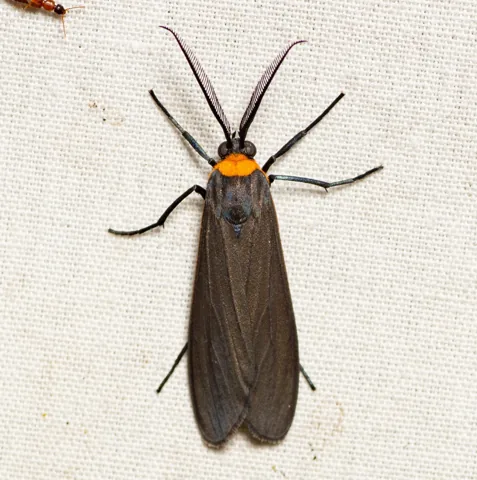 Yellow-collared Scape Moth
Cisseps fulvicollis
The yellow-collared scape moth is a slim black moth with a bright orange or yellow collar. Unlike most moths it flies by day, sipping nectar from goldenrods, asters and milkweeds, and its caterpillars feed on grasses, sedges and lichens.
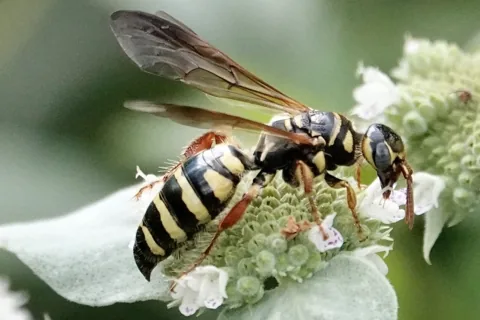 Five-banded thynnid wasp
Myzinum quinquecinctum
The five-banded thynnid wasp is a black-and-yellow solitary wasp of late-summer flowers. Its larvae feed on the white grubs of scarab beetles in the soil, and the clusters of males that gather on plants look alarming but cannot sting.
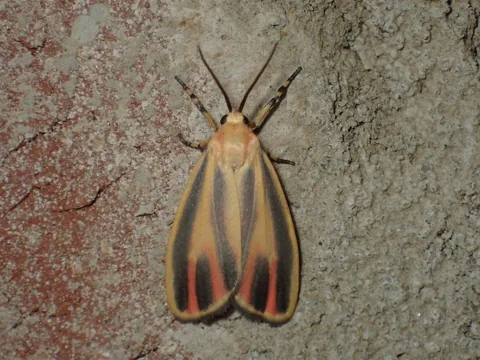 Painted Lichen Moth
Hypoprepia fucosa
The painted lichen moth is a woodland moth with red-orange forewings striped in dark gray. It flies at night and is drawn to lights. Its caterpillars feed on lichens, the crusty growths found on trees and rocks, and on mosses and algae growing on trees.
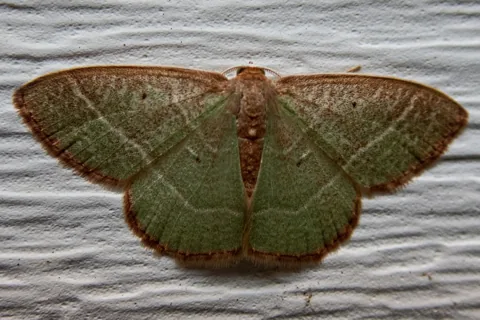 Red-fringed Emerald
Nemoria bistriaria
The red-fringed emerald is a small woodland moth that comes in two seasonal forms: green adults in summer, whose wing edges can carry a pink fringe, and tan adults in spring. It is drawn to lights, and you may find one resting on the side of your house near a light in the morning. Is it harmful? No; its caterpillars simply graze oak leaves, and the Missouri Department of Conservation describes no harm to people or trees. There is nothing to get rid of; every stage is food for predators.
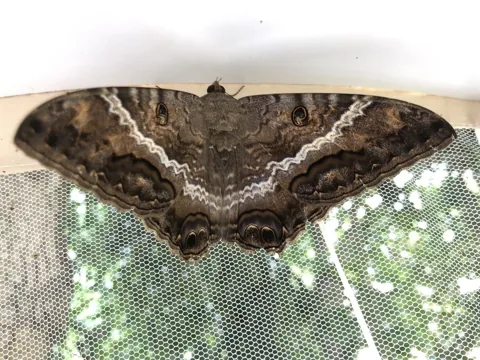 Black Witch
Ascalapha odorata
The black witch is one of the largest moths in North America, a dark brown night flier with a wingspan that can exceed 6 inches. Each summer and fall some fly north from Mexico and Central America, and people who find one resting under the eaves by day may take it for a bat. It is a subtropical and tropical species that does not reproduce in Colorado.
Cicadas
Annual cicadas are larger than periodical cicadas, with four membranous wings and big compound eyes; the northern dusk-singing cicada, nearly 2 inches long, is the largest in North America. Males call loudly from trees to attract females, females cut slits in twigs to lay eggs, and the nymphs feed from tree roots.[3]
- Periodical cicadas have black bodies, red eyes and orange wing veins and emerge in huge broods every 13 or 17 years in the eastern U.S., mostly from late April through June.[2]
- Females slit 1/4- to 1/2-inch twigs to lay eggs, so twig tips break and turn brown (flagging). Delay new plantings until the emergence ends, and cover young trees with netting or cheesecloth, secured around the trunk, as soon as males start singing; insecticides are of limited use.[2]
Crane flies and mayflies
- Crane flies are slender, very long-legged flies up to about 1-1/2 inches that look like giant mosquitoes but have no piercing mouthparts. Many adults don't eat at all, and the rest sip nectar. Larvae of some species eat decaying plant debris; others eat roots and can be lawn pests.[4]
- Mayflies are slender, soft-bodied insects that hold their wings upright and together over the back, like a butterfly. Adults live only hours or days and exist only to reproduce.[5]
- Where mayflies emerge in huge synchronized swarms, as around the Great Lakes, they can be a nuisance and cause problems for motorists; the swarms also feed fish, birds and spiders.[5]
Harmless and helpful
- Fireflies are beetles, not flies. Their larvae, called glowworms, are predators that overpower snails, slugs, earthworms and other soft-bodied prey.[6]
- Antlion larvae, or doodlebugs, dig small conical pits in sandy or loose soil and grab ants and other insects that tumble in. Adults look like fragile, drab damselflies with clubbed or curved antennae.[7][8]
- Barklice are tiny insects common on tree bark, feeding on mold, algae, lichens and organic debris. One species spins silken webbing over trunks and limbs, but Clemson Extension says the webbing doesn't harm the tree and barklice need no control.[9]
- Water boatmen live in quiet ponds and streams and suck juices from algae, other plants and debris. Unlike look-alike backswimmers, they aren't predators and don't bite people.[10]
- Walkingsticks are wingless, stick-like insects; the common northern walkingstick reaches about 3-3/4 inches and the giant walkingstick up to 7. They chew leaves of trees such as oaks, locusts, walnut and cherry, and occasional population peaks can defoliate trees, which usually recover.[11]
- Monarch caterpillars are white with black and yellow bands and feed on milkweeds, their required food plant.[12]
Mining bees and sweat bees in the lawn
- Many small mounds with holes in a sunny, thin patch of lawn in spring are usually solitary ground-nesting bees: mining bees, often black with reddish hair, or tiny, often metallic sweat bees. Each female digs her own burrow 6 inches or more deep.[1]
- They're important pollinators, damage turf only slightly, and solitary bees have no mass-attack behavior like honey bees or yellowjackets; insecticide treatment is almost never necessary.[1]
- To discourage nesting, water the area heavily, add organic matter, and grow dense turf or mulch bare spots.[1]
Harmless unless handled
- Giant water bugs reach about 2 inches and are called electric light bugs because they fly to lights at night. Handled, or stepped on by barefoot waders, they give an excruciatingly painful bite, hence the name toe-biters. Water scorpions are related aquatic predators with grasping, mantis-like forelegs, and they can also bite if handled.[13][14]
- Stag beetles run from under 1/2 inch to nearly 2-1/2 inches, and males have enlarged jaws for fighting other males. Larvae grow in rotting wood, and some species come to lights at night. They don't bite people aggressively but may pinch if handled.[15]
- Robber flies are predatory flies, many of them bee or wasp mimics, that dart from a perch to catch insects in flight and stab them with a pointed beak. They can bite painfully if mishandled.[16]
- Velvet ants, or cow killers, are solitary wasps, not ants: about 1/2 to 1-1/4 inches long, furry and usually red or orange with blackish legs. The wingless females, often found on open, sunny, sandy ground, sting excruciatingly if held or stepped on barefoot; males have wings.[17]
- Leafcutter bees cut rounded pieces from leaves and flowers to line nest cells in hollow twigs, stalks, holes in logs or the ground. They're solitary and not aggressive, and several species are important pollinators.[18]
- Blister beetles are long, soft-bodied beetles; some species feed on crops such as potatoes, tomatoes and clover. Squeezed or handled, they ooze an oil containing cantharidin that can blister skin, so don't handle them.[19]
Common questions
- Are crane flies dangerous?
- No. Crane flies don't bite and are harmless to people. Many adults don't eat at all, and those that do sip nectar.[4]
- Do cicadas bite or sting?
- Periodical cicadas can't sting and don't harm people or pets.[2]
- Is a velvet ant really an ant?
- No, it's a solitary wasp. The wingless females sting excruciatingly if held or stepped on, which gave them the name cow killer.[17]
Photo credits
- Annual Cicadas (dog-day cicadas): suzannehale, public domain (CC0), via iNaturalist
- Bordered Plant Bug (Largus Bug): Dennis White, public domain (CC0), via iNaturalist
- Caddisflies: Brighton Lee, public domain (CC0), via iNaturalist
- Eastern Dobsonfly: (c) daksu, some rights reserved (CC BY) — via iNaturalist, CC BY 4.0
- Giant Water Bugs: (c) Francisco Farriols Sarabia, some rights reserved (CC BY) — via iNaturalist, CC BY 4.0
- Horsehair Worms: (c) Joseph McPhail, some rights reserved (CC BY) — via iNaturalist, CC BY 4.0
- Household Casebearer: (c) Helio Lourencini, some rights reserved (CC BY) — via iNaturalist, CC BY 4.0
- Jerusalem Crickets: (c) Sean Vanderluit, some rights reserved (CC BY) — via iNaturalist, CC BY 4.0
- Lawn shrimp (terrestrial amphipods): jonatan sugatti, public domain (CC0), via iNaturalist
- Lovebug: (c) Sandra H Statner, some rights reserved (CC BY) — via iNaturalist, CC BY 4.0
- Mayflies: (c) DiegoH, some rights reserved (CC BY) — via iNaturalist, CC BY 4.0
- Red-shouldered bug (Jadera bug): (c) Catherine C. Galley, some rights reserved (CC BY) — via iNaturalist, CC BY 4.0
- Ringlegged Earwig: sealgyu, public domain (CC0), via iNaturalist
- Rough Stink Bugs: (c) Bill Keim, some rights reserved (CC BY) — via iNaturalist, CC BY 4.0
- Rove Beetles: (c) Brian C. Hunt, some rights reserved (CC BY) — via iNaturalist, CC BY 4.0
- Tropical House Cricket: Irene, public domain (CC0), via iNaturalist
- Hummingbird Moths: Chrissy McClarren and Andy Reago, public domain (CC0), via iNaturalist
- Large Milkweed Bug: (c) Matt Muir, some rights reserved (CC BY) — via iNaturalist, CC BY 4.0
- Horned Passalus: (c) Dominic, some rights reserved (CC BY) — via iNaturalist, CC BY 4.0
- Stag Beetles: (c) skitterbug, some rights reserved (CC BY) — via iNaturalist, CC BY 4.0
- Fireflies: (c) Albert Cardona, some rights reserved (CC BY) — via iNaturalist, CC BY 4.0
- Punctured Tiger Beetle: Brighton Lee, public domain (CC0), via iNaturalist
- Rainbow Scarab: (c) P.G.Th❤️mas, some rights reserved (CC BY) — via iNaturalist, CC BY 4.0
- Spicebush Swallowtail: (c) M. Whitson, some rights reserved (CC BY) — via iNaturalist, CC BY 4.0
- Pleasing Fungus Beetles: (c) Leila Dasher, some rights reserved (CC BY) — via iNaturalist, CC BY 4.0
- Eastern Hercules Beetle: (c) Kyle Rossner, some rights reserved (CC BY) — via iNaturalist, CC BY 4.0
- Polyphemus Moth: (c) Peter Waycik, some rights reserved (CC BY) — via iNaturalist, CC BY 4.0
- Eastern Tiger Swallowtail: (c) Bernie Paquette, some rights reserved (CC BY) — via iNaturalist, CC BY 4.0
- Zebra Swallowtail: Andy Wilson, public domain (CC0), via iNaturalist
- Hackberry Emperor: Anne P, public domain (CC0), via iNaturalist
- Viceroy: Robbie Hannawacker, public domain (CC0), via iNaturalist
- Red-spotted Purple: (c) northerly, some rights reserved (CC BY) — via iNaturalist, CC BY 4.0
- Silver-spotted Skipper: (c) Bernie Paquette, some rights reserved (CC BY) — via iNaturalist, CC BY 4.0
- Delta Flower Scarab: Ken Kneidel, public domain (CC0), via iNaturalist
- Question Mark: (c) stephen, some rights reserved (CC BY) — via iNaturalist, CC BY 4.0
- Cloudless Sulphur: (c) John Rosford, some rights reserved (CC BY) — via iNaturalist, CC BY 4.0
- Pipevine Swallowtail: (c) Arlo Sitimans, some rights reserved (CC BY) — via iNaturalist, CC BY 4.0
- Scarlet-bodied Wasp Moth: (c) Laura Gaudette, some rights reserved (CC BY) — via iNaturalist, CC BY 4.0
- Common True Katydid: Kirill Levchenko, public domain (CC0), via iNaturalist
- Barklice: (c) Alejandro Alfredo Aguirre, some rights reserved (CC BY) — via iNaturalist, CC BY 4.0
- Antlions: (c) Bartosz Czołczyński, some rights reserved (CC BY) — via iNaturalist, CC BY 4.0
- Red Admiral: (c) Thomas Boe, some rights reserved (CC BY) — via iNaturalist, CC BY 4.0
- Common Buckeye: (c) skitterbug, some rights reserved (CC BY) — via iNaturalist, CC BY 4.0
- Painted Lady: Brighton Lee, public domain (CC0), via iNaturalist
- Small Milkweed Bug: mefisher, public domain (CC0), via iNaturalist
- American Snout: (c) Louise Woodrich, some rights reserved (CC BY) — via iNaturalist, CC BY 4.0
- Tawny Emperor: (c) Laura Gaudette, some rights reserved (CC BY) — via iNaturalist, CC BY 4.0
- Eastern Comma: (c) Shirley Zundell, some rights reserved (CC BY) — via iNaturalist, CC BY 4.0
- Goatweed Leafwing: (c) Annika Lindqvist, some rights reserved (CC BY) — via iNaturalist, CC BY 4.0
- Grapevine Beetle: Chrissy McClarren and Andy Reago, public domain (CC0), via iNaturalist
- Hermit Flower Beetle: (c) Don, some rights reserved (CC BY) — via iNaturalist, CC BY 4.0
- Velvet Mites: (c) Firos AK, some rights reserved (CC BY) — via iNaturalist, CC BY 4.0
- Elm Borer: kcthetc1, public domain (CC0), via iNaturalist
- Mydas Flies: (c) Kristof Zyskowski, some rights reserved (CC BY) — via iNaturalist, CC BY 4.0
- Red-Banded Hairstreak: Brighton Lee, public domain (CC0), via iNaturalist
- Oblong-Winged Katydid: (c) Bernie Paquette, some rights reserved (CC BY) — via iNaturalist, CC BY 4.0
- Greater Angle-Winged Katydid: Vasily Reinkymov, public domain (CC0), via iNaturalist
- Cellophane Bees: (c) James Kindt, some rights reserved (CC BY) — via iNaturalist, CC BY 4.0
- Acorn Weevils: (c) Victor Heng, some rights reserved (CC BY) — via iNaturalist, CC BY 4.0
- Ivory-Marked Borer: Samuel Paul Galick, public domain (CC0), via iNaturalist
- Leaf-Rolling Weevils: Brighton Lee, public domain (CC0), via iNaturalist
- Wool Sower Gall Wasp: (c) Elizabeth Axley, some rights reserved (CC BY) — via iNaturalist, CC BY 4.0
- Monarch Butterfly: (c) Shirley Zundell, some rights reserved (CC BY) — via iNaturalist, CC BY 4.0
- Black-and-Yellow Lichen Moth: (c) Morgan Freese, some rights reserved (CC BY) — via iNaturalist, CC BY 4.0
- American Lady: (c) Healthy Yards, some rights reserved (CC BY) — via iNaturalist, CC BY 4.0
- Ornate Bella Moth: (c) Laura Gaudette, some rights reserved (CC BY) — via iNaturalist, CC BY 4.0
- Hibiscus Scentless Plant Bug: (c) Derrick Wales, some rights reserved (CC BY) — via iNaturalist, CC BY 4.0
- White-margined burrower bug: (c) zancat, some rights reserved (CC BY) — via iNaturalist, CC BY 4.0
- Pigeon tremex: (c) Daniel S., some rights reserved (CC BY) — via iNaturalist, CC BY 4.0
- Striped earwig: (c) Bob Miller, some rights reserved (CC BY) — via iNaturalist, CC BY 4.0
- Outdoor centipedes (stone, soil and bark centipedes): (c) Alexis Tinker-Tsavalas, some rights reserved (CC BY) — via iNaturalist, CC BY 4.0
- Ensign wasp: (c) Heatherelle, some rights reserved (CC BY) — via iNaturalist, CC BY 4.0
- Tiger Bee Fly: cgmayers, public domain (CC0), via iNaturalist
- Yellow-collared Scape Moth: (c) Justin Williams, some rights reserved (CC BY) — via iNaturalist, CC BY 4.0
- Five-banded thynnid wasp: (c) Louise Woodrich, some rights reserved (CC BY) — via iNaturalist, CC BY 4.0
- Painted Lichen Moth: (c) John P Friel, some rights reserved (CC BY) — via iNaturalist, CC BY 4.0
- Red-fringed Emerald: (c) Betsy Lambert, some rights reserved (CC BY) — via iNaturalist, CC BY 4.0
- Black Witch: (c) Alan Macnaughton, some rights reserved (CC BY) — via iNaturalist, CC BY 4.0
Sources
- NC State Extension, “Ground-Nesting Bees in Turf (TurfFiles).” www.turffiles.ncsu.edu/insects/bees-in-turf/ (accessed 2026-10-06)
- University of Kentucky Entomology, “ENTFACT-446: Periodical Cicadas in Kentucky.” entomology.mgcafe.uky.edu/ef446 (accessed 2026-10-06)
- Missouri Department of Conservation, “Annual Cicadas (Field Guide).” mdc.mo.gov/discover-nature/field-guide/annual-cicadas (accessed 2026-11-12)
- Missouri Department of Conservation, “Large Crane Flies (Field Guide).” mdc.mo.gov/discover-nature/field-guide/crane-flies (accessed 2026-11-12)
- Missouri Department of Conservation, “Mayflies (Field Guide).” mdc.mo.gov/discover-nature/field-guide/mayflies (accessed 2026-11-12)
- Missouri Department of Conservation, “Fireflies (Lightning Bugs) (Field Guide).” mdc.mo.gov/discover-nature/field-guide/fireflies-lightning-bugs (accessed 2026-11-12)
- Missouri Department of Conservation, “Antlion Larvae (Doodlebug Larvae) (Field Guide).” mdc.mo.gov/discover-nature/field-guide/antlion-larvae-doodlebug-larvae (accessed 2026-11-12)
- Missouri Department of Conservation, “Antlion Adults (Field Guide).” mdc.mo.gov/discover-nature/field-guide/antlion-adults (accessed 2026-11-12)
- Clemson Cooperative Extension Home & Garden Information Center, “Barklice.” hgic.clemson.edu/factsheet/barklice/ (accessed 2026-11-12)
- Missouri Department of Conservation, “Water Boatmen (Field Guide).” mdc.mo.gov/discover-nature/field-guide/water-boatmen (accessed 2026-11-12)
- Missouri Department of Conservation, “Walkingsticks (Stick Insects) (Field Guide).” mdc.mo.gov/node/219675 (accessed 2026-11-12)
- Missouri Department of Conservation, “Monarch (Field Guide).” mdc.mo.gov/discover-nature/field-guide/monarch (accessed 2026-11-12)
- Missouri Department of Conservation, “Giant Water Bugs (Field Guide).” mdc.mo.gov/discover-nature/field-guide/giant-water-bugs (accessed 2026-11-12)
- Missouri Department of Conservation, “Water Scorpions (Field Guide).” mdc.mo.gov/discover-nature/field-guide/water-scorpions (accessed 2026-11-12)
- Missouri Department of Conservation, “Stag Beetles (Lucanids) (Field Guide).” mdc.mo.gov/discover-nature/field-guide/stag-beetles (accessed 2026-11-12)
- Missouri Department of Conservation, “Robber Flies (Field Guide).” mdc.mo.gov/discover-nature/field-guide/robber-flies (accessed 2026-11-12)
- Missouri Department of Conservation, “Velvet Ants (Field Guide).” mdc.mo.gov/discover-nature/field-guide/velvet-ants (accessed 2026-11-12)
- Missouri Department of Conservation, “Leafcutter Bees (Field Guide).” mdc.mo.gov/discover-nature/field-guide/leafcutter-bees (accessed 2026-11-12)
- Missouri Department of Conservation, “Blister Beetles (Meloids) (Field Guide).” mdc.mo.gov/discover-nature/field-guide/blister-beetles (accessed 2026-11-12)
- New Mexico State University Cooperative Extension Service, “Blister Beetles in Alfalfa (Circular 536).” pubs.nmsu.edu/_circulars/CR536/index.html (accessed 2026-11-12)
- University of Kentucky Entomology, “ENTFACT-102: Blister Beetles.” entomology.mgcafe.uky.edu/ef102 (accessed 2026-11-12)