On this page
How to identify it
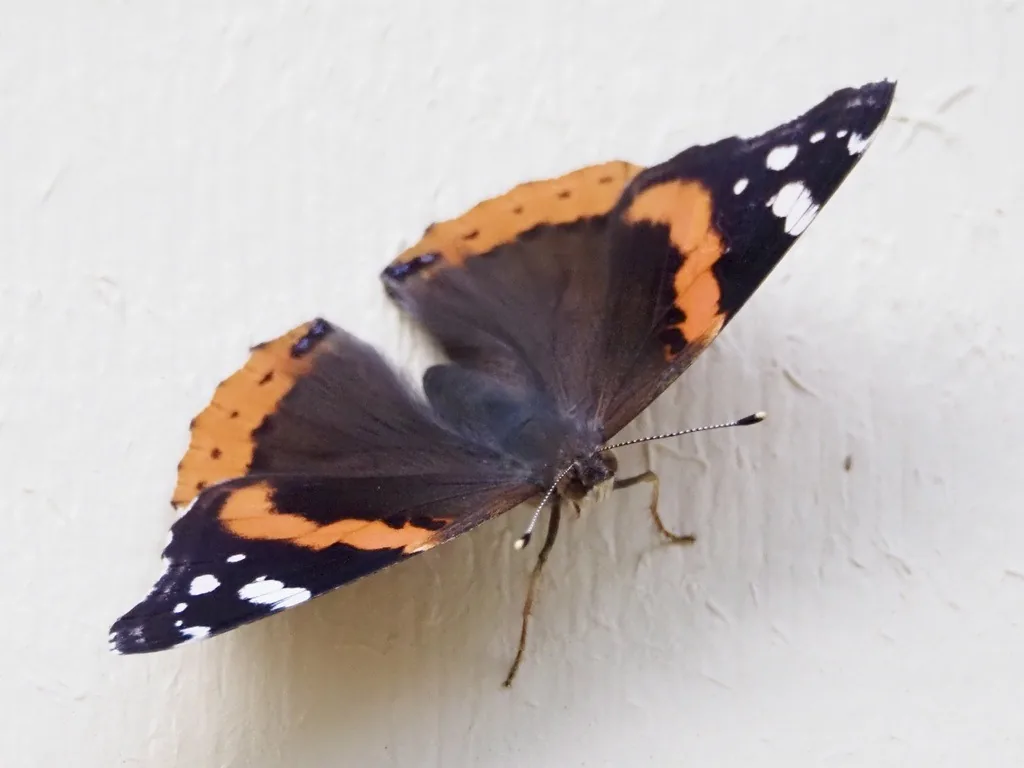
- From above it is black or brownish black with an orange-red forewing band, white spots near the forewing tips and an orange-red band along the hindwing edge.[1][3][4]
- Underneath, the hindwing is dark and mottled in grays and browns, and the forewing shows red, white and blue markings.[1][3]
- Wingspan is about 1 3/4 to 3 inches by the Illinois DNR and Butterflies and Moths of North America; the Missouri Department of Conservation gives 1 1/2 to 2 1/4 inches. Butterflies and Moths of North America says the winter form is smaller and duller.[3][4][1]
- Caterpillars grow to about 2 inches and change look with each molt: black, greenish, whitish or brown, with many small warts and dark spines.[1]
- It flies quickly and erratically.[1][4]
Look-alikes
| Look-alike | How to tell them apart |
|---|---|
| Painted lady | Also has white spots on dark forewing tips, but it is mostly orange and black with a brown, white-cobwebbed underside, not black with bold orange-red bands.[2][1] |
Where it lives
From Guatemala north through Mexico and the United States to northern Canada, and also in Hawaii, some Caribbean islands, New Zealand, Europe, northern Africa and Asia. It is found statewide in Missouri and Illinois.[4][1][3]
Biology and life cycle
It can't survive the coldest winters, so most of North America is recolonized each spring by butterflies moving north from the South. In Missouri adults arrive in March and fly into November; in Illinois they fly from March to early November.[4][1][3]
Missouri reports 2 or 3 broods a year, Butterflies and Moths of North America two broods from March to October in the north, and the Illinois DNR multiple generations.[1][4][3]
Females lay single eggs on the leaves of nettle-family plants. Young caterpillars live inside a folded leaf; older ones tie leaves together with silk into a nest.[4][1]
Adults prefer tree sap, fermenting fruit and animal or bird droppings, visiting flowers such as milkweeds, clovers and asters less often. They also take moisture at mud puddles.[1][4][3]
Males perch on trees and shrubs from late afternoon until almost dark, darting out at passing butterflies and other animals while they watch for females, and rarely keep the same territory for more than a day.[1][4]
Damage and signs
Health risk
None of the sources reports any harm to people or pets from the butterfly or its caterpillar.[1][4]
Control
Prevention
No control is needed. Butterflies and Moths of North America reports no management needs, and the Missouri Department of Conservation calls it a favorite of many people.[4][1]
How it migrates
Like the painted lady and American lady, it is a migrant, moving north from warmer regions to recolonize much of the United States and Canada; at least some move south for the winter.[1][2]
In Europe, a study of red admirals caught on the Baltic coast found spring arrivals came from the south with females already carrying eggs, while autumn migrants were local or more northern butterflies carrying large fat reserves for long-distance migration.[5]
A 2026 study of European red admirals found they pick their migratory direction from the sun and showed no sign of using a magnetic compass, unlike monarchs, which use both.[6]
Where sources disagree
Size: the Illinois DNR and Butterflies and Moths of North America give a wingspan of 1 3/4 to 3 inches; the Missouri Department of Conservation lists 1 1/2 to 2 1/4 inches.[3][4][1]
Winter stage: Butterflies and Moths of North America says adults hibernate; Missouri and Illinois say it overwinters as an adult or a chrysalis where winters are mild enough.[4][1][3]
Common questions
- What is the black butterfly with orange stripes?
- Often a red admiral: black wings with orange-red bands and white spots near the tips.[1][3]
- What do red admiral caterpillars eat?
- Nettle-family plants such as stinging nettle, wood nettle and false nettle.[1][4]
- Why do they land on rotting fruit?
- Adults prefer sap, fermenting fruit and droppings to flower nectar.[1][4]
Sources
- Missouri Department of Conservation, “Red Admiral (Field Guide).” mdc.mo.gov/discover-nature/field-guide/red-admiral (accessed 2026-11-11)
- Missouri Department of Conservation, “Painted Lady (Field Guide).” mdc.mo.gov/discover-nature/field-guide/painted-lady (accessed 2026-11-11)
- Illinois Department of Natural Resources, “Red admiral (Wild About Butterflies).” dnr.illinois.gov/education/wildaboutpages/wildaboutinvertebrates/wildaboutbutterflies/family-nymphalidae/wambredadmiral.html (accessed 2026-11-11)
- Butterflies and Moths of North America (BAMONA), “Red Admiral, Vanessa atalanta (species account).” www.butterfliesandmoths.org/species/Vanessa-atalanta (accessed 2026-11-11)
- Movement Ecology, via PubMed, “Geographic origin and migration phenology of European red admirals (Vanessa atalanta) as revealed by stable isotopes (Brattstrom et al. 2018).” pubmed.ncbi.nlm.nih.gov/30598824/ (accessed 2026-11-11)
- Journal of the Royal Society Interface, via PubMed, “Not all butterflies are monarchs: orientation using daytime celestial cues but not magnetic cues in European migratory red admirals (Pakhomov et al. 2026).” pubmed.ncbi.nlm.nih.gov/42901507/ (accessed 2026-11-11)
- iNaturalist, “Vanessa atalanta taxon page (order and family).” www.inaturalist.org/taxa/49133 (accessed 2026-11-11)