On this page
How to identify it
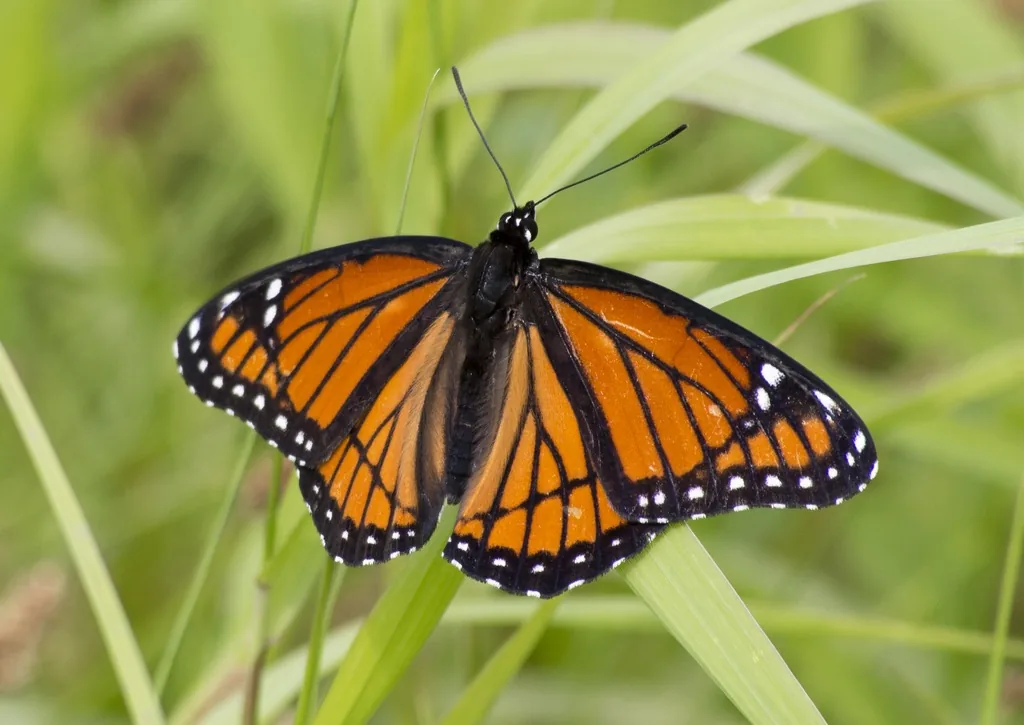
- Adults are orange with black veins and black wing borders with light spots. The best mark is a black line crossing the veins of the hindwing, which the monarch lacks.[1][3]
- Wingspan is about 2 1/4 to 3 inches; the Arizona subspecies measures 58 to 76 mm, and females are usually larger than males.[1][3]
- Full-grown caterpillars are about 1 1/2 inches, mottled white-pink and green-brown, humped at the front, with a pair of large barbed brown horns near the front of the body.[2][1]
- UF/IFAS says eggs are laid singly on leaf tips, where they look like galls. Caterpillars and pupae are cryptically colored, and the caterpillars grow increasingly long projections on the thorax.[4]
Look-alikes
| Look-alike | How to tell them apart |
|---|---|
| Monarch | The monarch is larger and has no black line across the hindwing. In the Southwest and Florida the viceroy also resembles the queen butterfly, which has more white spots near the forewing tip and no hindwing line. Arizona Game and Fish notes that perched viceroys hold their wings open while queens keep theirs closed. UF/IFAS says it can be confused with monarchs, queens and soldiers, which it mimics in different parts of its range, though it is only distantly related to these milkweed butterflies.[3][1][5][4] |
| Red-spotted purple | A close relative, Limenitis astyanax. UF/IFAS says the viceroy occasionally forms natural hybrids with it, and the immature stages of the two are very similar.[4] |
Where it lives
It is found statewide in Missouri, mostly in wet habitats but also in gardens. In the Southwest the subspecies obsoleta ranges from southeastern Nevada, far southwestern Utah and Arizona into southern New Mexico, western Texas and Sonora, Mexico. Florida and South Carolina populations have been studied for their bad taste to birds. UF/IFAS gives the overall range as east of the Cascade and Sierra Nevada mountains south to central Mexico and Florida, with strays in Cuba. It lists seven described subspecies, including L. a. floridensis, which merges with the nominate subspecies in Georgia, and two found only in Nevada.[1][3][6][4]
Biology and life cycle
MU Extension reports two generations a year, with caterpillars from early summer to fall. In Missouri adults fly from May to October.[2][1]
Females lay eggs a few at a time on the leaf tips of the host plant. Partly grown caterpillars of the fall brood roll a leaf into a shelter and spend the winter inside it.[1][3]
Caterpillars feed at night, on willow catkins first and then on leaves. Adults visit flowers, rotting fruit, tree sap, aphid honeydew, droppings and mud puddles.[1]
Caterpillars hatch about five days after the eggs are laid. Young caterpillars eat the leaf tip but leave the central vein as a perch. When days get short, third-stage caterpillars go dormant: they tie the leaf stem to the branch with silk and build a tube-like shelter, then in spring finish growing on fresh willow leaves in about three weeks.[4]
Adults prefer wet places along ponds, swamps and rivers, where the host plants often line the banks. Males perch in late morning and early afternoon to watch for females and defend territory.[4]
Damage and signs
Health risk
It feeds on leaves and none of these sources list any risk to people or pets. Its bad taste is a defense against birds, not a hazard to people.[2][1][5]
Control
Prevention
No control is needed: none of these sources recommend any, and the caterpillars only eat leaves of willows and other trees.[2][1]
A mimic that tastes bad too
The viceroy was long held up as the classic case of a tasty butterfly copying a bad-tasting one. The Missouri Department of Conservation now describes it as inedible itself, with viceroy and monarch sharing warning colors that teach birds to avoid both.[1]
In lab tests, red-winged blackbirds ate only 40% of Florida viceroy abdomens offered to them, against 98% of control butterflies, and immediately rejected nearly one-third after a single peck. The viceroys were less palatable than Florida queens.[5]
Wild-caught viceroys from three Florida sites and one South Carolina site were all moderately unpalatable; blackbirds ate fewer than half of the abdomens offered and taste-rejected over one-third after one peck.[6]
Viceroys take up bitter phenolic glycosides from Carolina willow leaves and release volatile phenolic compounds when disturbed, a different chemical defense from the cardiac glycosides of monarchs and queens.[7]
UF/IFAS explains that adults hold salicylic acid taken in by the caterpillar from its willow-family host, which makes them bitter. It calls the viceroy-monarch relationship Müllerian, with both species unpalatable, and notes the viceroy may have started as a Batesian mimic before evolving its own chemical defense.[4]
Where the sources disagree
Wingspan: the Missouri Department of Conservation gives about 2 1/4 to 3 inches, while UF/IFAS gives 2 1/2 to 3 3/8 inches (6.3 to 8.6 cm).[1][4]
Broods: MU Extension reports two generations a year, while UF/IFAS says two to three broods form through most of the range and reproduction may be continuous in south Florida.[2][4]
Common questions
- Is this a monarch or a viceroy?
- Look at the hindwing. A viceroy has a black line crossing the veins there; a monarch does not, and the monarch is also larger. UF/IFAS notes the viceroy is the smaller of the two.[1][3][4]
- What does a viceroy caterpillar look like?
- A humped, mottled white-and-brown caterpillar about 1 1/2 inches long that looks like a bird dropping, with two barbed horns near the front.[2][1]
- What do viceroy caterpillars eat?
- Willow catkins and leaves, poplar, aspen, wild cherry and related trees.[1][2]
- Is the viceroy a state butterfly?
- Yes. UF/IFAS notes it is the state butterfly of Kentucky.[4]
Sources
- Missouri Department of Conservation, “Viceroy (Field Guide).” mdc.mo.gov/discover-nature/field-guide/viceroy (accessed 2026-11-11)
- University of Missouri Extension (Caterpillars in Your Yard and Garden, IPM1019), “Caterpillars in Your Yard and Garden, page 50: Viceroy.” extension.missouri.edu/publications/ipm1019-50 (accessed 2026-11-11)
- Arizona Game and Fish Department, “Limenitis archippus obsoleta (Heritage Data Management System invertebrate abstract).” azgfd-hdms.s3.amazonaws.com/public/abstracts/Limearob.pdf (accessed 2026-11-11)
- University of Florida IFAS Extension (EDIS), “Viceroy Butterfly, Limenitis archippus (Cramer), EENY 458/IN828 (A. Sourakov; Featured Creatures).” ask.ifas.ufl.edu/publication/IN828 (accessed 2026-11-14)
- Oecologia, via PubMed, “Unpalatability of viceroy butterflies (Limenitis archippus) and their purported mimicry models, Florida queens (Danaus gilippus) (Ritland 1991).” pubmed.ncbi.nlm.nih.gov/28312737/ (accessed 2026-11-11)
- Oecologia, via PubMed, “Comparative unpalatability of mimetic viceroy butterflies (Limenitis archippus) from four south-eastern United States populations (Ritland 1995).” pubmed.ncbi.nlm.nih.gov/28306826/ (accessed 2026-11-11)
- Journal of Chemical Ecology, via PubMed, “Isolation, identification, and quantification of potential defensive compounds in the viceroy butterfly and its larval host-plant, Carolina willow (Prudic et al. 2007).” pubmed.ncbi.nlm.nih.gov/17431749/ (accessed 2026-11-11)
- iNaturalist, “Limenitis archippus taxon page (order and family).” www.inaturalist.org/taxa/58586 (accessed 2026-10-06)