On this page
How to identify it
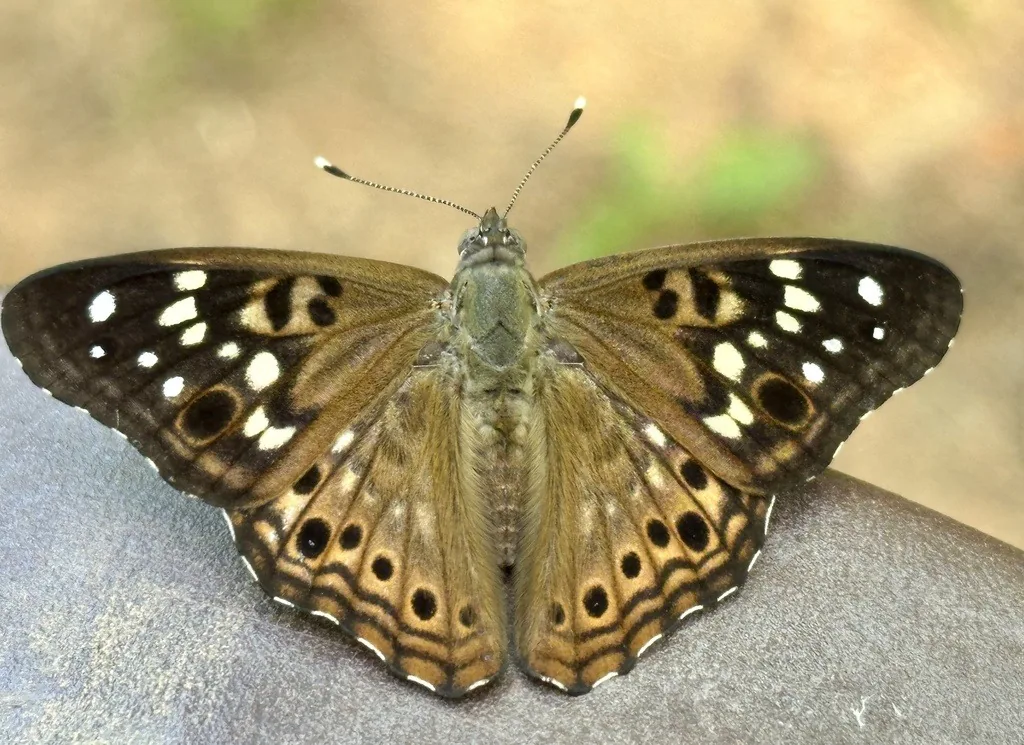
- Adults are reddish brown to tan above, with a wingspan of about 1 3/8 to 2 1/2 inches. The forewing has black tips with white spots, a jagged row of white spots and one distinct black eyespot. UF/IFAS gives a wing spread of 2.0 to 2.6 inches and notes that males are smaller, with narrower wings, than females. It separates this species from the tawny emperor by the white spots near the forewing tip and the black eyespot near the forewing edge.[3][2][7]
- Under the hindwing is a row of eyespots: blue centers ringed with black, yellow and brown.[2]
- Color is extremely variable from region to region.[3]
- Caterpillars grow to 1 to 1 1/2 inches, yellow to green with white-yellow stripes. Two barbed, antler-like horns rise from the green head, and the rear end has a pair of pointed tails. UF/IFAS gives full-grown caterpillars as about 1.4 inches long; the lower half of the head is green with short green spines and the upper half is brown with a pair of stout black horns.[1][2][7]
- Eggs are white or pale yellow and ringed with vertical ridges. The chrysalis is green with small white spots and white lines, has two horns at the head end and hangs from a silk pad.[7]
Look-alikes
| Look-alike | How to tell them apart |
|---|---|
| Tawny emperor | Less common and more rust-colored. From above it lacks the white spots on dark forewing tips and the black eyespot, and the forewing cell has two unbroken dark bars instead of one bar and two spots; its hindwing eyespots below look smudgy.[2] |
Where it lives
Resident in most of the eastern United States, the central Plains states and the mountains of the Southwest, and in northern Mexico. It lives along wooded streams and river edges, in forest glades, along wooded roadsides and in towns, wherever hackberry grows. UF/IFAS traces it from northeastern Mexico into the southwestern U.S., north to Nebraska and through most of the eastern U.S., but not the northern half of Wisconsin, Michigan and New York or any of New England. It is common in northern and central Florida and infrequent in southern Florida, where the panhandle form is called celtis and the peninsular form reinthali. It is most common in river bottoms, and dense swarms have been documented in some southern states.[3][2][7]
Biology and life cycle
There are two generations a year, with caterpillars present from early summer to fall. UF/IFAS adds that Florida may have three.[1][3][7]
Females lay eggs in clusters, and the young caterpillars feed together in groups.[3][2]
In fall, groups of half-grown caterpillars gather in rolled dead leaves and overwinter in the leaf litter, then climb back into the tree in spring to resume feeding.[2][3]
Adults seldom visit flowers. They feed on tree sap, rotting fruit, dung and carrion and take moisture and salts from damp ground, and they are one of several butterflies drawn to the sodium in human sweat.[2][3][4]
Males perch head-down on tree trunks, bushes, the sides of houses and other tall objects in sunny spots, darting out at passing butterflies, animals and people while they watch for females.[2][3]
Caterpillars rest on the undersides of leaves and are easiest to find at night by shining a flashlight up into small trees. UF/IFAS lists at least one tachinid fly and one ichneumonid wasp that parasitize them.[7]
Adults fly very fast. Both sexes come to fermenting fruit baits, and UF/IFAS notes males are drawn to bright objects, even leaving their perches to land on white paper held in the sun.[7]
Damage and signs
- Caterpillars feed only on hackberries, including common hackberry and sugarberry.[2][3][4]
- MU Extension notes the caterpillar is occasionally a serious pest of hackberry, while BAMONA reports no management needs. UF/IFAS says the caterpillars are rarely numerous enough to seriously affect host trees, though complete defoliation has been recorded on both hackberry and sugarberry.[1][3][7]
Health risk
None of the sources here reports any harm to people or pets; the butterflies that land on skin are only drinking sweat.[2][3]
Control
Prevention
Usually none is needed. BAMONA lists no management needs, and the caterpillars, including the groups hibernating in rolled leaves, are food for birds and mammals. UF/IFAS says control measures are not required.[3][2][7]
Where sources disagree
Flight season: Missouri lists adults from May through September; BAMONA gives two broods from May to October.[2][3]
Pest status: MU Extension says the caterpillar is occasionally a serious pest of hackberry; BAMONA reports no management needs.[1][3]
Wingspan: Butterflies and Moths of North America and Missouri give about 1 3/8 to 2 1/2 inches; UF/IFAS gives 2.0 to 2.6 inches.[3][2][7]
Egg laying: Missouri and BAMONA describe eggs laid in clusters; UF/IFAS says singly or in small groups on leaf undersides.[2][3][7]
Overwintering: UF/IFAS reports two accounts, one in which the rolled leaves holding the young caterpillars drop in fall so they must climb back up in spring, and another in which they overwinter in leaf nests on the tree.[7]
Generations: most sources give two a year; UF/IFAS says there may be three in Florida.[1][7]
Subspecies
A 2026 genomic study across the Central Texas suture zone restored several hackberry emperor subspecies, including Asterocampa celtis montis, A. c. jeffermont and A. c. alicia, as valid.[5]
Common questions
- What is the brown spotted butterfly near my hackberry tree?
- Likely a hackberry emperor; it is always found near hackberry. The less common tawny emperor is more rust-colored and lacks the white forewing spots and black eyespot.[2]
- Why did a butterfly land on me?
- Hackberry emperors are attracted to the sodium in human sweat and often land on people on hot days.[2]
- What does the caterpillar look like?
- Green with pale yellow-white stripes, two barbed horns on the head and two tail points.[1][2]
- Is it a pest?
- Rarely. MU Extension notes it is occasionally a serious pest of hackberry; BAMONA lists no management needs.[1][3]
- Is the hackberry emperor the only butterfly whose caterpillars eat hackberry?
- No. UF/IFAS notes the American snout and the tawny emperor also feed only on hackberries, which is why the old name 'hackberry butterfly' is misleading.[7]
Sources
- University of Missouri Extension (Caterpillars in Your Yard and Garden, IPM1019), “Caterpillars in Your Yard and Garden, page 22: Hackberry emperor.” extension.missouri.edu/publications/ipm1019-22 (accessed 2026-11-11)
- Missouri Department of Conservation, “Hackberry Emperor, Field Guide.” mdc.mo.gov/discover-nature/field-guide/hackberry-emperor (accessed 2026-11-11)
- Butterflies and Moths of North America (BAMONA), “Hackberry Emperor, Asterocampa celtis (species account).” www.butterfliesandmoths.org/species/Asterocampa-celtis (accessed 2026-11-11)
- Clemson Cooperative Extension, Home & Garden Information Center, “Butterflies of South Carolina (HGIC fact sheet).” hgic.clemson.edu/factsheet/butterflies-of-south-carolina/ (accessed 2026-11-11)
- Taxonomic Report of the International Lepidoptera Survey, via PubMed, “Three butterfly genera across the Central Texas Suture Zone (Cong et al. 2026).” pubmed.ncbi.nlm.nih.gov/41938823/ (accessed 2026-11-11)
- iNaturalist, “Asterocampa celtis taxon page (order and family).” www.inaturalist.org/taxa/68264 (accessed 2026-11-11)
- University of Florida IFAS Extension, EDIS (Featured Creatures), “Hackberry Emperor, Asterocampa celtis (Boisduval & Leconte), EENY 453/IN820 (Featured Creatures).” ask.ifas.ufl.edu/publication/IN820 (accessed 2026-11-14)