On this page
How to identify it
- Wingspan figures differ a little: 1 to 2 inches (Missouri Department of Conservation) or 1 3/8 to 2 inches (BAMONA).[1][3]
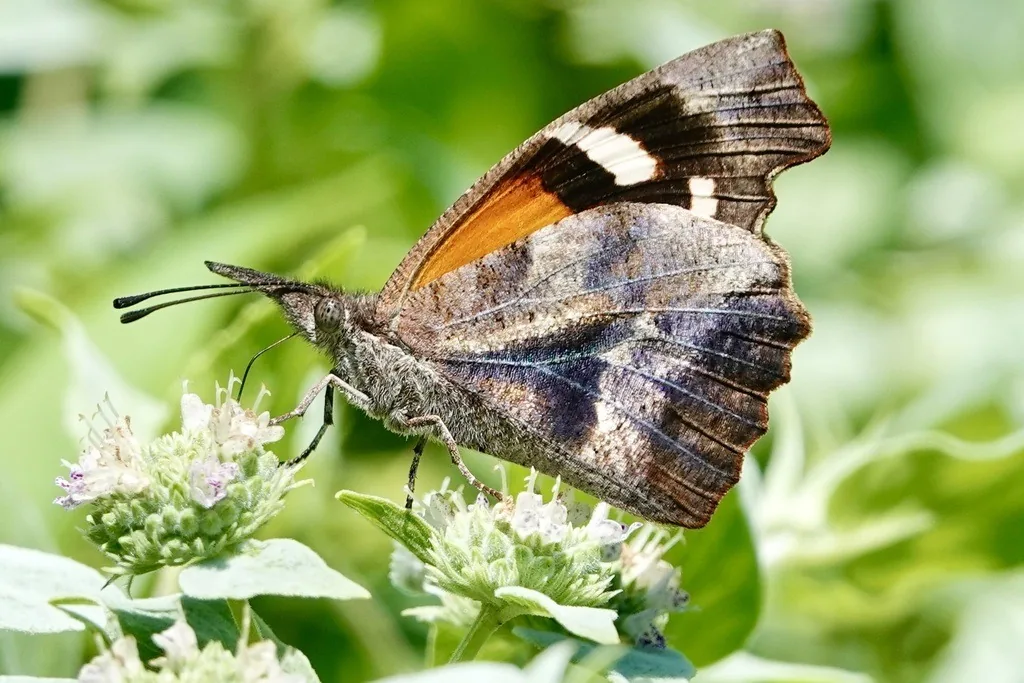
- From above it is orange with wide dark borders and white spots on the outer part of the forewing. The underside of the hindwing is mottled or smooth violet-gray.[1][3]
- At rest on a twig with wings closed it looks like a dead leaf: it holds its palps and antennae downward so they pass for a leaf stem, and only the drab gray edges show.[1][3]
- Caterpillars are green with yellow stripes along the back and sides and many tiny yellow specks; older ones are dark green. The thorax is enlarged, with two black bumps, and unlike most brush-footed butterfly caterpillars they have no spines or horns.[1]
- Males walk on only four legs, because their front pair is reduced.[1]
- Underwing patterns shift with the season. Researchers using field surveys in southern Arizona and crowdsourced photos found three camouflage morphs, one shared by both sexes and one specific to each sex; the sex-specific pair dominated in early fall in the Arizona surveys and in early spring in the photos.[4]
Look-alikes
| Look-alike | How to tell them apart |
|---|---|
| Hackberry emperor caterpillars | Both feed on hackberry, but snout caterpillars lack the spines and horns of most brush-footed butterfly caterpillars; look for a smooth green caterpillar with yellow stripes and a humped thorax.[1] |
Where it lives
BAMONA gives its range as Argentina north through Mexico and the West Indies to the southern United States, with migrants reaching central California, southern Nevada, Colorado and most of the eastern U.S. Migrants arrive in Missouri from the south in May. GBIF's 1990-2026 U.S. records (about 31,000, from 37 states on the map) come mostly from Texas, Arizona and Illinois.[3][1][6]
Biology and life cycle
BAMONA lists two broods, flying in May and June and again in August. Adults spend the winter in the southern part of the range.[3]
Snouts don't fly south in fall. Northern areas such as Missouri are restocked each May by migrants that survived the winter farther south, and numbers build through late summer.[1]
Numbers swing widely from year to year. Some years bring immense migrations; MDC links these booms to an early drought that cuts predator numbers followed by heavy summer rain that makes the host trees grow lush.[1][3]
Females lay eggs in small groups on hackberry leaves, and the caterpillars eat young leaves, usually resting along the leaf midrib.[3][1]
Adults sip nectar from flowers such as aster, dogbane, dogwood, goldenrod and sweet pepperbush, and drink from mud puddles and damp soil near creeks and lakes.[3][1]
Damage and signs
Health risk
It isn't a health pest. MDC and BAMONA describe no bite, sting or other risk, and the caterpillars have no spines.[1][3]
Control
Prevention
No control is needed: BAMONA reports no management needs, and MDC says hackberry feeding is relatively benign.[3][1]
An odd little butterfly group
It is the only snout butterfly in North America. MDC puts the world total at about 8 to 12 species, while a 2013 revision of the group recognizes 15 species in two genera, Libythea and Libytheana, within the brush-footed butterfly family.[1][5]
Common questions
- What butterfly has a long snout?
- The American snout. Its long labial palps stick forward like a nose, and it is the only snout butterfly in North America.[1][3]
- What do snout caterpillars eat?
- Hackberry leaves: hackberry, dwarf hackberry and sugarberry.[1][3]
- Why are there swarms of them some years?
- Populations boom in some years and migrate in huge numbers. MDC ties the booms to early drought followed by heavy summer rain.[1][3]
Sources
- Missouri Department of Conservation, “American Snout (Field Guide).” mdc.mo.gov/discover-nature/field-guide/american-snout (accessed 2026-11-11)
- iNaturalist, “Libytheana carinenta taxon page (order and family).” www.inaturalist.org/taxa/58561 (accessed 2026-11-11)
- Butterflies and Moths of North America (BAMONA), “American Snout, Libytheana carinenta (Cramer, 1777).” www.butterfliesandmoths.org/species/Libytheana-carinenta (accessed 2026-11-11)
- American Naturalist, via PubMed, “Papaj DR, Baek M, Fung C, Richards BA (2024), Seasonal alternation of putative camouflage wing morphs of the American snout butterfly (Libytheana carinenta), American Naturalist 204(3):304-313.” pubmed.ncbi.nlm.nih.gov/39179230/ (accessed 2026-11-11). Cited from the PubMed abstract.
- Zootaxa, via PubMed, “Kawahara AY (2013), Systematic revision and review of the extant and fossil snout butterflies (Lepidoptera: Nymphalidae: Libytheinae), Zootaxa 3631:1-74.” pubmed.ncbi.nlm.nih.gov/25325094/ (accessed 2026-11-11). Cited from the PubMed abstract.
- Global Biodiversity Information Facility (GBIF), “Libytheana carinenta (American snout): occurrence records in the U.S., 1990-2026 (GBIF occurrence search).” api.gbif.org/v1/occurrence/search?taxonKey=1898402&country=US&hasGeospatialIssue=false&occurrenceStatus=PRESENT&year=1990%2C2026&facet=stateProvince&facetLimit=400&limit=0 (accessed 2026-11-11). State counts are records reported (iNaturalist research-grade, museum specimens, surveys), not abundance.