On this page
How to identify it
- Wingspan is 1½ to 2½ inches according to the Missouri Department of Conservation, and 1 5/8 to 2 3/4 inches (4.2 to 7 cm) according to Butterflies and Moths of North America. Its appearance varies from region to region. UF/IFAS gives 2 to 2 5/8 inches (5 to 6.7 cm), says females are much larger than males, and notes that males have concave outer wing margins.[1][2][5]
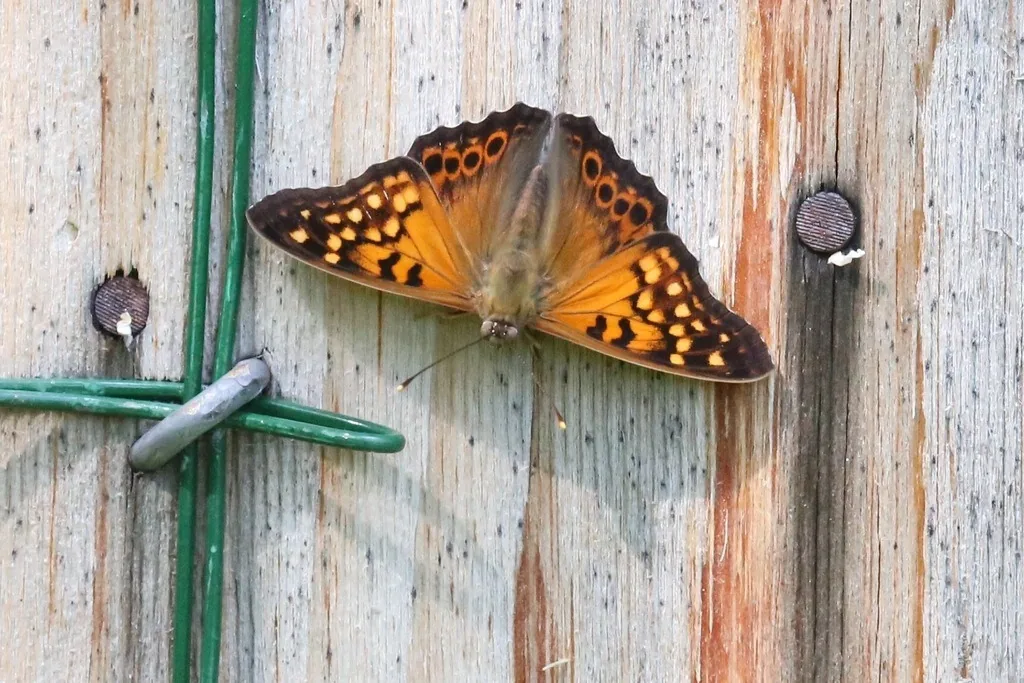
- The upperside is chestnut brown to rusty. The forewing cell has two dark, unbroken bars, the forewing tips are not dark with white spots, and there is no distinct black eyespot on the forewing.[1][2]
- The hindwing upperside is orange with black spots near the edge in one form and all black in the other. From below, the hindwing has smudged, iridescent eyespots.[2][1]
- Caterpillars are green with yellow-green and white stripes and a forked tail end. The head is ringed with small finger-like projections, and two larger ones on top fork like tiny deer antlers. UF/IFAS says full-grown caterpillars reach about 1.5 inches (3.8 cm), with a dark blue-green line down the back, a pair of short tails and short black-tipped horns on a shield-like head.[1][5]
- Eggs are white and darken before hatching. Pupae are green with small yellow spots, yellow lines and two horns at the front, and hang from a silk pad.[5]
Look-alikes
| Look-alike | How to tell them apart |
|---|---|
| Hackberry emperor | The hackberry emperor is a more neutral tan. Its forewing cell has one unbroken dark bar with the inner bar broken into two offset spots, its forewing tips are dark with white spots, it has a distinct black spot on the forewing, and its gray-brown hindwing underside has distinct eyespots. UF/IFAS adds that the hackberry emperor's forewing spots are pure white where the tawny emperor's are pale yellow, and that the pupae of the two species are virtually identical except for thin lines that are yellow in the tawny emperor and white in the hackberry emperor.[1][5] |
Where it lives
Butterflies and Moths of North America gives its range as North Dakota south to Texas and east to New England through most of the Southeast, with isolated populations in Florida, southwest New Mexico and southeastern Arizona. In Missouri it is found statewide, wherever hackberries grow. UF/IFAS describes it as particularly common in riparian forests but also found in dry woods and suburbs, often alongside the usually more abundant hackberry emperor.[2][1][5]
Biology and life cycle
Adults fly from June into October in Missouri, where it has two broods. Butterflies and Moths of North America gives one brood in the north (June to August) and two in the south (March to November).[1][2]
Males perch in sunny spots to watch for females. Females lay groups of 200 to 500 eggs on mature leaves (or on bark), and the young caterpillars feed together in large groups, thrashing as a group when disturbed.[1][2]
Caterpillars spend the winter on the tree in groups of about 10 inside a rolled, dead leaf tied with silk. UF/IFAS says the overwintering caterpillars are brown third instars, and the leaf stems of the shelter are tied to the twig with silk so it stays on the tree all winter. In spring they feed on the new leaves, turn green again and for a while keep returning to the shelter.[1][2][5]
Adults feed on tree sap, rotting fruit, dung and carrion and almost never visit flowers.[2][1]
Young caterpillars feed together through the third stage, moving as a group along silk trails and often passing many leaves before settling. UF/IFAS says this may help them avoid predators and parasitoids that find caterpillars by chewed leaves or droppings. When threatened they swing their spiny heads and try to bite. Older caterpillars live alone in leaf shelters.[5]
Tawny emperor caterpillars often feed on older leaves while hackberry emperor caterpillars prefer new growth, which may reduce competition between the two.[5]
Damage and signs
- Caterpillars eat the leaves of hackberry trees: common hackberry, sugarberry and dwarf hackberry, plus other Celtis species such as C. lindheimeri and C. reticulata. UF/IFAS says caterpillars are rarely numerous enough to seriously affect host trees, though outbreaks have been recorded, and parasitoids and general predators help regulate their numbers.[1][2][5]
Health risk
None known. Adults land on people because they are attracted to the sodium in sweat.[1]
Control
Prevention
No control is called for. Butterflies and Moths of North America reports no management needs and ranks the species as globally secure. UF/IFAS says control measures are neither required nor recommended.[2][5]
A recent change in its classification
A 2026 genomic study of butterflies across central Texas found that some populations treated as subspecies differ as much as separate species. It now treats Asterocampa louisa, earlier listed as a subspecies of the tawny emperor, as its own species, and it describes a new tawny emperor subspecies, A. clyton plana, from Denton County, Texas.[3]
Where the sources disagree
Wingspan: Missouri gives 1½ to 2½ inches, Butterflies and Moths of North America 1 5/8 to 2 3/4 inches, and UF/IFAS 2 to 2 5/8 inches (5 to 6.7 cm).[1][2][5]
Broods: Butterflies and Moths of North America gives one in the north and two in the south; UF/IFAS gives one in the northern U.S. but three in Florida and southern Louisiana.[2][5]
Florida: Butterflies and Moths of North America lists isolated populations in Florida; UF/IFAS says it is common in northern and central Florida near its host plants and more local in southern Florida.[2][5]
Common questions
- Why does this butterfly keep landing on me?
- Tawny and hackberry emperors are attracted to the sodium in human sweat, so they often land on people.[1]
- How do I tell it from the hackberry emperor?
- The tawny emperor is more rust-colored, has two unbroken bars in the forewing cell and has no black forewing eyespot or white-spotted wing tips.[1][2]
- Does it hurt hackberry trees?
- Its caterpillars eat hackberry leaves, but neither the Missouri Department of Conservation nor Butterflies and Moths of North America treats it as a pest, and BAMONA lists no management needs.[1][2]
- Will the caterpillars strip my hackberry tree?
- Unlikely. UF/IFAS says they are rarely numerous enough to seriously affect host trees, natural enemies help keep them in check, and control is neither required nor recommended.[5]
Sources
- Missouri Department of Conservation, “Tawny Emperor (Field Guide).” mdc.mo.gov/discover-nature/field-guide/tawny-emperor (accessed 2026-11-11)
- Butterflies and Moths of North America (BAMONA), “Tawny Emperor, Asterocampa clyton (species account).” www.butterfliesandmoths.org/species/Asterocampa-clyton (accessed 2026-11-11)
- Taxonomic Report of the International Lepidoptera Survey, via PubMed, “Three butterfly genera across the Central Texas Suture Zone (Cong, Zhang, Shen, Song and Grishin 2026).” pubmed.ncbi.nlm.nih.gov/41938823/ (accessed 2026-11-11)
- iNaturalist, “Asterocampa clyton taxon page (order and family).” www.inaturalist.org/taxa/58587 (accessed 2026-10-06)
- University of Florida IFAS Extension, EDIS (Featured Creatures), “Tawny Emperor Butterfly, Asterocampa clyton (Boisduval & LeConte), EENY-528/IN933 (Featured Creatures).” ask.ifas.ufl.edu/publication/IN933 (accessed 2026-11-14)