On this page
How to identify it
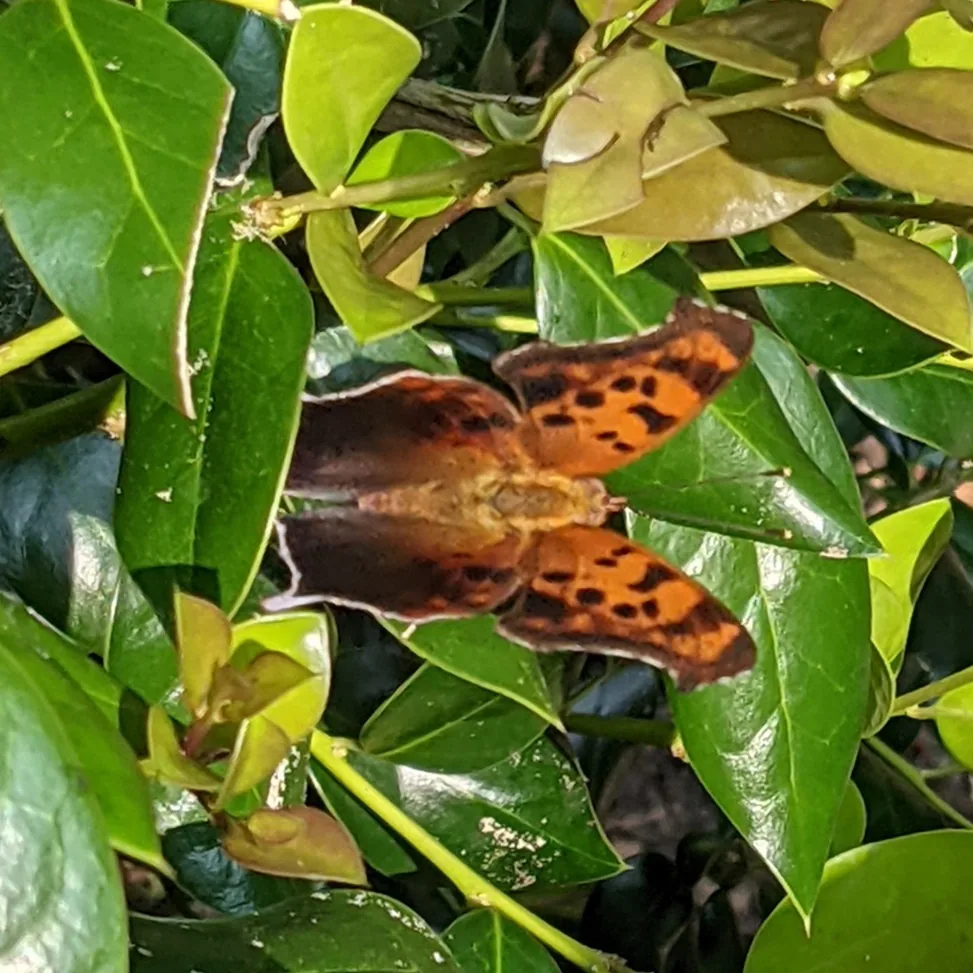
- The upper side is orange with black spots; the wings have ragged edges and usually white margins. A short tail projects from each hindwing.[1][2][3]
- Folded, the brown undersides look like a dead leaf. The silver mark under the hindwing is a curved line with a dot beside it.[2][1][4]
- There are two seasonal forms. The summer form has an almost all-dark upper hindwing; the overwintering fall form has more orange, brighter markings and longer, violet-tipped tails. Because the wing margins can look purplish, it is also called violet tip.[1][4][3]
- Caterpillars grow to about 1 1/2 inches. They are dark to yellowish or reddish brown with pale lines and speckles, and every segment carries spiny bumps; the head is reddish brown with short spines.[2][1][3]
Look-alikes
| Look-alike | How to tell them apart |
|---|---|
| Eastern comma | Of Missouri's three anglewings, the question mark is the only one with a dot next to the silver curve under the hindwing. From above it also has a dark dash over the black forewing spot closest to the tip, which the commas lack.[1] |
Where it lives
Southern Canada and all of the eastern United States except peninsular Florida, west to the eastern edge of the Rocky Mountains and south to southern Arizona and Mexico. Statewide in Missouri and Illinois, in forests, roadsides, parks, fencerows and residential areas.[4][1][3]
Biology and life cycle
Females lay green, ridged eggs singly or stacked up to four high, usually under leaves of plants that aren't hosts, and the newly hatched caterpillars have to find a host plant.[2][4]
Overwintered adults fly and lay eggs in spring; the summer form flies from about May to September and lays the eggs that become the fall form, which spends the winter as an adult. Overwintering adults may fly on any warm winter day, and some migrate south.[4][1][3]
Adults feed on tree sap, rotting fruit, dung, carrion and moisture from damp soil.[1][4][2]
Males perch on tree trunks or leaves in the late afternoon and fly out at passing butterflies, other insects and even birds.[1][4]
Damage and signs
Health risk
NC State calls the spiny caterpillars harmless, and none of the sources reports harm to people or pets.[2][1]
Control
Prevention
Usually none needed. Butterflies and Moths of North America reports no management needs.[4]
Pesticides
If caterpillars ever show up in alarming numbers on a landscape plant, NC State says insecticides labeled for residential landscapes should control them, while noting it is a pollinator.[2]
Where sources disagree
Size: the Missouri Department of Conservation and NC State give a wingspan of 2 to 2 1/2 inches; the Illinois DNR and Butterflies and Moths of North America give 2 1/4 to 3 inches.[1][2][3][4]
Flowers: Missouri says adults rarely visit flowers and Butterflies and Moths of North America says they do so only when sap, fruit and dung aren't available; NC State lists flower nectar alongside those foods.[1][4][2]
Common questions
Sources
- Missouri Department of Conservation, “Question Mark (Field Guide).” mdc.mo.gov/discover-nature/field-guide/question-mark (accessed 2026-11-11)
- NC State Extension, “Question Mark Butterfly (PDIC Factsheet).” content.ces.ncsu.edu/publication/question-mark-butterfly (accessed 2026-11-11)
- Illinois Department of Natural Resources, “Question mark (Wild About Butterflies).” dnr.illinois.gov/education/wildaboutpages/wildaboutinvertebrates/wildaboutbutterflies/family-nymphalidae/wambquestionmark.html (accessed 2026-11-11)
- Butterflies and Moths of North America (BAMONA), “Question Mark, Polygonia interrogationis (species account).” www.butterfliesandmoths.org/species/Polygonia-interrogationis (accessed 2026-11-11)
- iNaturalist, “Polygonia interrogationis taxon page (order and family).” www.inaturalist.org/taxa/58579 (accessed 2026-11-11)