On this page
How to identify it
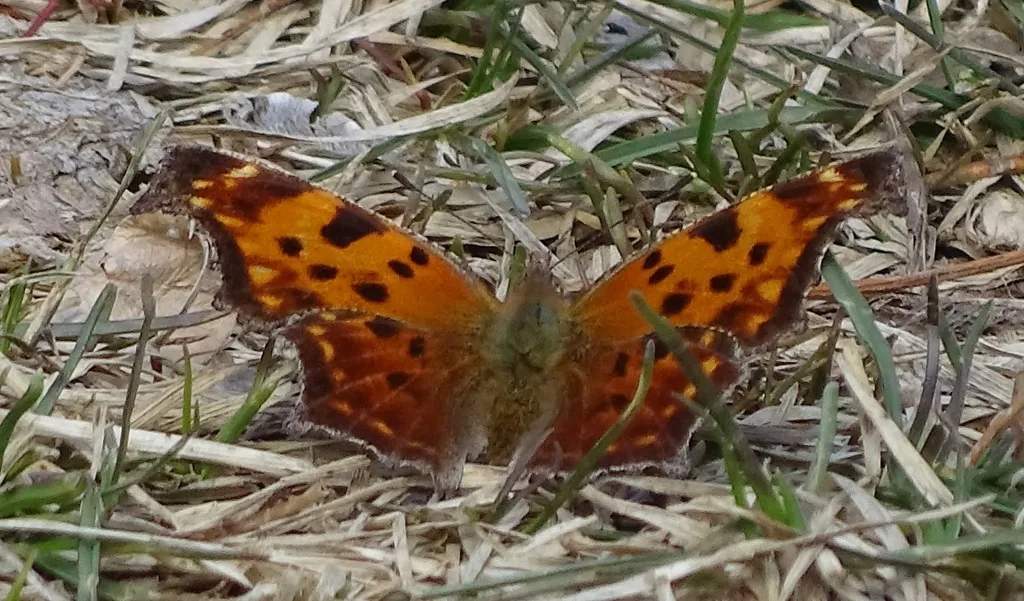
- Wingspan is 1 1/2 to 2 1/4 inches by Missouri's field guide, or 1 3/4 to 2 1/2 inches by Butterflies and Moths of North America. The hindwing has a ragged edge and a short projection.[1][3]
- The underside is mottled brown. The comma mark on the underside of the hindwing is white or silver, with wide, swollen ends and no separate dot beside it.[1][3]
- It has two seasonal forms: in the summer form the upper hindwing is mostly black, while the fall (winter) form is orange with black spots and more richly colored.[1][3]
- Caterpillars are whitish to greenish-brown with darker markings and several rows of pale, branching spines; the head carries one pair of spines.[1]
Look-alikes
| Look-alike | How to tell them apart |
|---|---|
| Question mark | Very similar on top, but it has a hyphen-like black line over the three black forewing spots, and its silver mark underneath has an extra dot that turns the comma into a question mark.[1] |
| Gray comma | Slightly smaller, heavily streaked underneath, with an L-shaped comma that narrows to a point at each end and no central dark smudge on the upper hindwing. Its caterpillars feed on wild gooseberry and relatives.[1] |
Where it lives
Butterflies and Moths of North America gives its range as the eastern half of the United States east of the Rocky Mountains, from southern Canada to central Texas and the Gulf Coast; Missouri's field guide finds it statewide. GBIF's 1990-2026 U.S. records come mostly from Ohio, Illinois, Vermont, Pennsylvania, Virginia and Maryland.[3][1][4]
Biology and life cycle
Overwintered adults fly and lay eggs in spring through the end of April. The summer form then flies from May to September, and its eggs produce the winter form, which appears in September or October and soon looks for shelter to hibernate; some first migrate south.[3][1]
Females lay eggs singly under host leaves or stems, but often stack them, up to nine eggs one on top of another.[1][3]
Caterpillars usually live alone and feed at night. Older ones make daytime shelters by pulling leaf edges together with silk.[1][3]
Adults feed mostly on tree sap and rotting fruit, only occasionally on flowers, and they also visit mud puddles, carrion and animal droppings.[1][3]
Males perch on leaves or tree trunks to wait for females and dart out at passing insects, even birds. Look for it in deciduous woods, woods along rivers, marshes and swamps, and brushy roadsides.[1][3]
Damage and signs
Health risk
Neither Missouri's field guide nor Butterflies and Moths of North America describes any risk to people or pets; adults feed on sap and rotting fruit.[1][3]
Control
Prevention
None needed. Missouri lists it as a breeding resident in every region of the state, and Butterflies and Moths of North America ranks it globally secure.[1][3]
Common questions
- What butterfly flies in winter?
- The eastern comma is one: adults hibernate through winter and are occasionally active on warm, sunny days.[1][3]
- Why is it called a comma?
- For the small white or silver comma-shaped mark under the hindwing.[1][3]
- What is a hop merchant?
- Another common name for the eastern comma; hops are one of its caterpillar food plants.[1][3]
Sources
- Missouri Department of Conservation, “Eastern Comma (Field Guide).” mdc.mo.gov/discover-nature/field-guide/eastern-comma (accessed 2026-11-11)
- iNaturalist, “Polygonia comma taxon page (order and family).” www.inaturalist.org/taxa/54064 (accessed 2026-11-11)
- Butterflies and Moths of North America (BAMONA), “Eastern Comma, Polygonia comma (Harris, 1842).” www.butterfliesandmoths.org/species/Polygonia-comma (accessed 2026-11-11)
- Global Biodiversity Information Facility (GBIF), “Polygonia comma (eastern comma): occurrence records in the U.S., 1990-2026 (GBIF occurrence search).” api.gbif.org/v1/occurrence/search?taxonKey=5129430&country=US&hasGeospatialIssue=false&occurrenceStatus=PRESENT&year=1990%2C2026&facet=stateProvince&facetLimit=400&limit=0 (accessed 2026-11-11). State counts are records reported (iNaturalist research-grade, museum specimens, surveys), not abundance; a few state names appear twice with different capitalization and were combined.