On this page
How to identify it
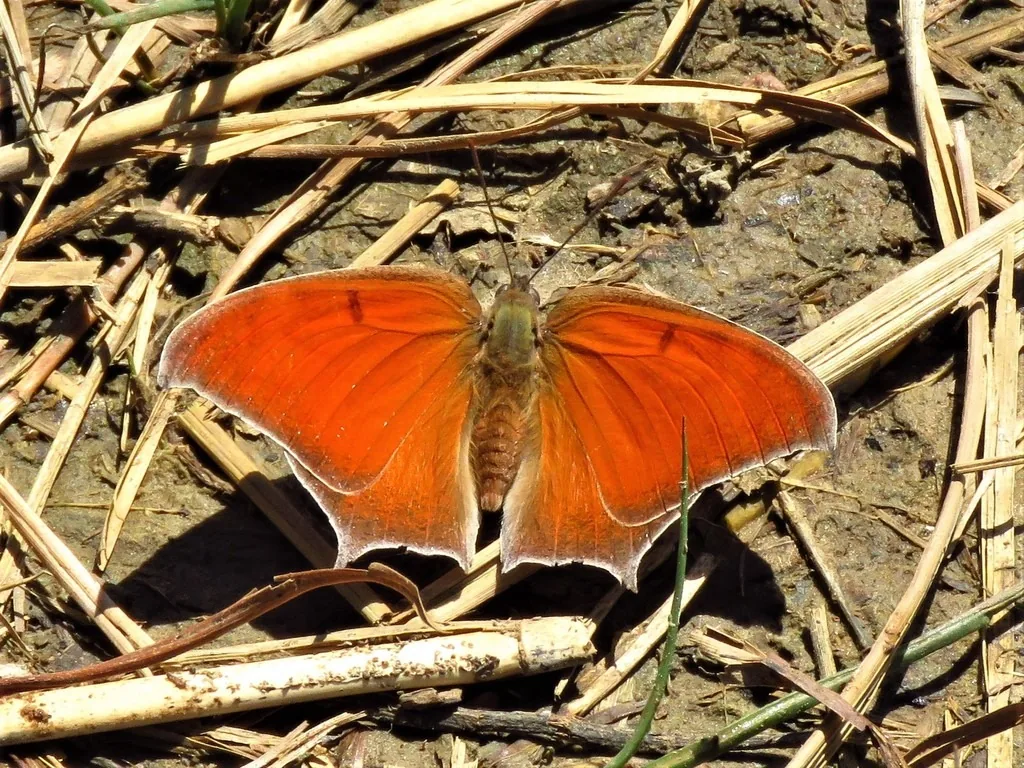
- The upper side is orange and the underside plain brown. Males have a dark margin; females are lighter, with a wide yellow-orange band just inside the outer edge. Wingspan is 1 3/4 to 2 1/2 inches by Missouri's field guide, or 2 3/8 to 3 1/4 inches by Butterflies and Moths of North America.[1][2]
- The wing edges are smooth, not scalloped. The winter form is more boldly marked, with more pointed, hooked forewing tips and longer tails than the summer form.[1][2]
- Caterpillars are grayish green with small raised dots, and the head is grayish green with small bumps.[1]
Look-alikes
| Look-alike | How to tell them apart |
|---|---|
| Commas and question mark | Anglewing butterflies with ragged, scalloped wing edges and patterned undersides.[1] |
Where it lives
Butterflies and Moths of North America gives the range as eastern Wyoming and eastern Colorado south to New Mexico, Arizona and Texas, and east to Michigan, South Carolina, Virginia and the Gulf states. In Missouri it is statewide but seen most in the Ozarks. GBIF has about 8,200 U.S. records from 1990 to 2026, from 25 states, by far the most from Texas, followed by Oklahoma, Arkansas and Missouri.[2][1][3]
Biology and life cycle
The day length nearly full-grown caterpillars experience decides whether they become summer- or winter-form adults, and whether females mate soon after emerging or wait until spring.[1]
Missouri's field guide says the summer form flies from late June into August and the winter form emerges at the end of August and lives until May or June. Butterflies and Moths of North America gives July to August for the summer form and August to May for the winter form.[1][2]
Winter-form adults hibernate and are sometimes seen flying on warm, sunny days in midwinter. In a laboratory study, winter-form adults kept cool and calm lived 40 times longer than summer-form adults.[1][4]
Adults have short tongues and don't visit flowers; they feed at tree sap, rotting fruit, dung and damp places. Their flight is fast, strong and erratic.[1][2]
Males perch near clearings or on ridgetops to wait for females, and females lay eggs one at a time under host plant leaves.[1][2]
Young caterpillars eat all but the midrib of a leaf and rest on its tip. Older ones fold a leaf over themselves and later roll it into a tube, plugging the opening with their tough heads.[1][2]
Damage and signs
Health risk
It is a butterfly whose caterpillars feed on Croton plants. Missouri's field guide and Butterflies and Moths of North America describe it only as a native butterfly and don't mention any risk to people or pets.[1][2]
Control
Prevention
Missouri's field guide lists it as a breeding resident, and Butterflies and Moths of North America says it is not usually of conservation concern. Its caterpillars feed on goatweed, Texas croton, prairie tea and other Croton plants, and the adults feed at tree sap, rotting fruit and dung rather than flowers.[1][2]
Where the sources disagree
Wingspan: Missouri's field guide gives 1 3/4 to 2 1/2 inches; Butterflies and Moths of North America gives 2 3/8 to 3 1/4 inches.[1][2]
Flight periods: Missouri says the summer form flies from late June into August and the winter form from the end of August to May or June; Butterflies and Moths of North America gives July to August and August to May.[1][2]
Where males wait for females: Missouri says on vegetation near open places; Butterflies and Moths of North America says in clearings or on ridgetops.[1][2]
Adult food: both list sap, rotting fruit and dung; Butterflies and Moths of North America adds bird droppings.[1][2]
Common questions
Sources
- Missouri Department of Conservation, “Goatweed Leafwing (Field Guide).” mdc.mo.gov/discover-nature/field-guide/goatweed-leafwing (accessed 2026-11-13)
- Butterflies and Moths of North America (BAMONA), “Goatweed Leafwing, Anaea andria Scudder, 1875.” www.butterfliesandmoths.org/species/Anaea-andria (accessed 2026-11-13)
- Global Biodiversity Information Facility (GBIF), “Anaea andria (goatweed leafwing): occurrence records in the U.S., 1990-2026 (GBIF occurrence search).” api.gbif.org/v1/occurrence/search?taxonKey=1907235&country=US&hasGeospatialIssue=false&occurrenceStatus=PRESENT&year=1990%2C2026&facet=stateProvince&facetLimit=400&limit=0 (accessed 2026-11-13). State counts are records reported (iNaturalist research-grade, museum specimens, surveys), not abundance; a few state names appear twice with different capitalization and were combined.
- Journal of Insect Physiology, via PubMed, “McElderry RM (2016), Seasonal life history trade-offs in two leafwing butterflies: delaying reproductive development increases life expectancy, Journal of Insect Physiology 87:30-34.” pubmed.ncbi.nlm.nih.gov/26868721/ (accessed 2026-11-13). Cited from the PubMed abstract.
- Global Biodiversity Information Facility (GBIF), “Anaea andria Scudder, 1875 (GBIF Backbone Taxonomy).” api.gbif.org/v1/species/1907235 (accessed 2026-11-13)
- iNaturalist, “Anaea andria taxon page (order and family).” www.inaturalist.org/taxa/81561 (accessed 2026-11-11)