On this page
How to identify it
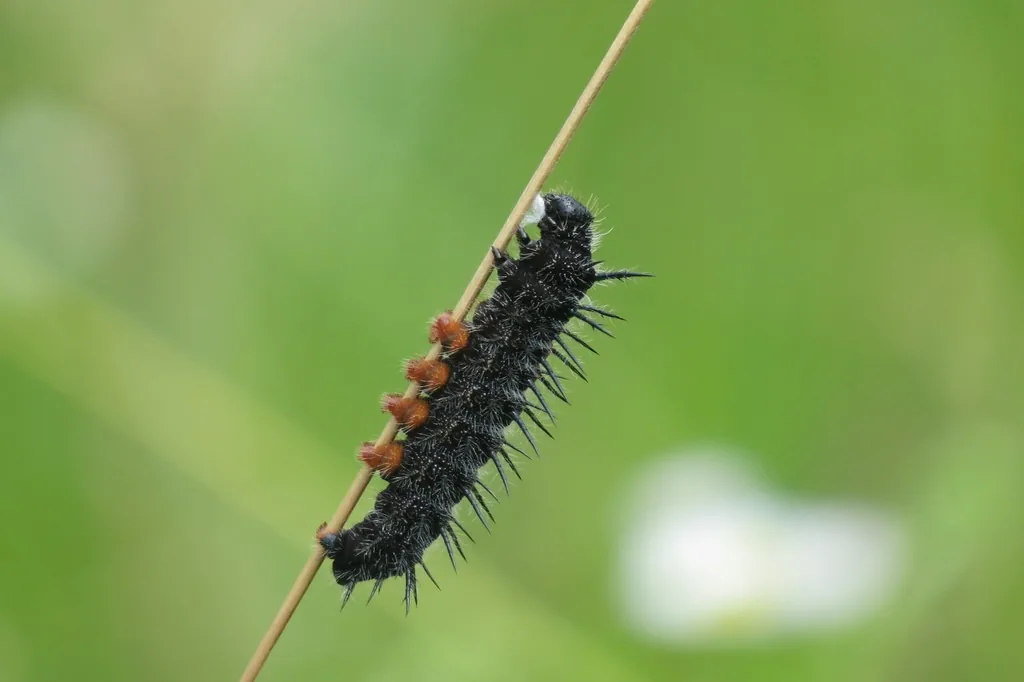
- Caterpillars are purplish black with tiny white specks and a row of orange to red spots along the back, and approach 2 inches long when grown. UF/IFAS gives full-grown larvae as about 2.0 inches, with a black head bearing white hairs and a reddish orange patch on most segments.[1][2][3]
- They are covered in long, forked black spines. The PNW handbook describes brownish prolegs, while the Missouri Department of Conservation calls the legs dark red.[1][2]
- The butterfly is purplish brown to purple-black above with a wide creamy yellow border and a row of blue spots just inside it. The wing edges are irregular, with short projections, and the undersides are dark and finely lined with a pale border. UF/IFAS says that at rest with its wings closed the butterfly is highly cryptic, the underside resembling charred wood.[1][2][4][3]
- Eggs are laid in rings around twigs, in groups of up to 200 or more.[2][4]
- The chrysalis is gray, about 0.8 inch long, with two rows of red-tipped points, and hangs straight down from a small silk pad. Eggs are whitish and darken before hatching.[3]
Where it lives
Butterflies and Moths of North America gives its range as all of North America south of the tundra to central Mexico, rarely in the Gulf States and peninsular Florida, and temperate Eurasia; in Britain it is called the Camberwell beauty. The PNW handbook covers it on landscape willows in the Pacific Northwest, and it occurs statewide in Missouri. UF/IFAS gives Alaska south to Venezuela and throughout Eurasia. It is probably not a permanent resident of Florida, where most adults are thought to be winter migrants; the first documented caterpillars there were about 50 mature larvae on a sugarberry tree in Alachua County in March 2011.[4][2][1][3]
Biology and life cycle
Adults overwinter under loose bark and in other sheltered spots, may fly on warm winter days, and are out on warm spring days around budbreak. They can shiver to warm their flight muscles. UF/IFAS calls it one of the most widely distributed butterflies and says that in northern areas adults may be seen basking on warm days in almost every month of winter.[1][2][3]
Overwintered adults mate in spring. Caterpillars live and feed together, often in a communal web, then each pupates in a chrysalis hanging from a leaf.[4][2][1]
New adults emerge in June or July, feed briefly, rest through the summer, and feed again in fall before hibernating. Adults live 10 to 11 months, long for a butterfly, and feed mostly on tree sap and rotting fruit rather than flowers. UF/IFAS adds that adults also visit mud and occasionally flower nectar, and calls the summer rest aestivation, a summer dormancy.[4][2][3]
The overwintering adults are unmated. UF/IFAS says males perch, defend territories and fly out to meet females, and adults may play dead if a predator attacks. Larvae stay together all their lives and twitch in unison when threatened, likely to deter predators.[3]
Damage and signs
- Groups eat every leaf on a branch before moving on, leaving ragged, chewed leaves.[1]
- Hosts include willows, elms, poplars and cottonwood, aspen, hackberry and birch. Older caterpillars wander and may turn up on plants they don't eat. UF/IFAS says willows, including weeping willow, and poplars are preferred, with elms and hackberries also used; where it is common in the North it can seriously defoliate willows and elms, and less often poplars, birches, hackberries and lindens.[1][2][4][3]
Health risk
It feeds on plants; none of these sources reports a risk to people or pets.[1][2]
Control
Prevention
Control is seldom needed. Butterflies and Moths of North America says it is only occasionally necessary to protect shade trees. Where treatment is warranted, UF/IFAS says the caterpillars are readily controlled with Bacillus thuringiensis (Bt) insecticides.[4][1][3]
Traps and physical control
Hand-pick larvae or remove heavily infested branches.[1]
Biological control
Several parasitic wasps attack the larvae, and birds chase and eat the adults; ants, beetles, spiders and other predators feed on every life stage. UF/IFAS lists at least 17 tachinid fly parasitoids and at least eight parasitic wasps recorded from its caterpillars.[1][2][3]
Where sources disagree
Generations: the PNW handbook says a second generation, when there is one, emerges in August; the Missouri Department of Conservation says a female may have two broods in Missouri; and Butterflies and Moths of North America gives usually one flight, in June and July. UF/IFAS says there is a single generation a year in most areas and possibly a second farther south.[1][2][4][3]
Wingspan: the PNW handbook gives about 2.5 inches, the Missouri Department of Conservation 2½ to 3½ inches, and Butterflies and Moths of North America 2 1/4 to 4 inches. UF/IFAS gives about 3.0 inches.[1][2][4][3]
Common questions
- What are the spiny black caterpillars with red spots on my willow?
- Probably spiny elm caterpillars, the larvae of the mourning cloak butterfly, which feed in groups on willow, elm and poplar.[1][2]
- Are spiny elm caterpillars serious pests?
- Usually not, though groups can strip whole branches. Hand-pick them or prune off the infested branch.[1]
- Why do I see this butterfly so early in spring?
- Mourning cloaks spend the winter as adults in sheltered spots, so they are flying on the first warm days, sometimes even in winter.[2][1]
- Do mourning cloaks live in Florida?
- Only rarely. UF/IFAS says most found there are thought to be winter migrants from farther north, though it may occasionally breed in northern Florida; the first documented caterpillars were found in Alachua County in 2011.[3]
Sources
- Pacific Northwest Pest Management Handbooks (OSU, WSU, University of Idaho), “Willow (Salix): Spiny elm caterpillar (mourning cloak butterfly) (Insect Management Handbook).” pnwhandbooks.org/insect/hort/landscape/hosts-pests-landscape-plants/willow-salix-spiny-elm-caterpillar-mourning-cloak-butterfly (accessed 2026-11-11)
- Missouri Department of Conservation, “Mourning Cloak (Field Guide).” mdc.mo.gov/discover-nature/field-guide/mourning-cloak (accessed 2026-11-11)
- University of Florida IFAS Extension (EDIS), “Mourning Cloak, Nymphalis antiopa (Linnaeus), EENY 451/IN821 (D. W. Hall and J. F. Butler; Featured Creatures).” ask.ifas.ufl.edu/publication/IN821 (accessed 2026-11-14)
- Butterflies and Moths of North America, “Mourning Cloak, Nymphalis antiopa (species account).” www.butterfliesandmoths.org/species/Nymphalis-antiopa (accessed 2026-11-11)
- iNaturalist, “Nymphalis antiopa taxon page (order and family).” www.inaturalist.org/taxa/56832 (accessed 2026-10-06)