On this page
How to identify it
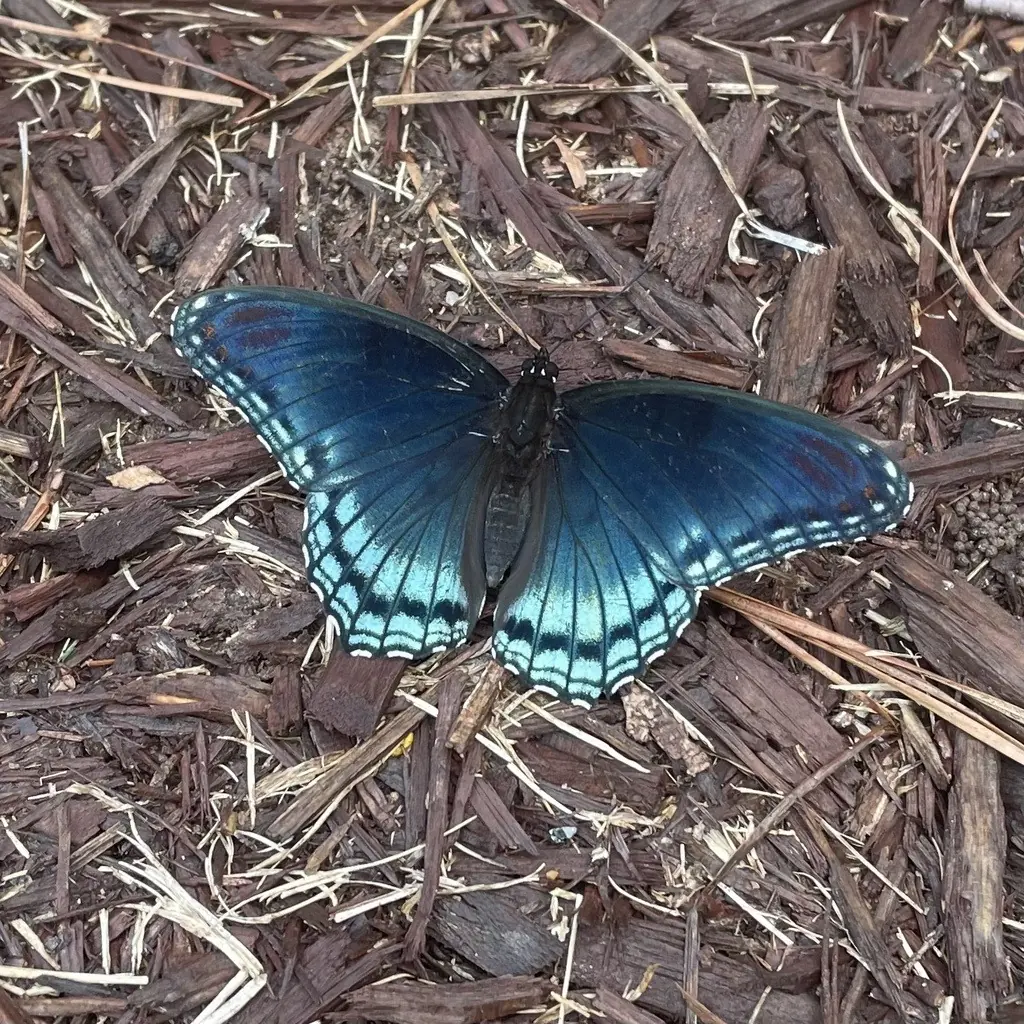
- Wingspan is 2¼ to 3½ inches. The wings are black with blue on top, more blue than the violet the name suggests, and black lines near the hindwing edge.[1]
- From below, there are red-orange spots near the body; the Missouri Department of Conservation notes the spots are really orange rather than red.[1]
- Full-grown caterpillars are about 1.5 inches long, mottled white, green, yellow-brown and brown like a bird dropping, humped at the thorax with a pair of large, barbed brown horns.[2][1]
Look-alikes
| Look-alike | How to tell them apart |
|---|---|
| Pipevine swallowtail | The red-spotted purple is thought to mimic this bad-tasting butterfly. It has no swallowtail tails, and no swallowtail has red-orange spots near the body on the underside.[1] |
| White admiral | The same species in the North: like the red-spotted purple but with a broad white band across all the wings. The forms interbreed where they meet.[1] |
Where it lives
Found statewide in Missouri as a common breeding resident. The white-banded form of the same species, the white admiral, is found in Canada, Alaska, New England and the Great Lakes region, and a long-term butterfly count study found the switch between the two forms happens over a narrow band at the edge of the pipevine swallowtail's range.[1][3]
Biology and life cycle
There are two generations a year, and caterpillars are present from early summer to fall. Adults fly from May into October in Missouri.[2][1]
Partly grown caterpillars spend the winter in a rolled leaf spun into a tube and tied to the twig with silk. During this time their body water drops from 80% to 55%, which helps prevent freezing damage.[1]
Adults visit flowers but prefer to take moisture and nutrients from puddles, damp ground, rotting fruit and animal droppings. They often sit on trees and shrubs, slowly opening and closing their wings.[1]
Damage and signs
Health risk
None reported. Neither MU Extension nor the Missouri Department of Conservation lists any harm to people or pets.[2][1]
Control
Prevention
No control is needed. The Missouri Department of Conservation calls it a common resident and a stunning sight.[1]
How the mimicry works
Pipevine swallowtail caterpillars eat pipevines and store bitter, toxic chemicals, so birds learn to avoid large black-and-blue butterflies. The red-spotted purple gains protection by looking like them.[1]
Using 29 years of July 4th Butterfly Count data, a 2008 study found that the advantage of mimicry does not extend beyond the pipevine swallowtail's range, yet the mimic form persists even where the model is rare.[3]
A 2025 experiment with butterfly replicas found the red-spotted purple, an imperfect mimic, was protected only when the pipevine swallowtail was present at the same time, not when the model had appeared earlier.[4]
Common questions
- What is the black butterfly with blue wings in my yard?
- Possibly a red-spotted purple, especially near woods or in a shady yard. Check for the missing tails and the orange spots near the body underneath, which rule out a pipevine swallowtail.[1]
- Why does the caterpillar look like bird poop?
- Its mottled pattern resembles a bird dropping, which makes it unappealing to predators.[2][1]
- Is it a pest?
- No. The caterpillars eat some tree leaves, but neither MU Extension nor the Missouri Department of Conservation treats it as a pest.[2][1]
Sources
- Missouri Department of Conservation, “Red-Spotted Purple (Field Guide).” mdc.mo.gov/discover-nature/field-guide/red-spotted-purple (accessed 2026-11-11)
- University of Missouri Extension (Caterpillars in Your Yard and Garden, IPM1019), “Caterpillars in Your Yard and Garden, page 36: Red-spotted purple.” extension.missouri.edu/publications/ipm1019-36 (accessed 2026-11-11)
- Evolution, via PubMed, “A rare model limits the distribution of its more common mimic: a twist on frequency-dependent Batesian mimicry (Ries and Mullen 2008).” pubmed.ncbi.nlm.nih.gov/18410533/ (accessed 2026-11-11)
- Proceedings of the Royal Society B, via PubMed, “Is temporal synchrony necessary for effective Batesian mimicry? (Robinson et al. 2025).” pubmed.ncbi.nlm.nih.gov/39837508/ (accessed 2026-11-11)
- iNaturalist, “Limenitis arthemis taxon page (order and family).” www.inaturalist.org/taxa/60607 (accessed 2026-10-06)