On this page
How to identify it
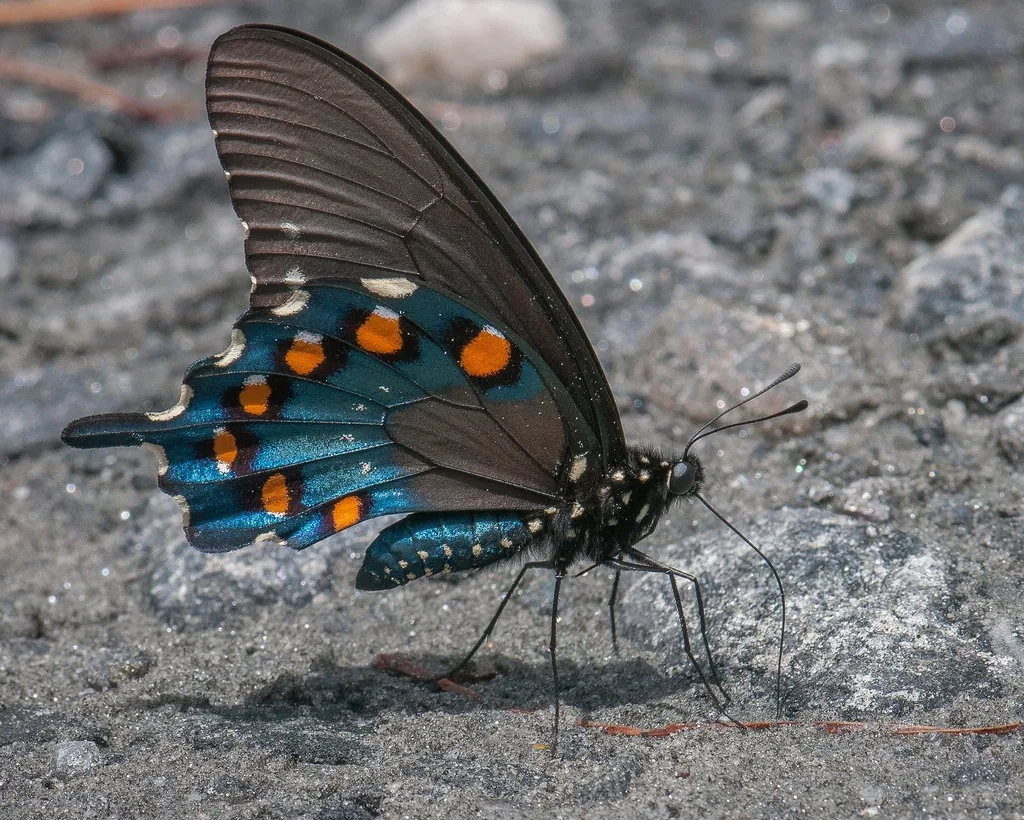
- Adults span about 2 3/4 to 5 inches (7 to 13 cm). The hind wings are iridescent blue or blue-green above and carry tails; underneath, the hind wing has a row of seven round orange spots on an iridescent blue field.[3][1][4]
- Males are a brighter metallic blue on the upper hind wing than females.[4]
- Caterpillars have long, fleshy filaments and rows of spots. Mississippi State describes them as purple with orange spots; Animal Diversity Web describes black larvae with red projections and spots and says warmer temperatures shift their color from black toward red.[1][4]
- Eggs are red-orange and round, laid in clusters on or under pipevine leaves.[4][3]
Look-alikes
| Look-alike | How to tell them apart |
|---|---|
| Mimics (black swallowtail, spicebush swallowtail, red-spotted purple) | These palatable butterflies look so much like the pipevine swallowtail that most birds can't tell them apart. Check the hind-wing underside: the pipevine has a single row of seven round orange spots on iridescent blue. Studies of the red-spotted purple found its mimicry pays off only within the pipevine's range and, in an experiment with butterfly replicas, only when model and mimic were out at the same time.[1][3][5][6] |
Where it lives
The pipevine swallowtail lives mostly in the southern half of the United States, occasionally farther north, and south to southern Mexico, with rare strays into southern Manitoba. GBIF has 1990-2026 U.S. records from more than 40 states, the most from Texas, California, Arizona, North Carolina and Tennessee. Michigan, at the northern edge of its range, lists it as a species of special concern.[4][3][7]
Biology and life cycle
Caterpillars take up toxins from pipevine and keep them as adults. Birds that try to eat a pipevine swallowtail are reluctant to try another, and other butterflies gain protection by looking like it.[1][4][5]
Young caterpillars feed in small groups and become solitary as they grow. The species spends the winter as a chrysalis, and in warm areas the pupal stage may last only a few weeks.[3][4]
In the East and California adults fly mainly in late spring and summer, as early as late February or March; in the South and Southwest they are more common in late summer and fall.[3]
Adults feed only on flower nectar, from thistles, phlox, lantana, verbenas, azaleas, lilac and many others.[3][4]
Damage and signs
Health risk
The caterpillars' and butterflies' toxins work against animals that eat them; none of these sources describes a bite, sting or other risk to people.[1][4]
Control
Prevention
No control is needed: the caterpillars feed only on pipevine, and the adults only on flower nectar.[4][3][1]
Common questions
- What is the black butterfly with blue wings and orange spots underneath?
- If the hind wings are iridescent blue above and show a single row of seven round orange spots underneath, it is likely a pipevine swallowtail.[3][1]
- What is eating my Dutchman's pipe?
- Pipevine swallowtail caterpillars: dark (purple to black or reddish) with orange or red spots and long fleshy filaments. They feed only on Aristolochia.[1][4]
- Why do other butterflies look like it?
- It is distasteful and toxic to birds, so palatable species such as the red-spotted purple and the black and spicebush swallowtails are protected by resembling it.[1][5][6]
Sources
- Mississippi State University Extension (Bug's Eye View), “Pipevine Swallowtail Caterpillar, Vol. 3, No. 17.” extension.msstate.edu/newsletters/bugs-eye-view/2017/pipevine-swallowtail-caterpillar-vol-3-no-17 (accessed 2026-11-11)
- iNaturalist, “Battus philenor taxon page (order and family).” www.inaturalist.org/taxa/49972 (accessed 2026-11-11)
- Butterflies and Moths of North America (BAMONA), “Pipevine Swallowtail, Battus philenor (Linnaeus, 1771).” www.butterfliesandmoths.org/species/Battus-philenor (accessed 2026-11-11)
- Animal Diversity Web, University of Michigan Museum of Zoology, “Battus philenor (pipevine swallowtail), species account.” animaldiversity.org/accounts/Battus_philenor/ (accessed 2026-11-11)
- Evolution, via PubMed, “Ries L, Mullen SP (2008), A rare model limits the distribution of its more common mimic: a twist on frequency-dependent Batesian mimicry, Evolution 62(7):1798-1803.” pubmed.ncbi.nlm.nih.gov/18410533/ (accessed 2026-11-11). Cited from the PubMed abstract.
- Proceedings of the Royal Society B, via PubMed, “Robinson AE et al. (2025), Is temporal synchrony necessary for effective Batesian mimicry?, Proceedings of the Royal Society B 292(2039):20241737.” pubmed.ncbi.nlm.nih.gov/39837508/ (accessed 2026-11-11). Cited from the PubMed abstract.
- Global Biodiversity Information Facility (GBIF), “Battus philenor: occurrence records, 1990-2026 (GBIF occurrence search).” api.gbif.org/v1/occurrence/search?taxonKey=5141342&hasGeospatialIssue=false&occurrenceStatus=PRESENT&year=1990%2C2026&facet=stateProvince&facet=country&facetLimit=400&limit=0 (accessed 2026-11-11). Counts are records reported (iNaturalist research-grade, museum specimens, surveys), not abundance; the U.S. state split uses the same query with country=US.