On this page
How to identify it
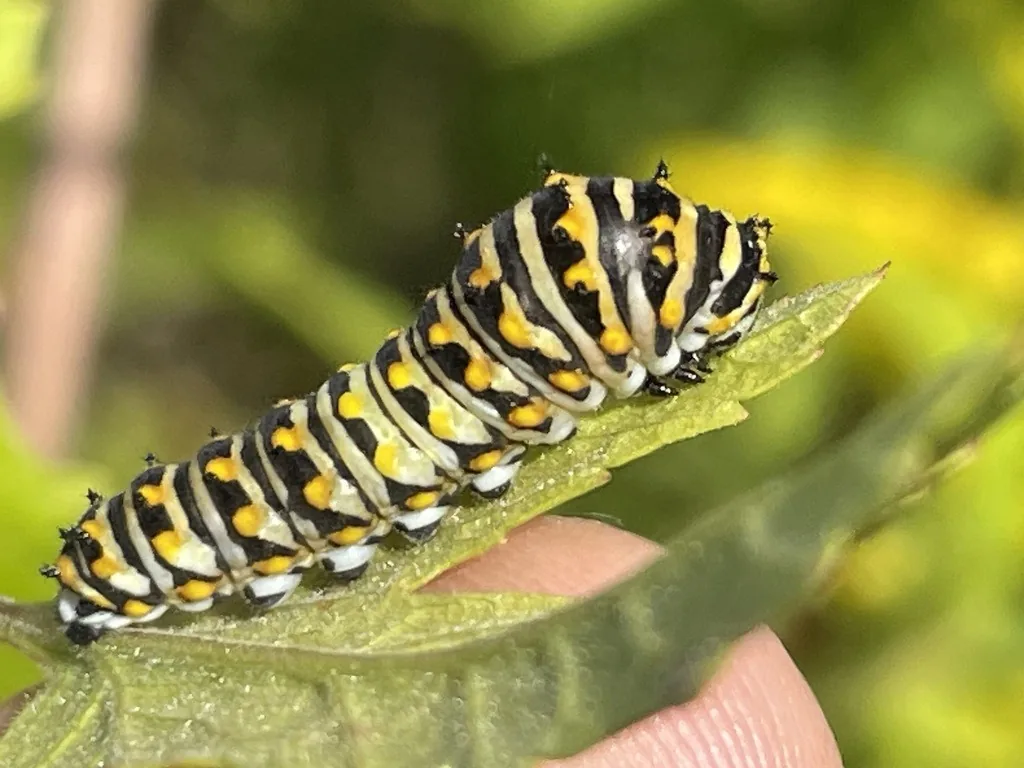
- Young caterpillars are glossy black and spiny with a white saddle, so they look like bird droppings. Older ones are smooth and green with black crossbands holding yellow or yellow-orange spots, and they grow to 1½ to 2 inches.[1][2]
- A threatened caterpillar rears up and pushes out a bright yellow-orange, forked osmeterium that releases a foul-smelling repellent.[1]
- Adults are mostly black with two rows of yellow spots near the wing edges and a red-orange eyespot with a black center on each hind wing. Males show more yellow; females have smaller yellow spots and more blue on the hind wings. Wingspan is 3¼ to 4¼ inches.[1][4]
- Mississippi State Extension notes they are often confused with monarch caterpillars, which also have black, white and yellow-green stripes, but monarchs feed on different plants and carry a pair of black, whip-like projections at each end of the body.[3]
- Fun fact: Mississippi State Extension says you can gently prod a resting caterpillar's back with a small stick to see, and smell, its orange forked osmeterium.[3]
Look-alikes
| Look-alike | How to tell them apart |
|---|---|
| Pipevine swallowtail | Pipevine swallowtails are black with an iridescent blue-green sheen, only faint white spots above and a single row of spots below. The black swallowtail's underside mimics this distasteful species.[1] |
| Spicebush swallowtail | Spicebush swallowtails have white spots on top, and the yellow spots underneath are broken in the middle by a blue area.[1] |
Where it lives
It ranges from southern Canada to northern South America and is most common east of the Rocky Mountains: most of the eastern U.S., north into Quebec, and west into southern Saskatchewan, Colorado and southeastern California, with the subspecies coloro in the desert Southwest.[1][4]
Biology and life cycle
Females lay pale yellow, round eggs singly on host plants, usually on new foliage, which hatch in 3 to 9 days. The caterpillar stage takes 10 to 30 days depending on temperature and host plant.[1][4]
Grown caterpillars wander off to pupate head-up on a stem, trunk or wall. First-brood chrysalises last 2 to 3 weeks; fall ones are always brown and spend the winter.[1][4]
Garden hosts include dill, parsley, fennel, celery, caraway, carrot, parsnip and anise, and sometimes common rue. Wild hosts include Queen Anne's lace, poison hemlock, wild parsnip, spotted water hemlock and golden alexanders.[1][2][4]
To keep parasitoids that hunt by smell from finding them, caterpillars flick their droppings off the plant with their mandibles.[1]
In Missouri, MU Extension reports parsleyworm caterpillars from May to October, with three generations a year.[2]
Most of the eating happens in the last few days of caterpillar life, so a planting that looks fine one day can be stripped to stems a couple of days later; grown caterpillars (about 2 inches) usually crawl away from the plant to form a chrysalis.[3]
The caterpillars feed only on plants that contain furanocoumarins, defensive plant chemicals. University of Illinois lab work found the caterpillars break these down with cytochrome P450 enzymes, and that mixtures of two furanocoumarins slowed caterpillar growth more than either one alone.[5]
Damage and signs
- Caterpillars chew the leaves of garden herbs and, when numerous, can eat entire plants, but they are usually not numerous enough to be a real problem.[1]
- Damage can be sudden: young caterpillars are camouflaged as bird droppings and eat little, so they are easily overlooked until the large ones finish off fennel, dill or parsley in a few days.[3]
Health risk
The caterpillars and their osmeterium are harmless to people; none of these sources reports a risk to people or pets.[1][2]
Control
Prevention
To share the garden instead, plant host plants for the caterpillars plus nectar flowers for the adults, such as milkweed, thistles, purple coneflower and zinnia, and avoid pesticides.[1][4]
Traps and physical control
Step 1, check and hand-pick: look over dill, parsley and fennel regularly, because young caterpillars are hard to spot. Hand-picking solves the problem in most gardens, and caterpillars can be moved to host plants outside the garden, such as extra dill or wild carrot-family plants.[1][3]
Biological control
Parasitic flies (Phoridae and Tachinidae) and wasps (Braconidae and Ichneumonidae) attack the caterpillars and pupae.[1]
Pesticides
Step 2, only if needed: insecticides are rarely justified. UW-Madison Extension says the bacterial insecticide Bt (Bacillus thuringiensis) gives effective control. For larger plantings, Mississippi State Extension names zeta-cypermethrin (a GardenTech product) labeled for parsley and fennel, and spinosad (Bonide and GreenLight products) for organic gardeners. Check the label's preharvest interval on herbs, and read and follow the label.[1][3]
Where sources disagree
Generations: UW-Madison Extension says there are usually two in the upper Midwest, with a third flight farther south; MU Extension gives three per year for Missouri; and Butterflies and Moths of North America gives one to two flights in the North and three in the South.[1][2][4]
Citrus-family hosts: UW-Madison Extension says the caterpillars sometimes use common rue, while Butterflies and Moths of North America says citrus-family plants are sometimes preferred.[1][4]
Wingspan: UW-Madison Extension gives 3¼ to 4¼ inches, with females larger than males; University of Illinois Extension gives 2.75 to 4 inches.[1][6]
Common questions
- What are the green and black striped caterpillars eating my dill?
- Probably eastern black swallowtail caterpillars (parsleyworms), which feed on dill, parsley, fennel and related herbs.[1][2]
- Should I kill black swallowtail caterpillars?
- Rarely necessary. Hand-pick or move them to wild carrot-family plants outside the garden; insecticides are rarely justified.[1]
- Are parsleyworms the same as monarch caterpillars?
- No. Both are striped black, white and yellow-green, but monarch caterpillars feed on different plants and have black, whip-like projections at each end; parsleyworms eat carrot-family plants and hide an orange forked osmeterium behind the head.[3]
- Is the black swallowtail caterpillar poisonous?
- None of these sources reports any risk to people or pets. The orange osmeterium only releases a bad smell to scare off predators.[1][3]
Sources
- University of Wisconsin-Madison Extension, “Black Swallowtail, Papilio polyxenes.” hort.extension.wisc.edu/articles/black-swallowtail-papilio-polyxenes/ (accessed 2026-11-12)
- University of Missouri Extension, “Caterpillars in Your Yard and Garden (IPM1019): Parsleyworm.” extension.missouri.edu/publications/ipm1019-32 (accessed 2026-11-12)
- Mississippi State University Extension Service, “Parsleyworm (Bug's Eye View, Vol. 6, No. 23).” extension.msstate.edu/newsletters/bugs-eye-view/2020/parsleyworm-vol-6-no-23 (accessed 2026-11-12)
- Butterflies and Moths of North America, “Black Swallowtail, Papilio polyxenes (species account).” www.butterfliesandmoths.org/species/Papilio-polyxenes (accessed 2026-11-12)
- Oecologia 93, 1993 (Berenbaum & Zangerl), via PubMed, “Furanocoumarin metabolism in Papilio polyxenes: biochemistry, genetic variability, and ecological significance.” pubmed.ncbi.nlm.nih.gov/28314013/ (accessed 2026-11-12)
- University of Illinois Extension, “Swallowtail Butterflies fact sheet.” extension.illinois.edu/sites/default/files/swallowtail_fact_sheet_2021.pdf (accessed 2026-11-12)
- iNaturalist, “Papilio polyxenes taxon page (order and family).” www.inaturalist.org/taxa/58523 (accessed 2026-10-06)