On this page
How to identify it
- Young caterpillars mimic bird droppings; older ones look more like small snakes. They are brown with grayish-white markings, including a wide saddle in the middle of the body and a patch at the rear.[2][1]
- When disturbed, the caterpillar pushes out a pinkish or red, paired, hornlike organ called the osmeterium. UF/IFAS describes it as an orange or reddish Y-shaped gland behind the head that the caterpillar wipes against small attackers. In older caterpillars it gives off a pungent mix that smells like rancid butter and repels ants and spiders; birds aren't repelled, but they still rarely eat the caterpillars.[2][7]
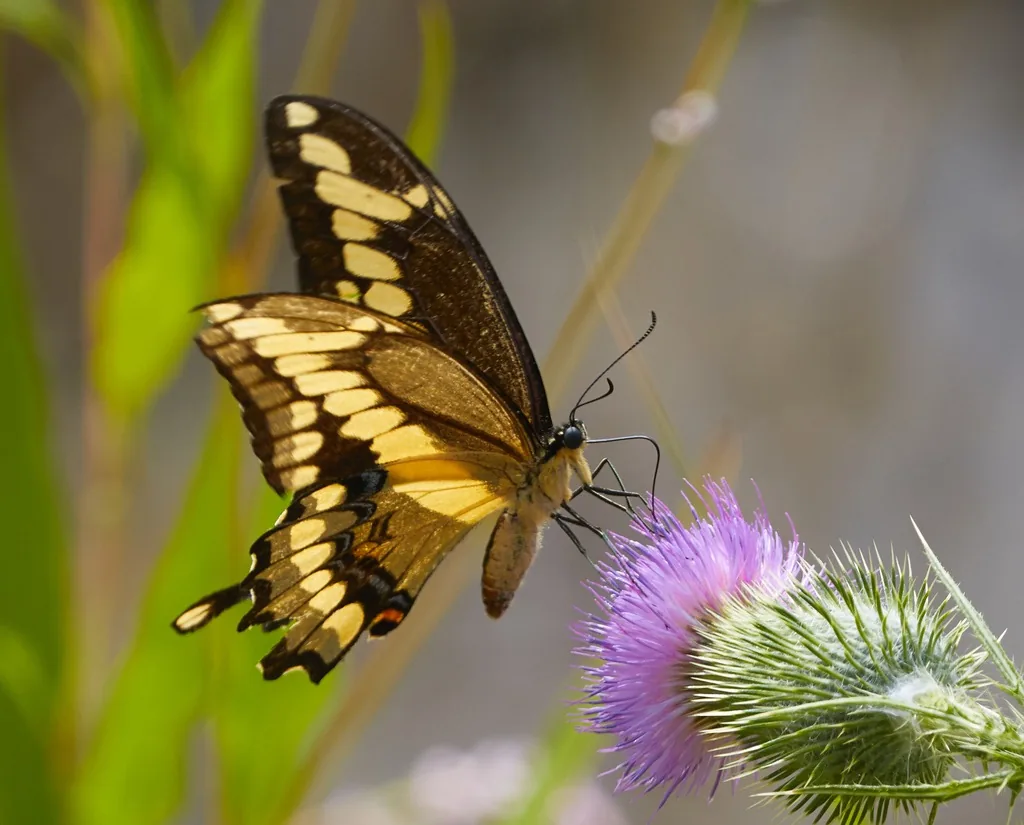
- Adults are dark blackish brown above with bands of yellow spots, including a diagonal band across the forewing, and the tails are filled with yellow. Undersides are mostly yellow with black, blue and red markings.[2][3]
- Wingspan is 3 3/4 to 5 1/2 inches by Missouri's field guide, or 4 to 6 1/4 inches by Butterflies and Moths of North America. UF/IFAS gives forewing spans of 11.7 to 17.5 cm for males and 13.5 to 18.8 cm for females.[2][3][7]
- Eggs are spherical, 1 to 1.5 mm across and cream to brown, often with an irregular orange coating that looks a bit like orange peel. Females lay them one at a time on the upper surface of host leaves.[7]
Look-alikes
| Look-alike | How to tell them apart |
|---|---|
| Schaus' swallowtail | An endangered swallowtail confined to the Florida Keys. Its tails are all black, while the giant swallowtail's tails are filled with yellow, and the giant swallowtail has a small brick-red patch just inside the blue band under the hindwing.[7] |
Where it lives
Butterflies and Moths of North America gives the range as eastern North America west to the Rocky Mountains and south through the desert Southwest to South America. Missouri's field guide notes that giant swallowtails of the western U.S. are now treated as a separate species, the western giant swallowtail (Papilio rumiko). It has expanded rapidly northward and now reaches the Ottawa area of Ontario. GBIF holds about 25,900 U.S. records since 1990, the most from Florida (5,287) and Texas (4,085), then Vermont, Illinois and New York. UF/IFAS adds that it is very common throughout Florida, active all year in south Florida and common in north Florida except in January and February.[3][2][4][5][7]
Biology and life cycle
Caterpillars feed on trees and herbs of the citrus family: citrus, prickly ash, hop tree (wafer ash) and common rue, and they have been reared on gas plant. UF/IFAS adds Florida natives such as Hercules-club, lime pricklyash and sea torchwood, plus exotic citrus-family plants such as white sapote.[3][2][4][7]
Females lay eggs one at a time on host leaves and twigs. Caterpillars go through five instars; in Ontario the larval stage lasts 3 to 4 weeks. UF/IFAS says the caterpillars usually feed at night. Mature caterpillars rest on stems or leaf stalks, while young ones often sit in plain view on upper leaf surfaces, where a bird dropping would be expected. They pupate on twigs of the host or on a nearby upright object such as a fence.[3][2][4][7]
There are two broods a year in the north, with adults from about April or May into September or October, and adults fly all year in Florida and the Deep South. Winter is spent as a chrysalis.[2][3][4]
In Ontario, summer chrysalids produce adults after 10 to 12 days, while autumn ones wait until spring. A cold-tolerance study there found autumn cold doesn't limit how far north the species lives; growing degree-days and rainfall predicted its range best.[4]
Adults are avid flower visitors, taking nectar from plants such as lantana, goldenrod and swamp milkweed, and they also drink at mud puddles.[2][3]
UF/IFAS says at least two, and probably three, generations occur each year in Florida. Males patrol flyways through pine woods or citrus groves looking for females, and courtship happens in the afternoon.[7]
The chrysalis can't move or defend itself. UF/IFAS lists a tachinid fly, Lespesia rileyi, a chalcidid wasp, Brachymeria robusta, and two pteromalid wasps that parasitize the pupae.[7]
Damage and signs
Health risk
It feeds on citrus-family leaves, and no cited source describes any risk to people or pets.[1][2]
Control
Prevention
Clemson Extension says mature citrus trees can tolerate a fair amount of feeding and that sacrificing a few leaves is well worth it to see the butterfly; young citrus trees are where the caterpillars can become a pest. On small potted or planted citrus, UF/IFAS advises picking the caterpillars off by hand so blooms and fruit aren't badly reduced; mature dooryard trees can withstand some defoliation. For commercial nursery stock and young grove trees, it points to Bacillus thuringiensis and other insecticides listed in the Florida Citrus Pest Management Guide when necessary.[1][7]
Where the sources disagree
Wingspan: Missouri's field guide gives 3 3/4 to 5 1/2 inches, Butterflies and Moths of North America 4 to 6 1/4 inches.[2][3]
Flight season: Missouri gives two broods with adults from April to October, Butterflies and Moths of North America two flights in the north from May to September, and the Ontario study flights from May to July and again from late July to late September.[2][3][4]
Range: Butterflies and Moths of North America extends it west to the Rocky Mountains and south to South America, the Ontario study says it ranges from Costa Rica throughout North America, and Missouri's field guide says western populations are now a separate species.[3][4][2]
Pest status: Clemson Extension calls it a pest of young citrus trees, Missouri's field guide calls the caterpillars crop pests in citrus orchards in southern states, and Butterflies and Moths of North America calls them occasional pests of citrus.[1][2][3]
Caterpillar hosts: Missouri names hop tree and prickly ash as favorites there and gas plant as a rearing host, Butterflies and Moths of North America lists citrus, prickly ash, hop tree and common rue, and the Ontario study says hosts there are mainly northern prickly ash and hop tree.[2][3][4]
Size in metric: UF/IFAS gives forewing spans of 11.7 to 17.5 cm (average 14 cm) for males and 13.5 to 18.8 cm (average 14.7 cm) for females, so its top end runs larger than the inch ranges in the other guides.[7][2][3]
Florida generations: northern sources give two broods; UF/IFAS says at least two and probably three in Florida.[2][7]
Common questions
- What looks like bird poop on my citrus leaves?
- Probably a young giant swallowtail caterpillar, an orangedog.[1][2]
- Should I kill them?
- Clemson Extension says mature trees tolerate a fair amount of feeding and that a few leaves are worth sacrificing to see the butterfly; the caterpillars are more of a concern on young citrus trees.[1]
- What else do the caterpillars eat besides citrus?
- Other citrus-family plants, such as prickly ash, hop tree and common rue.[3][2]
Sources
- Clemson Cooperative Extension, Home & Garden Information Center, “What Is It? Wednesday: Giant Swallowtail Caterpillar.” hgic.clemson.edu/what-is-it-wednesday-giant-swallowtail-caterpillar/ (accessed 2026-11-13)
- Missouri Department of Conservation, “Eastern Giant Swallowtail (Field Guide).” mdc.mo.gov/discover-nature/field-guide/giant-swallowtail (accessed 2026-11-13)
- Butterflies and Moths of North America (BAMONA), “Giant Swallowtail, Papilio cresphontes Cramer, 1777.” www.butterfliesandmoths.org/species/Papilio-cresphontes (accessed 2026-11-13)
- Ecology and Evolution, via PubMed Central, “Tremblay P, MacMillan HA, Kharouba HM (2021), Autumn larval cold tolerance does not predict the northern range limit of a widespread butterfly species, Ecology and Evolution 11(12):8332-8346.” pmc.ncbi.nlm.nih.gov/articles/PMC8216912/ (accessed 2026-11-13). Cited from the open-access full text (PubMed 34188890).
- Global Biodiversity Information Facility (GBIF), “Papilio cresphontes (giant swallowtail): occurrence records in the U.S., 1990-2026 (GBIF occurrence search).” api.gbif.org/v1/occurrence/search?taxonKey=1937846&country=US&hasGeospatialIssue=false&occurrenceStatus=PRESENT&year=1990%2C2026&facet=stateProvince&facetLimit=400&limit=0 (accessed 2026-11-13). Exact count at access: 25,889 U.S. records, 1990-2026 (Florida 5,287; Texas 4,085; Vermont 1,836; Illinois 1,450; New York 1,312). State counts are records reported (iNaturalist research-grade, museum specimens, surveys), not abundance.
- Global Biodiversity Information Facility (GBIF), “Papilio cresphontes Cramer, 1777 (GBIF Backbone Taxonomy).” api.gbif.org/v1/species/1937846 (accessed 2026-11-13)
- University of Florida IFAS Extension, EDIS (Featured Creatures), “Giant Swallowtail, Orangedog, Papilio cresphontes Cramer, EENY-008/IN134 (Featured Creatures).” ask.ifas.ufl.edu/publication/IN134 (accessed 2026-11-14)