On this page
How to identify it
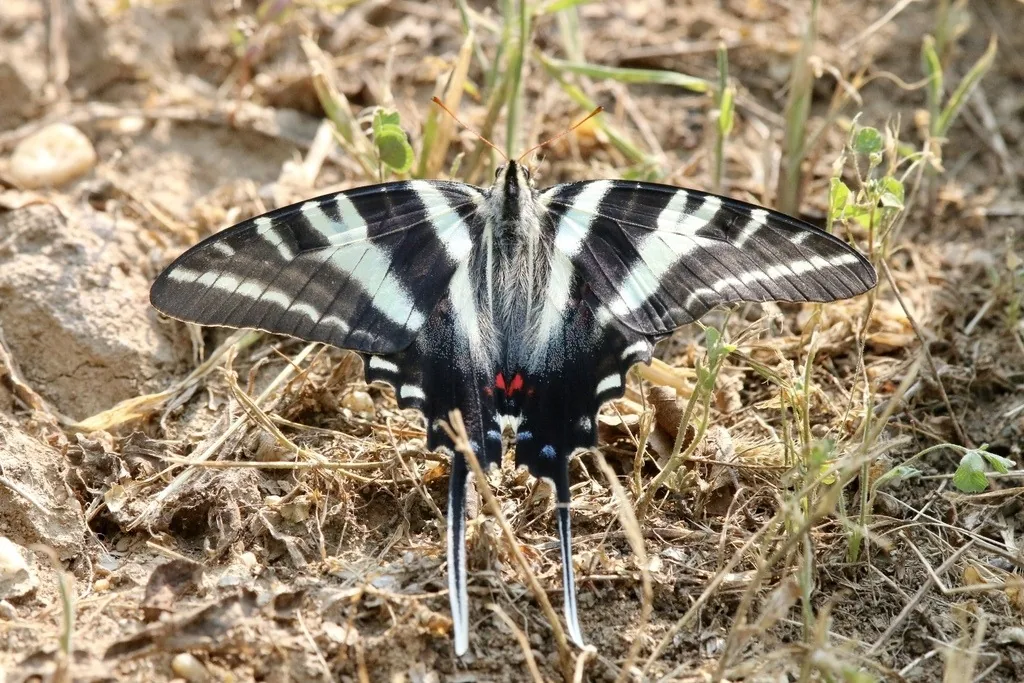
- The wings are striped black on a pale whitish-green background, and the hindwings carry very long tails. Wingspan is 2½ to 4 inches.[3][1]
- Butterflies that emerge in spring are smaller and paler, with shorter tails; summer adults have wider black stripes and longer tails.[1][3]
- Full-grown caterpillars look hump-backed, with most segments ringed in yellow-white and green lines and a thick black band across the swollen part of the body. Young caterpillars are black with a yellow band across the hump, and some stay black all the way through.[2][1][5]
- Like other swallowtail caterpillars, a disturbed caterpillar can push out a forked, orange-red gland (the osmeterium) from behind its head that gives off a disagreeable odor.[2]
Where it lives
It lives where pawpaw grows, breeding in moist, low woodlands and bottomland forests near swamps and rivers. It is common across Arkansas and is occasionally found as far north as southern New England; in Iowa it is seen occasionally, mostly in the south, and BAMONA describes it as rare in the northern part of its range.[1][5][6][3]
Biology and life cycle
BAMONA counts two flights from April to August in the northern part of the range and many flights from March to December in the south. In Missouri adults fly from late March to October in several broods, and MU Extension finds caterpillars from May to November in two or three generations a year.[3][1][2]
Females lay one egg at a time; BAMONA says single green eggs go on the lower leaves of the host plant, and young pawpaw plants are preferred.[1][3]
Caterpillars live and feed on the leaf undersides, then pupate there, and the pupae pass the winter.[3]
Females are triggered to lay eggs by a single leaf chemical, 3-caffeoyl-muco-quinic acid; in lab tests, extracts of pawpaw leaves made in September got fewer approaches and eggs than spring extracts.[8]
Adults have a shorter proboscis than most swallowtails and nectar at flowers with short tubes, such as milkweeds, clovers, blackberry, redbud and verbena. Groups also gather at mud puddles and in creek beds.[1][3]
Puddling at damp soil is done mostly by males, which take up extra sodium.[5]
Fun fact: the caterpillars and adult butterflies carry acetogenins, toxic compounds from pawpaw leaves, which probably defend them against birds.[7]
Damage and signs
Health risk
None of these sources reports bites, stings or other harm to people or pets. The caterpillar's osmeterium only releases an unpleasant smell.[2][1][6]
Control
Prevention
No control is called for. The Missouri Department of Conservation notes that planting native pawpaws widens the habitat for zebra swallowtails, Iowa State says planting a pawpaw raises your odds of seeing one, and BAMONA lists keeping host trees in various stages of succession as its management need.[1][6][3]
Where sources disagree
Caterpillar markings: MU Extension places the thick black ring on the first abdominal segment, while the Missouri Department of Conservation describes bluish-green caterpillars with a wider black band across the humped third segment of the thorax.[2][1]
Scientific name: MU Extension uses Graphium marcellus and BAMONA uses Neographium marcellus, also listing Eurytides marcellus as an alternate name; this page's taxonomy follows iNaturalist.[2][3]
Size: BAMONA gives a wingspan of 2 1/2 to 4 inches, while Arkansas describes spring butterflies as not quite three inches and summer ones as reaching as much as four inches.[3][5]
Common questions
- What is the black-and-white striped butterfly with long tails?
- A zebra swallowtail. No other North American butterfly has its black-and-white stripes and long hindwing tails.[1][3]
- What do zebra swallowtail caterpillars eat?
- Pawpaw leaves. BAMONA notes that young plants are preferred.[1][3][2]
- How many generations are there?
- Two or three a year in Missouri according to MU Extension. BAMONA reports two flights in the north and many flights from March to December in the south.[2][3][1]
- Should I worry about zebra swallowtail caterpillars on my pawpaw?
- No control is needed. The caterpillars feed only on pawpaw, their feeding does not usually harm the shrub much, and planting more pawpaws is encouraged to support the butterfly.[1][3][6]
- Why don't birds eat zebra swallowtails?
- Pawpaw leaves contain toxic acetogenins, and these compounds turn up in the caterpillars and adults, where they probably defend them against birds.[7]
Sources
- Missouri Department of Conservation, “Zebra Swallowtail (Field Guide).” mdc.mo.gov/discover-nature/field-guide/zebra-swallowtail (accessed 2026-11-12)
- University of Missouri Extension (Caterpillars in Your Yard and Garden, IPM1019), “Caterpillars in Your Yard and Garden, page 56: Zebra swallowtail.” extension.missouri.edu/publications/ipm1019-56 (accessed 2026-11-12)
- Butterflies and Moths of North America, “Zebra Swallowtail, Neographium marcellus (species account).” www.butterfliesandmoths.org/species/Eurytides-marcellus (accessed 2026-11-12)
- iNaturalist, “Eurytides marcellus taxon page (order and family).” www.inaturalist.org/taxa/83086 (accessed 2026-11-12)
- University of Arkansas Division of Agriculture Cooperative Extension Service, “Metamorphosis in zebra swallowtail.” uaex.uada.edu/environment-nature/musings-on-nature-blog/posts/interacting-with-wildlife/05-19-2021-metamorphis-zebra-swallowtail.aspx (accessed 2026-11-12)
- Iowa State University Extension and Outreach, Yard and Garden, “Keep an Eye Out for the Zebra Swallowtail.” yardandgarden.extension.iastate.edu/article/2012/7-11/swallowtail.html (accessed 2026-11-12)
- Journal of Natural Products (1999), via PubMed, “Chemical defense in the zebra swallowtail butterfly, Eurytides marcellus, involving annonaceous acetogenins.” pubmed.ncbi.nlm.nih.gov/9917274/ (accessed 2026-11-12). Cited from the PubMed abstract.
- Journal of Chemical Ecology (2003), via PubMed, “Combined roles of contact stimulant and deterrents in assessment of host-plant quality by ovipositing zebra swallowtail butterflies.” pubmed.ncbi.nlm.nih.gov/12757326/ (accessed 2026-11-12). Cited from the PubMed abstract.