On this page
How to identify it
- Adults have dark brown wings with a dusting of white scales, and some moths have patches of reddish or yellowish brown on the wings. The wingspan is 2 to 2 11/16 inches (5 to 6.8 cm).[1]
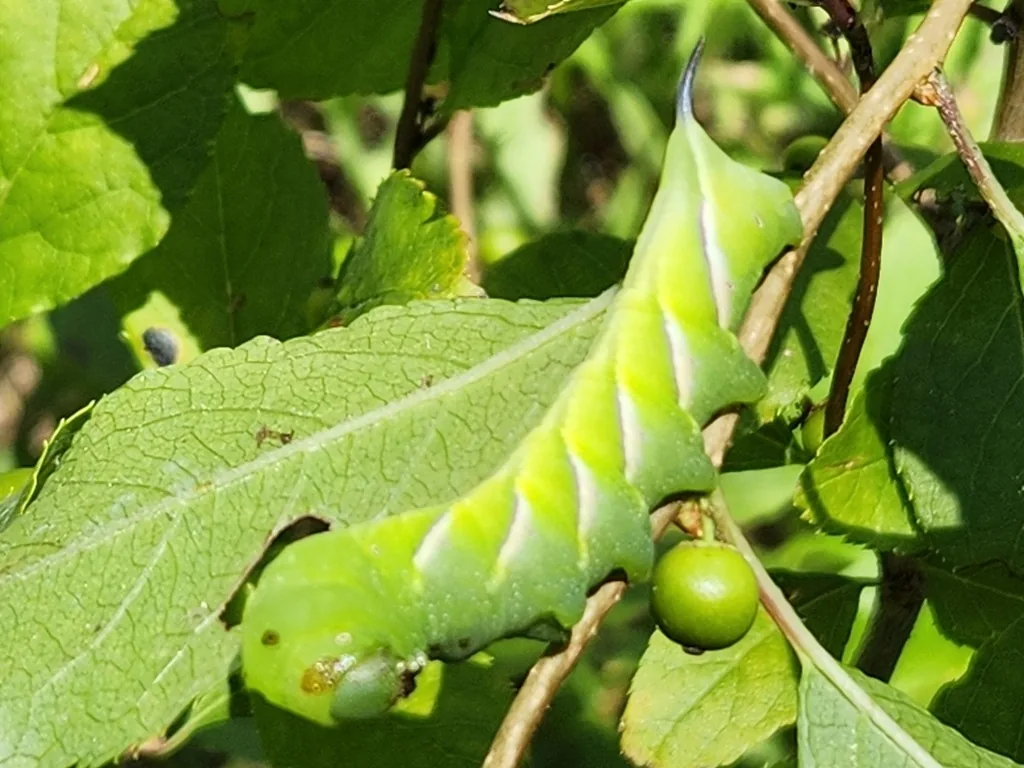
- The caterpillar is a hornworm: it has a horn at the end of its abdomen.[1]
- Sphingidae of the United States gives a forewing length of 22 to 30 mm and says males and females are nearly identical, differing only slightly in size. The forewing has white blotching on the outer and inner parts but little in the middle.[2]
- The full-grown caterpillar is a fairly small, green to greenish-blue hornworm with a blue-purple horn that turns more purple toward the tip, white side stripes each underlined in purple, and purple spiracles ringed in white.[2]
- The USDA Forest Service describes the caterpillar as pale green and smooth, with a green head without bands, black legs with a yellow band at the base, six slanting white side stripes, small black spiracles ringed in white and a slender blue horn. UF/IFAS notes it occurs in bright green or brown forms.[4][3]
Look-alikes
| Look-alike | How to tell them apart |
|---|---|
| Tomato and tobacco hornworms | Close relatives in the genus Manduca, per a 2013 DNA study. Food plants help tell them apart: pawpaw sphinx caterpillars are recorded on pawpaw, littleleaf sweetfern, possum haw and inkberry.[5][1] |
Where it lives
Maine south to Florida, west to Wisconsin, eastern Oklahoma and South Texas. GBIF holds 3423 U.S. records since 1990 from 40 state-level areas, the most from Texas (1335), Massachusetts (178) and North Carolina (146).[1][6]
Biology and life cycle
Caterpillars feed on pawpaw (Asimina triloba), littleleaf sweetfern (Myrica aspleniifolia), possum haw (Ilex decidua) and inkberry (Ilex glabra). Adults sip nectar from deep-throated flowers, including bouncing bet, petunia, jasmine and mimosa. The USDA Forest Service lists hollies and related plants, pawpaws and sweetfern, and UF/IFAS adds yaupon holly.[1][4][3]
Sphingidae of the United States says the caterpillars feed on many hollies (Ilex) as well as pawpaw, and that in the Northeast and other places without pawpaw the moth uses holly. Adults are common at lights and also visit flowers, especially milkweeds.[2]
Where to look: in mid-Atlantic forests with plenty of pawpaw, caterpillars are found under the leaves of mid-sized trees, near the leaf stem. On holly they feed openly toward the outside or top of the plant at night and rest on inner stems by day.[2]
There is one flight from June to September, and two flights from March to September in Florida and Louisiana. Fully grown caterpillars pupate and spend the winter in underground burrows.[1]
A fun family fact: in a DNA study of the tobacco hornworm and its relatives, the hornworm genus Manduca only formed a natural group when two other genera, Dolba and Euryglottis, were included, so the pawpaw sphinx sits right inside the tobacco and tomato hornworm family tree.[5]
The Forest Service finds caterpillars from June to November, with two generations a year in the South and one in the North.[4]
On yaupon holly a caterpillar works from the tip of a twig back toward the branch, often eating whole leaves rather than chewing notches in them.[3]
Damage and signs
- The caterpillars eat the leaves of pawpaw, sweetfern and native hollies. Butterflies and Moths of North America lists its management needs as none reported and says conservation action is not usually required. UF/IFAS says caterpillars on yaupon holly are relatively uncommon and not known to cause significant damage, and the twig generally grows new leaves the following year.[1][3]
Health risk
No source reviewed reports a bite, sting or any risk to people or pets; Butterflies and Moths of North America lists no management needs. The USDA Forest Service notes that hornworms in general may thrash from side to side and regurgitate when handled.[1][4]
Control
Prevention
No control is recommended. Butterflies and Moths of North America lists management needs for this native moth as none reported. On yaupon holly, UF/IFAS says tolerating the feeding or removing the caterpillars by hand, if necessary, is likely the best option.[1][3]
Where sources disagree
Flight season: Butterflies and Moths of North America gives one flight from June to September, and two from March to September in Florida and Louisiana; Sphingidae of the United States says adults fly from early spring to early fall over most of the range and year-round in Florida.[1][2]
Caterpillar color: Sphingidae of the United States describes a green to greenish-blue hornworm with a blue-purple horn turning more purple toward the tip; the USDA Forest Service gives a pale green caterpillar with a blue horn, and UF/IFAS says bright green and brown forms occur.[2][4][3]
Common questions
- What does a pawpaw sphinx moth look like?
- A large hawk moth with dark brown wings dusted with white scales, sometimes with reddish or yellowish brown patches, and a wingspan of 2 to 2 11/16 inches.[1]
- What do pawpaw sphinx caterpillars eat?
- Pawpaw, littleleaf sweetfern, and the native hollies possum haw and inkberry. Sphingidae of the United States adds that many holly species are used.[1][2]
- Is it related to the tomato hornworm?
- Yes, closely. A DNA study of Manduca hornworms, the genus of the tobacco and tomato hornworms, found the genus only holds together as a natural group when Dolba is included.[5]
- Do I need to get rid of it?
- Usually not. No source reports harm to people or pets, and BAMONA lists no management needs.[1]
- What is the green hornworm on my yaupon holly?
- It may be a pawpaw sphinx caterpillar: the Forest Service describes it as smooth and pale green with six slanting white side stripes and a slender blue horn, and UF/IFAS lists yaupon holly as a food plant and notes a brown form too.[4][3]
- Will it hurt my holly?
- Usually not. UF/IFAS says these caterpillars are relatively uncommon on yaupon holly, are not known to cause significant damage, and the twig generally leafs out again the next year; picking them off by hand is enough if needed.[3]
Sources
- Butterflies and Moths of North America (BAMONA), “Pawpaw sphinx, Dolba hyloeus (species account).” www.butterfliesandmoths.org/species/Dolba-hyloeus (accessed 2026-11-14)
- Sphingidae of the United States of America, “Dolba hyloeus.” www.sphingidae.us/dolba-hyloeus.html (accessed 2026-11-14)
- University of Florida/IFAS Extension (EDIS), journals.flvc.org copy, “Yaupon Holly Culture and Pest Management for Tea Production and Ornamental Use, ENY-2054 (M. A. Borden, M. A. Wilhelm and A. G. Dale).” journals.flvc.org/edis/article/view/121727 (accessed 2026-11-14). The ask.ifas.ufl.edu page (IN1299) returns 410 Gone; the EDIS journal copy at journals.flvc.org is cited.
- USDA Forest Service, Forest Health Technology Enterprise Team (scan at Internet Archive), “Caterpillars of Eastern Forests, FHTET-96-34 (D. L. Wagner, V. Giles, R. C. Reardon and M. L. McManus, 1997).” archive.org/details/caterpillarsofea001997 (accessed 2026-11-14). Read from the Internet Archive's scan and full text of the USDA Forest Service publication.
- Mol Phylogenet Evol 2013;68(3):381-6, via PubMed, “Evolution of Manduca sexta hornworms and relatives: biogeographical analysis reveals an ancestral diversification in Central America.” pubmed.ncbi.nlm.nih.gov/23643972/ (accessed 2026-11-14)
- Global Biodiversity Information Facility (GBIF), “Dolba hyloeus: U.S. occurrence records since 1990 by state (GBIF occurrence search).” api.gbif.org/v1/occurrence/search?taxonKey=1861604&country=US&hasGeospatialIssue=false&occurrenceStatus=PRESENT&year=1990%2C2026&facet=stateProvince&facetLimit=400&limit=0 (accessed 2026-11-14)
- iNaturalist, “Dolba hyloeus taxon page (order and family).” www.inaturalist.org/taxa/143441 (accessed 2026-11-14)