On this page
How to identify it
- The caterpillar is yellow-green above and gray-green below, with seven slanted white lines along each side; the last line is broad and leads to a long white horn that sticks out past the end of the body. The head has a broad white band on each side. Full grown, it is about 3-1/2 inches long. The USDA Forest Service's Caterpillars of Eastern Forests describes it as usually greenish, sometimes reddish, with 7 pairs of slanting side stripes, a pink or yellow band on each side of the head running from the eyes to the crown, and a pinkish horn.[1][8]
- Like most hornworms it has a flexible horn on the hind end. Hornworms are among the largest caterpillars; full-grown larvae leave the plant to dig into loose soil and pupate. The Forest Service guide says almost all hornworms have the horn on top of the eighth abdominal segment, and their large droppings often give them away in a tree or garden.[5][2][8]
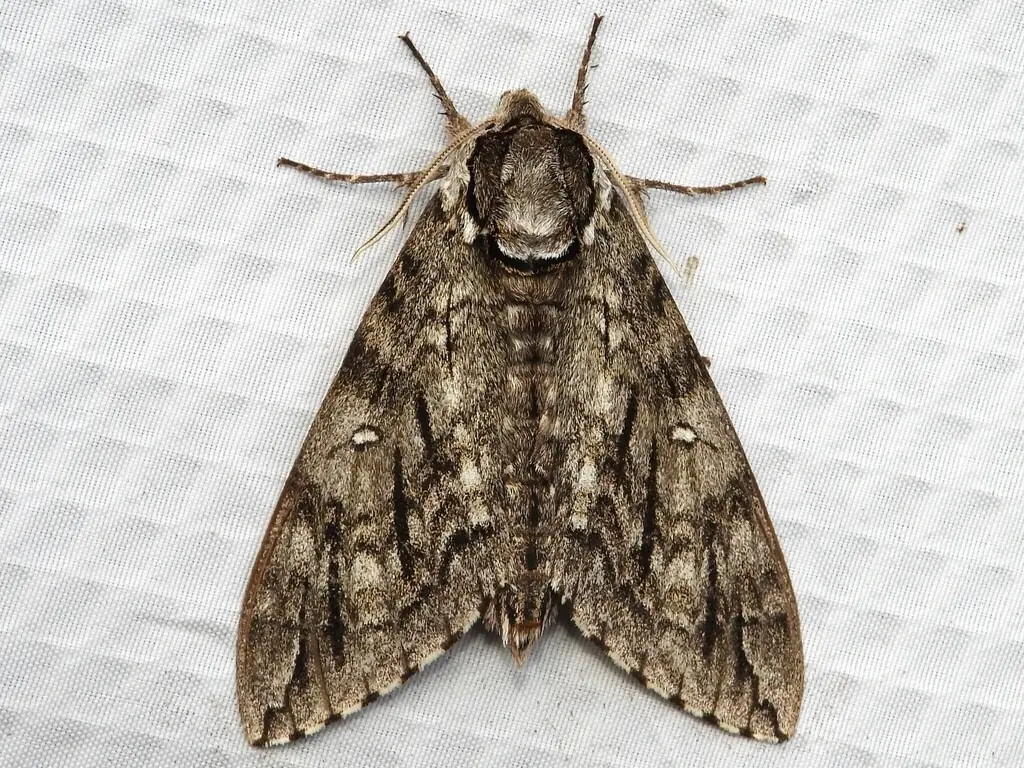
- The moth is large, with a wingspan of 3 to 4-5/16 inches (7.6 to 11 cm). The forewing is pale brownish gray with wavy black and white lines and a black-outlined white spot; the hindwing is gray with darker bands. Some moths are almost black, others light yellowish brown.[2]
- The Forest Service guide adds that the plate on top of the last segment is rounded (convex), and that this plate and the hindmost prolegs carry conspicuous black spots.[8]
Look-alikes
| Look-alike | How to tell them apart |
|---|---|
| Great ash sphinx | Its caterpillar also feeds on ash, lilac and privet (and quaking aspen). The moths differ: the great ash sphinx's forewing is soft dark gray to blue-gray with a series of black dashes, one reaching the wing tip, and its hindwing is black with blurry pale gray bands, while the waved sphinx's forewing is pale brownish gray with wavy black and white lines and a black-outlined white spot. The Forest Service guide says the great ash sphinx caterpillar is pale blue-green or pinkish with white granular spotting, especially on the thorax and below the breathing pores; its side stripes reach forward to above the proleg of the segment in front, and its rear plate is flat, without black spots. The waved sphinx's stripes stop at the segment boundary.[6][2][8] |
| Catalpa sphinx | A close relative in the same genus that specializes on catalpa and also feeds on desert willow (Chilopsis). The two species are attacked by the same specialist parasitoid. The Forest Service guide says catalpa sphinx caterpillars are always some combination of yellow and black, feed in groups, are restricted to catalpas and occasionally become pests.[4][8] |
Where it lives
BAMONA gives its range as Maine west to Alberta, western North Dakota and Colorado, and south to Florida, the Gulf Coast and Texas; it is on Ohio State's list of Ohio sphinx moths and Colorado State's list of Colorado hornworms. There are two broods a year in the south, flying March to October, and one in the north, flying May to August. The USDA Forest Service includes it in its guide to caterpillars of eastern forests, with caterpillars from April through October.[2][3][5][8]
Biology and life cycle
Ash is the main food plant: BAMONA lists ash, privet, oak, hawthorn and fringe tree, Ohio State lists white oak, ash, hawthorn, white fringe tree and privet, and Fontenelle Forest naturalists list ash and lilac. The Forest Service guide says ashes are preferred but also lists lilacs, privets, hawthorns, oaks and other trees.[2][3][1][8]
Its usual hosts belong to the olive family, plants that produce defensive compounds called seco-iridoid glycosides. In lab tests the waved sphinx could not store catalpol, a defensive compound the catalpa sphinx sequesters, and adding catalpol to its diet weakened its immune response.[4]
Fully grown caterpillars pupate underground. Hornworms in general dig into loose soil and pupate a few inches below the surface in a small chamber of packed earth. The Forest Service guide notes that grown hornworms are commonly found wandering over the ground in search of a place to pupate.[2][5][8]
The adults probably do not feed: Ohio State lists the waved sphinx among sphinx moths whose adults are non-feeding, and BAMONA says adults probably do not feed.[3][2]
Damage and signs
- The caterpillars eat the leaves of ash, privet, lilac and related trees and shrubs. Fontenelle Forest naturalists say it is reportedly the most commonly seen of the six hornworms that feed on ash. Colorado State Extension says most hornworm species cause insignificant plant injury; only the tomato and tobacco hornworms are treated as garden pests.[1][5]
Health risk
None of these sources (Fontenelle Forest naturalists, BAMONA, Ohio State, Colorado State Extension, the Journal of Chemical Ecology study) mentions any bite, sting or other risk to people. The USDA Forest Service guide notes that hornworms may thrash violently from side to side and regurgitate when handled.[1][2][3][5][4][8]
Control
Prevention
No control is needed. No source recommends any for the waved sphinx, and Colorado State Extension says most of the more than 30 hornworm species in Colorado are rarely seen and do not cause significant injury to plants.[5]
Where the sources disagree
Horn and head color: Fontenelle Forest naturalists describe a long white horn and a broad white band on each side of the head, while the USDA Forest Service guide describes a pinkish horn and a pink or yellow head band.[1][8]
Body color: Fontenelle Forest naturalists describe the caterpillar as yellow-green above, while the USDA Forest Service guide says it is usually greenish but sometimes reddish.[1][8]
Common questions
- What is the big green caterpillar with slanting stripes on my lilac or ash?
- Often a waved sphinx: Fontenelle Forest naturalists say it is reportedly the most commonly seen hornworm on ash, and it has seven slanted white side lines and a long white horn. The great ash sphinx also feeds on ash, lilac and privet; BAMONA describes how the two moths differ. The USDA Forest Service guide adds that the waved sphinx caterpillar lacks the great ash sphinx's white granular spots and has black spots on its rounded rear plate and hindmost prolegs.[1][6][8]
- Is the waved sphinx related to the catalpa worm?
- Yes. Both are in the genus Ceratomia and are attacked by the same specialist parasitoid, but the waved sphinx feeds on ash and its relatives, while the catalpa sphinx specializes on catalpa.[4]
- Do waved sphinx moths visit flowers like hummingbird moths?
- Probably not. Ohio State lists its adults as non-feeding, and BAMONA says adults probably do not feed.[3][2]
- When can I find waved sphinx caterpillars?
- The USDA Forest Service guide gives April through October, with two generations in the South and one in the North.[8]
Sources
- Fontenelle Forest (Nebraska), volunteer naturalists, “Waved Sphinx Moth (NatureSearch).” ffnaturesearch.org/waved-sphinx/ (accessed 2026-11-12)
- Butterflies and Moths of North America (BAMONA), “Waved sphinx Ceratomia undulosa.” www.butterfliesandmoths.org/species/Ceratomia-undulosa (accessed 2026-11-12)
- The Ohio State University, College of Food, Agricultural, and Environmental Sciences (CFAES), “It's a Bird, It's a Plane, It's a Moth: The Sphinx Moths of Ohio.” cfaes.osu.edu/fact-sheet/its-bird-its-plane-its-moth-sphinx-moths-ohio (accessed 2026-11-12)
- Journal of Chemical Ecology (via NCBI PubMed), “Incompatibility between plant-derived defensive chemistry and immune response of two sphingid herbivores (E. C. Lampert and M. D. Bowers; Journal of Chemical Ecology 41(1): 85-92, 2015; abstract).” pubmed.ncbi.nlm.nih.gov/25516226/ (accessed 2026-11-12)
- Colorado State University Extension, “Hornworms and "Hummingbird" Moths.” extension.colostate.edu/resource/hornworms-and-hummingbird-moths/ (accessed 2026-11-12)
- Butterflies and Moths of North America (BAMONA), “Great ash sphinx Sphinx chersis.” www.butterfliesandmoths.org/species/Sphinx-chersis (accessed 2026-11-12)
- iNaturalist, “Ceratomia undulosa taxon page (order and family).” www.inaturalist.org/taxa/82153 (accessed 2026-11-09)
- USDA Forest Service, Forest Health Technology Enterprise Team, “Caterpillars of Eastern Forests, FHTET-96-34 (D. L. Wagner, V. Giles, R. C. Reardon and M. L. McManus, November 1997; scanned copy).” archive.org/details/caterpillarsofea001997 (accessed 2026-11-14). Read from the Internet Archive's full-text (djvu.txt) of this scan.