On this page
How to identify it
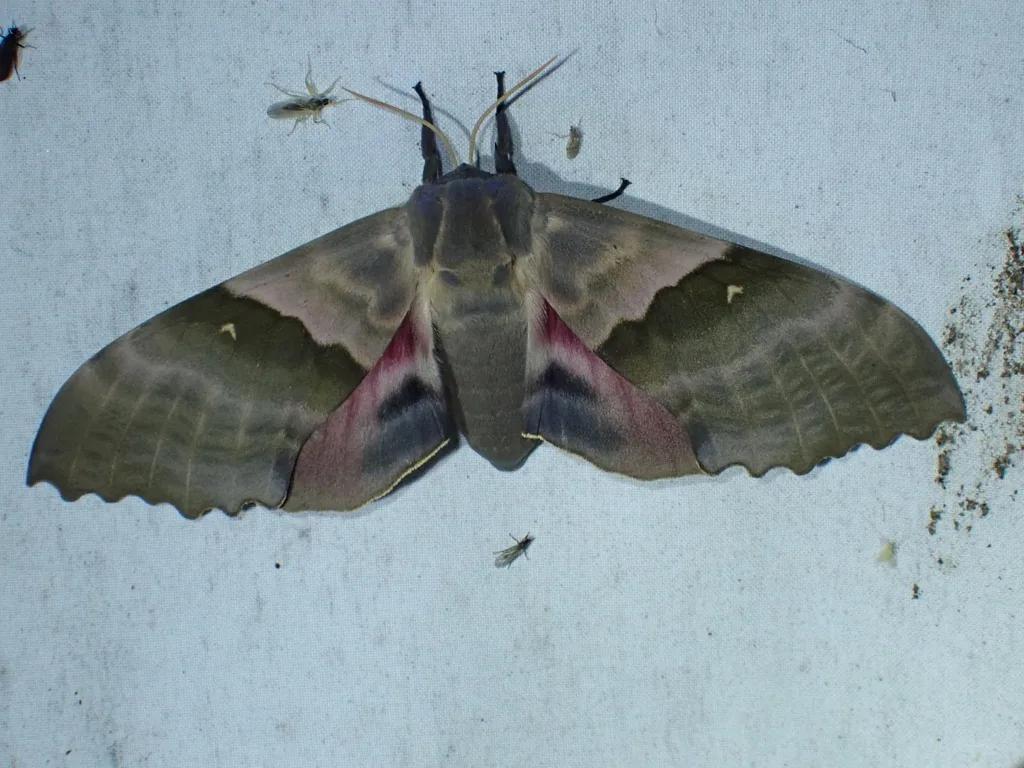
- The moth is very large, with a wingspan of 10 to 12 cm (about 4 to 4.7 inches). The long, narrow forewings are banded in light and dark gray-brown, and the hindwing is maroon with a blue-black blotch at its rear corner.[1]
- The caterpillar is large and green; the University of Alberta museum says the larvae are reputed to be the largest insects in Alberta by weight.[1]
Look-alikes
| Look-alike | How to tell them apart |
|---|---|
| Paler western forms | Very pale moths from southern Alberta have been called Pachysphinx occidentalis, a lighter tan moth with more maroon on the hindwing. Alberta specimens grade from pale to dark, and the University of Alberta museum treats them all as the big poplar sphinx pending further study.[1] |
Where it lives
BAMONA gives Maine to north Florida and west to Washington, Oregon, Utah, New Mexico and Texas, plus Baja California Norte; the University of Alberta museum says it ranges from the Gulf States north into the boreal forest. It lives where poplars grow: riparian areas and moist mountainsides (BAMONA), open mature poplar or mixedwood forest (Alberta), and, the Missouri Department of Conservation says, moist areas around lakes and river bottoms with willow, poplar and cottonwood.[2][1][4]
Biology and life cycle
The University of Alberta museum says the caterpillars feed on poplars, especially aspen, and that single reports from willow and birch need confirmation. BAMONA lists poplar, aspen, cottonwood and willow.[1][2]
BAMONA gives one brood in the north, flying in June and July, and two in the south from May to September; eggs hatch in about 9 days. In Alberta caterpillars are found from mid-July to September.[2][1]
The pupa overwinters in the ground, in a shallow burrow according to BAMONA. In Alberta the moths fly from mid-May through mid-July, and BAMONA says the adults do not feed.[1][2]
The adults are active at night and come readily to lights. In a field survey of synthetic chemical lures, big poplar sphinx moths were among the sphinx moths attracted to 10,12-hexadecadienyl compounds.[1][5]
Damage and signs
Health risk
The University of Alberta museum, BAMONA and the Missouri Department of Conservation describe only its feeding and life history; none reports bites, stings or any danger to people from the caterpillar or the moth.[1][2][4]
Control
Prevention
None of these sources suggests control; the University of Alberta museum lists the moth as common and widespread.[1][2][4]
Where the sources disagree
Wingspan: the University of Alberta museum gives 10 to 12 cm; BAMONA gives 7.6 to 12 cm.[1][2]
Willow: the University of Alberta museum says single reports from willow need confirmation; BAMONA lists willow as a host, and the Missouri Department of Conservation names willow among its food plants.[1][2][4]
Flight season: the University of Alberta museum gives mid-May to mid-July in Alberta; BAMONA gives June and July in the north and May to September in the south.[1][2]
Name: BAMONA and Ohio DNR call it the modest sphinx, the University of Alberta museum the big poplar sphinx, and the Missouri Department of Conservation uses both names.[2][3][1][4]
Common questions
- What is the huge green caterpillar on my cottonwood or aspen?
- A likely candidate is the big poplar sphinx, a large green caterpillar of poplars, aspen and cottonwood; in Alberta its larvae are reputed to be the largest insects by weight.[1][2]
- What does the moth look like?
- It is a very large gray-brown moth, 10 to 12 cm across, with banded forewings and a maroon hindwing marked with a blue-black blotch.[1]
Sources
- University of Alberta Museums, “Species Details: Pachysphinx modesta (Big Poplar Sphinx), E.H. Strickland Entomological Museum.” search.museums.ualberta.ca/g/2-439 (accessed 2026-11-13)
- Butterflies and Moths of North America (BAMONA), “Modest sphinx, Pachysphinx modesta (species account).” www.butterfliesandmoths.org/species/Pachysphinx-modesta (accessed 2026-11-13)
- Ohio Department of Natural Resources, Division of Wildlife, “Moths of Ohio Field Guide (Publication 5467).” dam.assets.ohio.gov/image/upload/ohiodnr.gov/documents/wildlife/backyard-wildlife/Moths%20of%20Ohio%20Field%20Guide%20pub5467.pdf (accessed 2026-11-13)
- Missouri Department of Conservation, “Sphinx Moths (Hawk Moths).” mdc.mo.gov/discover-nature/field-guide/sphinx-moths-hawk-moths (accessed 2026-11-13)
- Journal of Chemical Ecology (via NCBI PubMed), “Attraction of sphingid moths (Lepidoptera: Sphingidae) to 10,12-hexadecadienyl aldehydes and acetates: evidence of pheromone components (D. W. Reed, E. W. Underhill and E. M. Giblin, Journal of Chemical Ecology, 1987; abstract).” pubmed.ncbi.nlm.nih.gov/24302058/ (accessed 2026-11-13)
- Global Biodiversity Information Facility (GBIF), “Pachysphinx modesta Harris, 1839 (GBIF Backbone Taxonomy).” api.gbif.org/v1/species/1863025 (accessed 2026-11-13)
- iNaturalist, “Pachysphinx modesta taxon page (order and family).” www.inaturalist.org/taxa/143445 (accessed 2026-11-09)