On this page
How to identify it
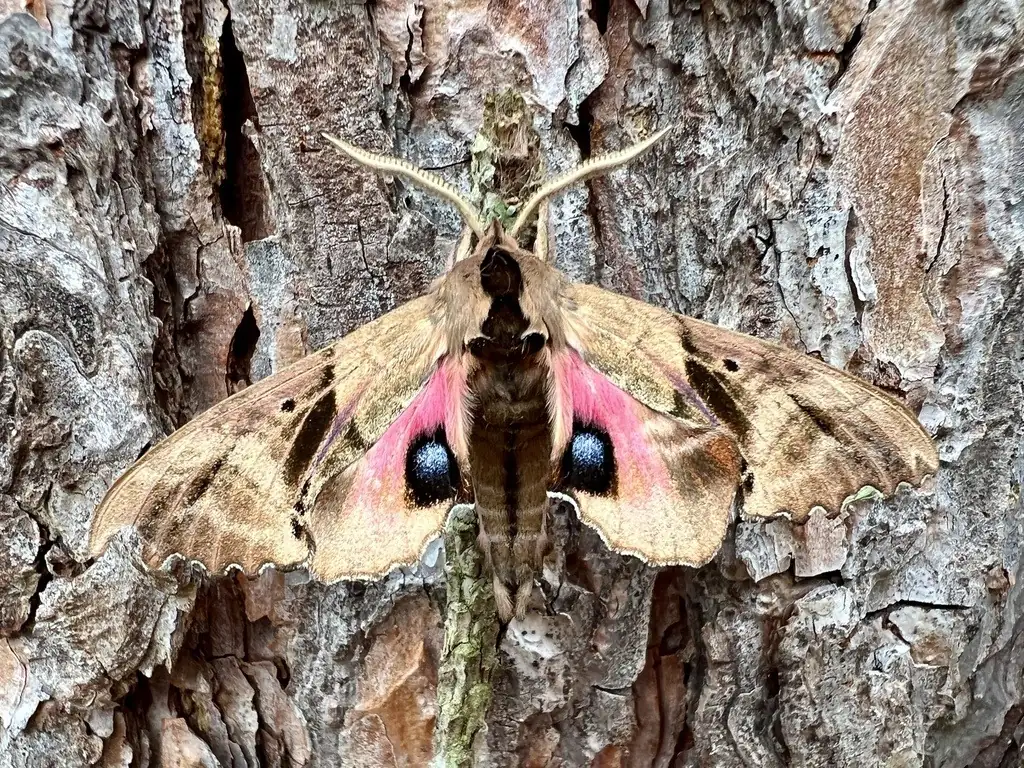
- BAMONA describes the forewing upperside as pale gray to dark reddish brown, with pink at the base underneath, and white fringe in the hollows of the strongly scalloped outer edges.[2]
- The moth's forewings resemble dead leaves in both pattern and outline, with strongly scalloped outer edges. Each hindwing has a broad pink patch and a single large blue eyespot, shown when the moth flicks its forewings open. Ohio gives a wingspan of 2.2 to 3.7 inches; Butterflies and Moths of North America gives 2 3/16 to 3 3/4 inches.[1][2]
Look-alikes
| Look-alike | How to tell them apart |
|---|---|
| One-eyed sphinx (Paonias myops) | Smaller, with dark brown forewings and orange rather than pink around the hindwing eyespots.[1] |
| Other eyespot moths | The io and polyphemus moths also use the false-eye defense; the Ohio guide treats them separately from the sphinx moths.[1] |
Where it lives
Butterflies and Moths of North America gives Nova Scotia and Maine to Florida and west to British Columbia, Washington, northern California and Arizona. It lives in forests, woodlots and suburbs with larger trees and is the most common eyespot sphinx in Ohio. GBIF holds about 10,500 U.S. records since 1990, most from Massachusetts, Vermont and Pennsylvania.[2][1][3]
Biology and life cycle
Butterflies and Moths of North America gives three broods in Florida (March to October), several in Louisiana and one or two elsewhere, with moths flying from May to September.[2]
By day the moth sits camouflaged by its leaf-like forewings. When disturbed, it rapidly opens them to uncover the hindwing eyespots; the sudden 'eyes' make birds recoil and often leave.[1]
Eggs hatch seven to eight days after they are laid. Full-grown caterpillars pupate and spend the winter in chambers underground, and the adult moths do not feed.[2]
Like other sphinx caterpillars, they can be parasitized by small braconid wasps; the white oval cocoons sometimes seen on hornworms belong to these wasps.[4]
Damage and signs
Health risk
Ohio DNR, BAMONA and the Missouri Department of Conservation describe only leaf feeding by the caterpillar and the moth's eyespot display; none reports bites, stings or other effects on people.[1][2][4]
Control
Prevention
None of the sources gives a control step, and Butterflies and Moths of North America lists the species as globally secure. Ohio describes it as a common moth of forests, woodlots and suburban areas with larger trees, where its caterpillars feed on many tree species.[1][2]
Where the sources disagree
Wingspan: Ohio DNR gives 2.2 to 3.7 inches; Butterflies and Moths of North America gives 2 3/16 to 3 3/4 inches.[1][2]
Spelling: the Ohio guide writes Paonias excaecatus; BAMONA and GBIF use Paonias excaecata.[1][2][5]
Common questions
- What moth flashes a big eyespot ringed with pink?
- In Ohio, most likely the blinded sphinx, the most common of five sphinx moths with hindwing eyespots. The smaller one-eyed sphinx has orange, not pink, around its eyespots.[1]
- Where does the blinded sphinx spend the winter?
- As a pupa in a chamber underground; full-grown caterpillars leave the tree to pupate.[2]
Sources
- Ohio Department of Natural Resources, Division of Wildlife, “Moths of Ohio Field Guide (Publication 5467).” dam.assets.ohio.gov/image/upload/ohiodnr.gov/documents/wildlife/backyard-wildlife/Moths%20of%20Ohio%20Field%20Guide%20pub5467.pdf (accessed 2026-11-13)
- Butterflies and Moths of North America (BAMONA), “Blinded sphinx, Paonias excaecata (species account).” www.butterfliesandmoths.org/species/Paonias-excaecata (accessed 2026-11-13)
- Global Biodiversity Information Facility (GBIF), “Paonias excaecata: occurrence records in the U.S., 1990-2026 (GBIF occurrence search).” api.gbif.org/v1/occurrence/search?taxonKey=4301348&country=US&hasGeospatialIssue=false&occurrenceStatus=PRESENT&year=1990%2C2026&facet=stateProvince&facetLimit=400&limit=0 (accessed 2026-11-13). State counts are records reported (iNaturalist research-grade, museum specimens, surveys), not abundance.
- Missouri Department of Conservation, “Sphinx Moths (Hawk Moths).” mdc.mo.gov/discover-nature/field-guide/sphinx-moths-hawk-moths (accessed 2026-11-13)
- Global Biodiversity Information Facility (GBIF), “Paonias excaecata Smith, 1797 (GBIF Backbone Taxonomy).” api.gbif.org/v1/species/4301348 (accessed 2026-11-13)
- iNaturalist, “Paonias excaecata taxon page (order and family).” www.inaturalist.org/taxa/49716 (accessed 2026-11-11)