On this page
How to identify it
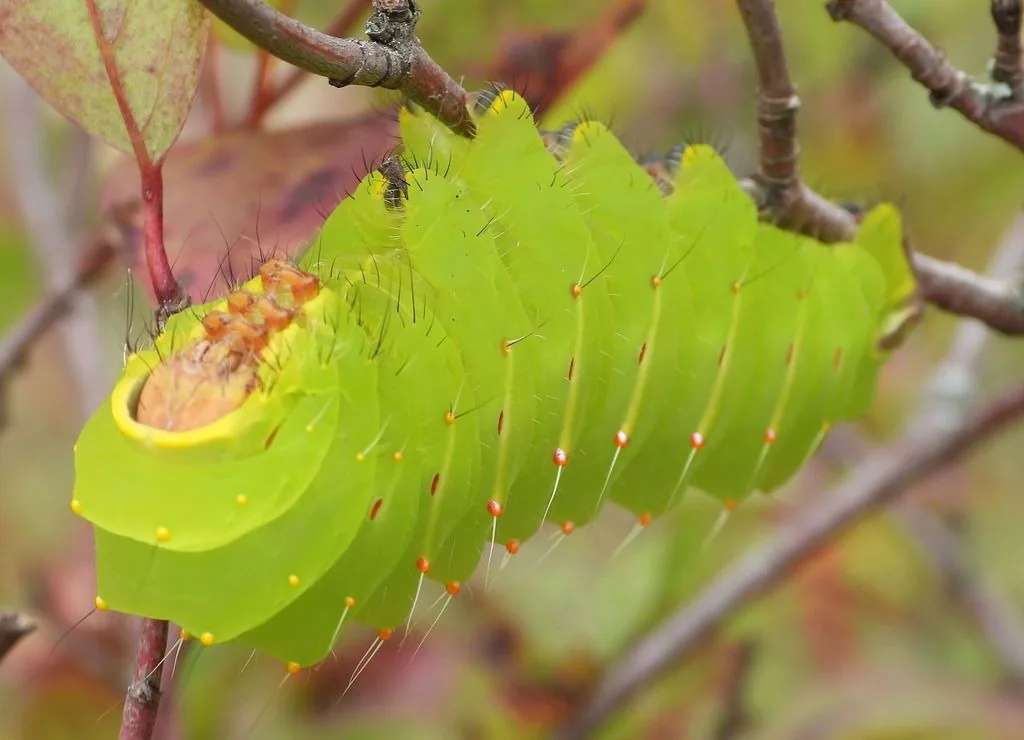
- Full-grown caterpillars are nearly 3 inches long, bright translucent green with a brown head. Each angular body segment carries six yellow-orange to reddish bumps (tubercles) with small bristles, and on most abdominal segments a yellow line runs through the brown spiracle on each side. UF/IFAS gives full-grown caterpillars as 60 to 75 mm (2 1/3 to 3 inches), translucent yellowish green to green, with orange to red bumps that are silver on their outer sides.[2][1][3]
- The moth's ground color varies from tan or brown to bright reddish brown or yellowish brown. Each forewing has a small eyespot and each hind wing a very large one; the eyespots are clear ovals ringed with yellow, blue and black. UF/IFAS adds gray among the color forms, notes wide variation even among moths from one place, and describes pink-edged white lines across the forewings.[1][4][3]
- Males have smaller bodies than females and larger, feathery antennae. UF/IFAS says the antennae are comblike on four sides in both sexes.[1][3]
- The cocoon is oval, with a tough outer layer of silk, and is usually wrapped in a leaf of the food plant. Most fall to the ground with the leaves in autumn; some stay attached to stems through the winter.[1][2]
- Caterpillars pass through five stages. First-stage larvae are white with two black crossbars on each segment; later stages are yellow-green, and their bristles look less prominent after each molt.[3]
- Eggs are slightly oval and flattened, white with two broad brown rings, and glued down with a dark brown adhesive; the largest reported measured 2.4 by 2 by 1.52 mm.[3]
Look-alikes
| Look-alike | How to tell them apart |
|---|---|
| Luna moth | Luna caterpillars are also bright green and plump, but their narrow yellow bands sit at the back edge of each segment, while the polyphemus caterpillar's yellow lines run near the center of each segment through the spiracles. The adult luna moth is pale lime green with long tails on the hind wings. UF/IFAS says the polyphemus cocoon is single-layered, thicker and more elliptical than the luna moth's.[5][3] |
Where it lives
Butterflies and Moths of North America places it in every U.S. state except Arizona and Nevada, in every Canadian province except Newfoundland and Prince Edward Island, and in Mexico. The Missouri Department of Conservation finds it statewide in Missouri, in and near forests and also in parks, suburbs, orchards and wetlands. UF/IFAS calls it the most widely distributed large silk moth, from southern Canada into Mexico and in all of the lower 48 states except Arizona and Nevada.[4][1][3]
Biology and life cycle
Females lay eggs singly or in groups of 2 or 3 on leaves of the host plant. Caterpillars feed alone, and older ones eat a whole leaf and then cut the leaf stalk so it drops to the ground. UF/IFAS says caterpillars eat their eggshells right after hatching, and droppings on driveways or parking lots can give away large caterpillars overhead.[4][3]
MU Extension finds caterpillars from May to October in Missouri, where the Missouri Department of Conservation says adults fly from mid-April through August.[2][1]
Adults do not feed and live a few weeks at most. They fly at night, are often drawn to lights, and in Missouri seek mates between about 11 p.m. and 1 a.m. UF/IFAS says adults have vestigial mouthparts and are strongly drawn to light, especially ultraviolet, and it notes concern that street lighting may disrupt mating in towns.[1][4][3]
Males usually start emerging several days before the females of their brood, typically in the afternoon. Females release a sex pheromone starting the evening they emerge, pairs stay coupled through the day and separate at dusk, and females lay eggs for several nights.[3]
To escape the cocoon, which has no exit valve, the moth secretes an enzyme that softens the silk at one end, then tears its way out with spurs near the base of the front wings.[3]
Caterpillars raised under short days (8 to 12 hours of light) form overwintering pupae, while long days (over 17 hours) give pupae that develop without a winter rest. They have been reported from more than 50 species of broad-leaved plants.[3]
Cocoons may be fixed lengthwise to a twig, hung from a silk stalk (more common in the South), spun among leaves so most fall in winter, or spun on the ground among leaves and grass.[3]
When threatened, caterpillars often rear up in a 'sphinx' pose; if attacked they click their jaws and may bring up distasteful fluid, which deterred ants and mice in one study. Adults flash the big hind-wing eyespots, which may startle predators.[3]
Damage and signs
- Common hosts include hickory, maple, hazelnut, oak, ash, walnut, sycamore, butternut, willow, elm, hawthorn, basswood and birch. In Missouri the caterpillars feed on more than 20 species of trees and shrubs, with silver maple, birch, hazelnut and oak among the favorites.[2][1]
- A single caterpillar eats a lot of foliage, but numbers rarely reach levels that call for control. Butterflies and Moths of North America notes the caterpillars can be occasional pests in California plum orchards. UF/IFAS likewise says they are never common enough to cause significant damage, except occasionally on commercial plums in California, and that parasitoids and predators keep their numbers in check.[2][4][3]
Health risk
None of these sources reports a sting, bite or other risk to people or pets; MU Extension says caterpillars in this family are usually not considered pests.[2][1]
Control
Prevention
No control is needed in yards; silk moth caterpillars are usually not considered pests and rarely reach damaging numbers.[2]
Biological control
Leave them be. The Missouri Department of Conservation says some polyphemus populations are declining, harmed by parasitic flies and wasps that were introduced to fight the spongy moth. UF/IFAS lists ten species of tachinid flies and several kinds of parasitic wasps that attack it, and says squirrels and woodpeckers take cocoons in trees while mice may find those on the ground.[1][3]
Where sources disagree
Wingspan: the Missouri Department of Conservation gives 3½ to 5½ inches, while Butterflies and Moths of North America gives 3 15/16 to 5 7/8 inches (10 to 15 cm). UF/IFAS gives 10 to 15 cm (about 4 to 6 inches).[1][4][3]
Generations: MU Extension and the Missouri Department of Conservation describe several generations a year in Missouri. Butterflies and Moths of North America gives one brood in the north, two from the Ohio Valley southward, and several through most of the year in Florida, Texas and Louisiana. UF/IFAS gives one brood a year from Pennsylvania northward and two from the Ohio Valley southward, and says staggered emergence means adults can be found in every month in Florida.[2][1][4][3]
Eyespot rings: Butterflies and Moths of North America describes them as ringed with yellow, blue and black, while UF/IFAS describes the hind-wing eyespots as ringed with yellow, partial white and black.[4][3]
Mating time: the Missouri Department of Conservation says Missouri moths seek mates between about 11 p.m. and 1 a.m.; UF/IFAS says males are drawn all night, most strongly in the last two hours before sunrise.[1][3]
Common questions
- What is the huge green caterpillar on my oak?
- Possibly a polyphemus moth caterpillar: bright green, nearly 3 inches long, with a brown head and yellow-orange bumps on each segment.[2][1]
- Will it hurt my tree?
- Rarely. One caterpillar eats a lot of leaves, but their numbers seldom reach damaging levels.[2]
- Why does the moth have eyes on its wings?
- The big eyespot on each hind wing gave it its name, after the one-eyed giant Polyphemus in Homer's Odyssey. UF/IFAS adds that the family name, Saturniidae, comes from eyespots with rings reminiscent of the planet Saturn.[1][3]
- I found a polyphemus cocoon with a hole in it. Is it still alive?
- Probably not. UF/IFAS says woodpeckers and ichneumon wasps both leave similar exit holes; a cocoon a wasp has left still holds the dead caterpillar inside.[3]
Sources
- Missouri Department of Conservation, “Polyphemus Moth (Field Guide).” mdc.mo.gov/discover-nature/field-guide/polyphemus-moth (accessed 2026-11-14)
- University of Missouri Extension (Caterpillars in Your Yard and Garden, IPM1019), “Caterpillars in Your Yard and Garden, page 34: Polyphemus moth.” extension.missouri.edu/publications/ipm1019-34 (accessed 2026-11-14)
- University of Florida/IFAS Extension (Featured Creatures), “Polyphemus Moth, Antheraea polyphemus (Cramer), EENY-531/IN945.” ask.ifas.ufl.edu/publication/IN945 (accessed 2026-11-14)
- Butterflies and Moths of North America, “Polyphemus moth, Antheraea polyphemus (species account).” www.butterfliesandmoths.org/species/Antheraea-polyphemus (accessed 2026-11-14)
- Missouri Department of Conservation, “Luna Moth (Field Guide).” mdc.mo.gov/discover-nature/field-guide/luna-moth (accessed 2026-11-14)
- iNaturalist, “Antheraea polyphemus taxon page (order and family).” www.inaturalist.org/taxa/47919 (accessed 2026-11-14)