On this page
How to identify it
- A caterpillar ready to pupate strengthens a leaf stem with silk and spins its cocoon inside the curled leaf, which hangs from the host plant through the winter; in Ohio the hanging cocoons are readily found in winter.[1][2]
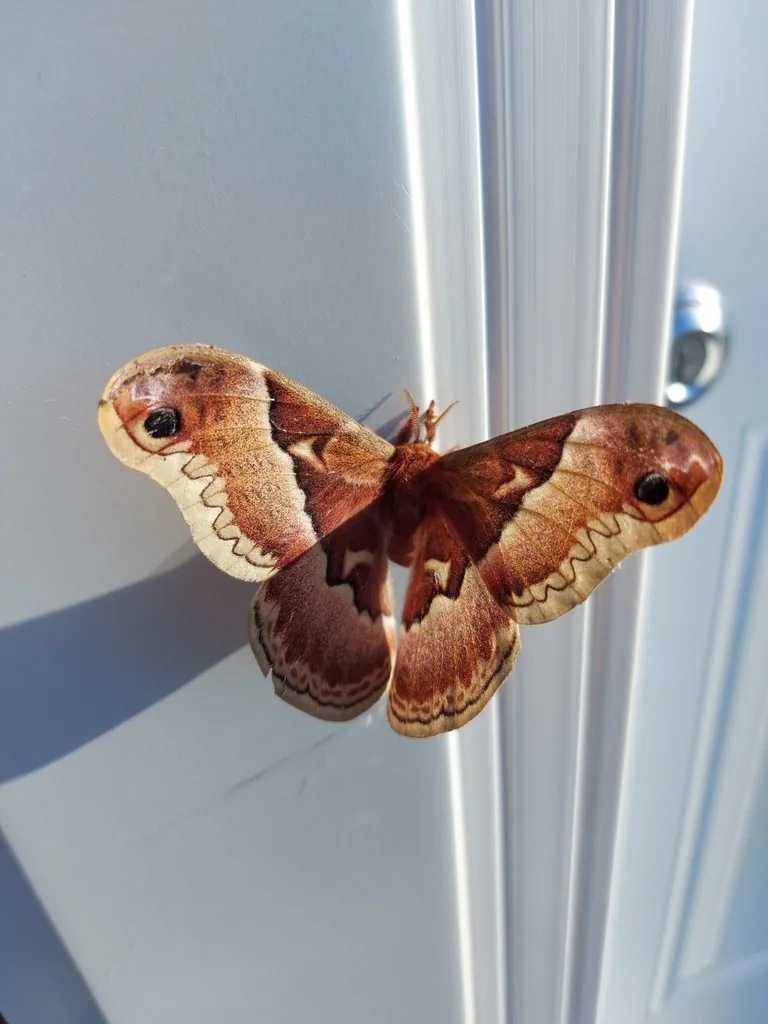
- Males are almost black with a light brown (tan) border and pink near the eyespots at the forewing tips. Females are dark brown to reddish-brown with tan borders, tan cell spots and half-moon wing spots.[2][1]
- The grown caterpillar is about 50 to 62 mm long, hairless and chalky bluish or greenish white, with a small yellow head (Baker, USDA Forest Service).[9][8]
- Paired coral-red knobs, black at the base, stand on the second and third thoracic segments, and one large yellow knob sits on top of the eighth abdominal segment. The sides carry black spots rimmed with blue, the hind proleg has a blackened C-shaped mark, and the plate at the rear end is decidedly yellow-green.[8][9]
- Winter cocoons are tough and light-colored, enclosed in a leaf whose stalk is fastened to the twig by a very strong band of silk.[9]
- Baker's USDA manual gives the adult a wing expanse of about 75 mm; the female's wings are reddish-purple to brown with light brown borders, crossed near the middle by a wavy white line, with an angular white spot on each wing and an eyelike spot near each forewing tip.[9]
Look-alikes
| Look-alike | How to tell them apart |
|---|---|
| Tuliptree silkmoth (Callosamia angulifera) | Less common; both sexes look much like the female promethea but are browner. As caterpillars, the USDA Forest Service guide says tuliptree silkmoth larvae are often indistinguishable from sweetbay silkmoth larvae but feed only on tuliptree.[2][8] |
| Sweetbay silkmoth (Callosamia securifera) | Its caterpillar looks like the promethea's but waxier, with orange-red thoracic knobs that are yellow and black at the base, smaller side spots not rimmed with blue, and an anal plate the same color as the rest of the body. It feeds on sweet bay.[8] |
| Cecropia moth caterpillar (Hyalophora cecropia) | Much larger and sea green, with orange thoracic knobs, yellow knobs along the back and pale blue knobs on the sides; Baker describes all the knobs as bearing stiff black bristles.[8][9] |
Where it lives
BAMONA gives the range as the eastern United States to the Great Plains, from Maine west through southern Quebec and Wisconsin to Minnesota, and south to the Florida panhandle, the Gulf coast and east Texas, in deciduous woodlands. In Ohio it is most common in the southern part of the state but probably occurs statewide, in forest, forest edges and woodlots. GBIF holds about 5,500 U.S. records since 1990 from 35 state-level areas, the most from Pennsylvania (568), Ohio (512), Vermont (471) and New York (465). Baker's USDA manual describes it as occurring throughout most of the eastern United States and southern Canada.[1][2][3][9]
Biology and life cycle
BAMONA gives one brood in the north, flying from May to July, and two in the south, flying from March to May and in August.[1]
The cocoon hangs from the host plant through the winter; in Ohio the cocoons are easy to find in winter, especially on or near sassafras and wild black cherry. Baker's USDA manual says winter is spent in this leaf-enclosed cocoon.[1][2][9]
Females come readily to lights, but males do not. Males fly mainly in the late afternoon looking for newly emerged females, and their fast flight makes them look like swallowtail butterflies.[2]
Most mating happens from 4 PM to sunset, and at night females lay rows of 4 to 10 eggs on the upper side of host leaves. Young caterpillars feed together and older ones alone; older caterpillars cut the leaf stem so the leaf falls, perhaps to remove signs of feeding. The adults do not feed.[1]
A 1991 study describes a wide host range on 6 to 10 plant families, with local populations on black cherry, tuliptree, sassafras and spicebush; caterpillars from tuliptree lines could not survive on paper birch.[4]
In Massachusetts forests, an introduced parasitic fly, Compsilura concinnata, parasitized 69.8 percent of promethea caterpillars set out for 6 days and 65.6 percent of those set out for 8 days; the authors suggest the fly may explain reported declines of silk moths in New England.[5]
The USDA Forest Service guide gives caterpillars from May to September, with two generations in the South and one in the North.[8]
Damage and signs
Health risk
It is a silkmoth with a hairless caterpillar. Ohio, BAMONA and the USDA Forest Service guides don't mention stings or any other risk to people or pets.[2][1][8][9]
Control
Prevention
None of the sources gives a control step. BAMONA reports no management needs and gives its global rank as G5.[1][2]
Where the sources disagree
Wingspan: the Ohio guide gives 3.0 to 3.7 inches; BAMONA gives 2 15/16 to 3 3/4 inches (7.5 to 9.5 cm). Baker's 1972 USDA manual gives about 75 mm.[2][1][9]
Sweetbay: BAMONA lists sweetbay as a caterpillar host, but in a 1996 laboratory study promethea caterpillars fed readily on sweetbay yet could not survive past the third instar. The USDA Forest Service caterpillar guide lists magnolias among its foods.[1][6][8]
Common questions
- What are the curled leaves hanging from my sassafras in winter?
- They may be promethea cocoons. The caterpillar strengthens the leaf stem with silk and spins its cocoon inside the curled leaf, so it hangs on through winter; in Ohio they are easy to find on or near sassafras and wild black cherry.[1][2]
- Why does the moth look so different from the pictures?
- The sexes differ: males are almost black with a light brown border, females reddish-brown with white markings.[2]
- What is the big blue-green caterpillar with red knobs on my lilac or cherry?
- Likely a promethea moth caterpillar: the USDA Forest Service describes it as chalky green and hairless, with paired red knobs near the front, one yellow knob near the rear and blue-rimmed black spots along the sides.[8][9]
Sources
- Butterflies and Moths of North America (BAMONA), “Promethea silkmoth, Callosamia promethea (Drury, 1773).” www.butterfliesandmoths.org/species/Callosamia-promethea (accessed 2026-11-13)
- Ohio Department of Natural Resources, Division of Wildlife, “Moths of Ohio Field Guide (Publication 5467).” dam.assets.ohio.gov/image/upload/ohiodnr.gov/documents/wildlife/backyard-wildlife/Moths%20of%20Ohio%20Field%20Guide%20pub5467.pdf (accessed 2026-11-13)
- Global Biodiversity Information Facility (GBIF), “Callosamia promethea: U.S. occurrence records since 1990 by state (GBIF occurrence API).” api.gbif.org/v1/occurrence/search?taxonKey=1866341&country=US&hasGeospatialIssue=false&occurrenceStatus=PRESENT&year=1990%2C2026&facet=stateProvince&facetLimit=400&limit=0 (accessed 2026-11-13). 5,480 records from 35 state-level areas; Pennsylvania 568, Ohio 512, Vermont 471, New York 465; fetched 2026-11-13.
- Oecologia, via PubMed, “Lack of physiological improvement in performance of Callosamia promethea larvae on local host plant favorites (Scriber, Potter and Johnson, 1991).” pubmed.ncbi.nlm.nih.gov/28313205/ (accessed 2026-11-13). Cited from the abstract, read through NCBI E-utilities. Michigan State University and University of Wisconsin authors.
- Conservation Biology, via PubMed, “Effects of a biological control introduction on three nontarget native species of saturniid moths (Boettner, Elkinton and Boettner, 2000).” pubmed.ncbi.nlm.nih.gov/35701905/ (accessed 2026-11-13). Cited from the abstract, read through NCBI E-utilities. University of Massachusetts Amherst authors.
- Journal of Chemical Ecology, via PubMed, “Phenylpropenoid phenolics in sweetbay magnolia as chemical determinants of host use in saturniid silkmoths (Callosamia) (Johnson, Scriber and Nair, 1996).” pubmed.ncbi.nlm.nih.gov/24227209/ (accessed 2026-11-13). Cited from the abstract, read through NCBI E-utilities. Michigan State University authors.
- Global Biodiversity Information Facility (GBIF), “Callosamia promethea Drury, 1773 (GBIF Backbone Taxonomy).” api.gbif.org/v1/species/1866341 (accessed 2026-11-13). ACCEPTED; order Lepidoptera, family Saturniidae; vernacular name Promethea Silkmoth
- USDA Forest Service, Forest Health Technology Enterprise Team (scan at Internet Archive), “Caterpillars of Eastern Forests, FHTET-96-34 (D. L. Wagner, V. Giles, R. C. Reardon and M. L. McManus, November 1997).” archive.org/details/caterpillarsofea001997 (accessed 2026-11-14)
- USDA Forest Service (scan at Internet Archive), “Eastern Forest Insects, Miscellaneous Publication No. 1175 (W. L. Baker, 1972).” archive.org/details/easternforestins1175bake (accessed 2026-11-14)