On this page
How to identify it
- Adults have stout, hairy bodies and feathery antennae. The body is red with a white collar and white bands on the abdomen, and each of the four dark brown or gray wings has a red-rimmed whitish crescent near the center.[2][3]
- Wingspans run up to about 6 inches; the sources give different ranges (see Where the sources disagree).[1][2][3]
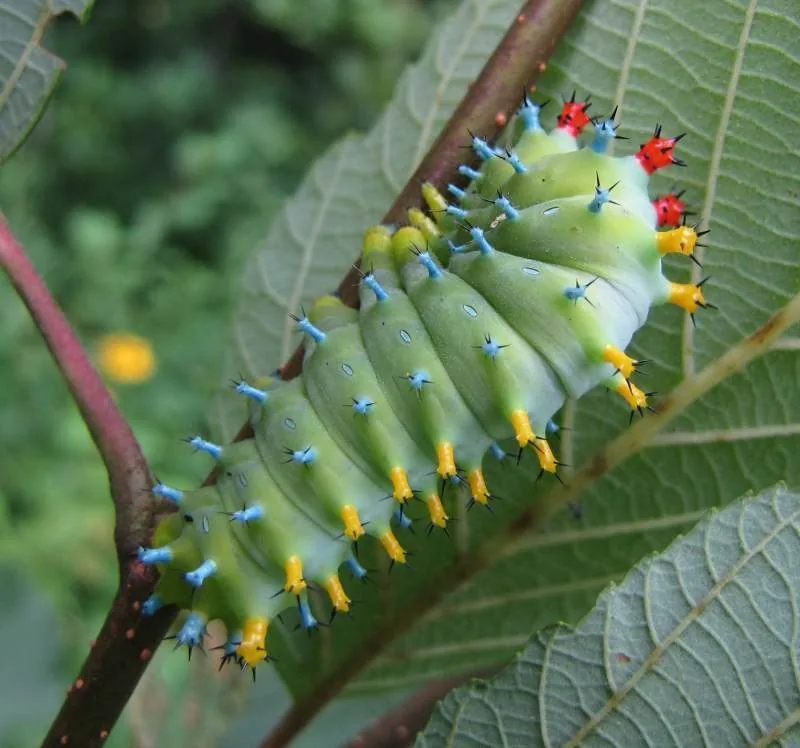
- Newly hatched caterpillars are tiny, black and spiny. Grown caterpillars reach about 4 inches and are pale to bluish green, with four reddish-orange knobs on the thorax, a double row of yellow knobs down the back and rows of blue knobs along the sides; all the knobs carry tiny black spikes.[1][2]
- Eggs are white and brown mottled, laid in small groups or rows of 2 to 6 on both sides of host leaves.[1][3]
- The cocoon is tough, brownish silk fastened along its full length to a twig, usually in a sheltered spot.[1][2][3]
Look-alikes
| Look-alike | How to tell them apart |
|---|---|
| Other giant silk moths | Missouri's field guide lists the polyphemus, luna, io, honey locust and rosy maple moths as similar species. Look for the cecropia's red body with a white collar and white abdominal bands, and the red-rimmed white crescent on each wing.[2] |
Where it lives
It ranges from Nova Scotia and Maine south to Florida, and west across southern Canada and the eastern U.S. to the Rocky Mountains. GBIF's 1990-2026 U.S. records (about 9,400) come mostly from Minnesota, Pennsylvania, New York, Texas and Ohio, with only a handful from Montana, Colorado, Wyoming, Utah, Arizona and California.[3][5]
Biology and life cycle
It spends the winter as a pupa in its cocoon on a host twig. Adults emerge in spring, live about two weeks and don't feed, since their mouthparts are small or absent.[1][2][3]
NC State and the Missouri Department of Conservation report one generation a year, with Missouri adults flying from early April through June; other sources give more generations in parts of the range (see Where the sources disagree).[1][2]
Adults are active at night and come to lights. Females release scent before sunrise to attract mates.[2]
Eggs hatch in about 10 to 14 days. Young caterpillars feed in groups, then spread out and feed alone as they grow.[3][2]
NC State says females lay about 100 eggs (the same page later says hundreds). Few caterpillars survive: birds eat them, and predators, parasites and disease take many more.[1]
In Massachusetts field trials, none of 500 newly hatched cecropia caterpillars placed on trees survived past the fifth instar, and an introduced parasitic fly, Compsilura concinnata, caused 81% of deaths in the first three instars.[4]
Damage and signs
- Caterpillars feed on more than 20 plant families, mainly maples (including box elder), cherries, plums, apples, birches, alders, dogwoods, lilacs and willows. A USDA Forest Service guide says maples and cherries are preferred and lists many other broad-leaved trees and shrubs, including larch.[1][2][3][6]
Health risk
Adults can't feed, since they lack functioning mouthparts, and the sources describe the caterpillars only as leaf feeders; no cited source describes any risk to people or pets.[2][1]
Control
Prevention
No control is needed: NC State says no control measures seem to be needed, and BAMONA reports no management needs.[1][3]
A moth that may be declining
The Missouri Department of Conservation says numbers are declining in some regions because of habitat loss, pesticides and other causes, including a parasitic tachinid fly introduced to fight the spongy moth.[2]
That fly, Compsilura concinnata, was released in North America repeatedly from 1906 to 1986 against 13 pest species. Researchers at the University of Massachusetts concluded it may explain reported declines of silk moths in New England.[4]
Where the sources disagree
Generations: NC State and the Missouri Department of Conservation report one generation a year; BAMONA gives one flight from March to July over most of the range and two flights in the Midwest; a USDA Forest Service caterpillar guide gives two or three generations in the South and one in the North.[1][2][3][6]
Wingspan: NC State gives up to 6 inches, the Missouri Department of Conservation 3 3/4 to 6 inches, and BAMONA 4 5/16 to 5 7/8 inches.[1][2][3]
Common questions
- What is the huge green caterpillar with colored knobs?
- If it's pale green, up to about 4 inches long, with red-orange knobs behind the head, yellow knobs down the back and blue knobs along the sides, it's likely a cecropia moth caterpillar.[1][2]
- Is it a pest?
- Rarely. NC State says the caterpillars are rarely abundant enough to cause noticeable damage and no control measures seem to be needed, and BAMONA reports no management needs.[1][3]
- Why don't cecropia moths live long?
- Adults have small or absent mouthparts and don't feed. They live about two weeks on reserves stored as caterpillars.[2][1]
Sources
- NC State Extension, “Cecropia Moth.” content.ces.ncsu.edu/cecropia-moth (accessed 2026-11-13)
- Missouri Department of Conservation, “Cecropia Moth (Field Guide).” mdc.mo.gov/discover-nature/field-guide/cecropia-moth (accessed 2026-11-13)
- Butterflies and Moths of North America (BAMONA), “Cecropia silkmoth, Hyalophora cecropia (Linnaeus, 1758).” www.butterfliesandmoths.org/species/Hyalophora-cecropia (accessed 2026-11-13)
- Conservation Biology, via PubMed, “Boettner GH, Elkinton JS, Boettner CJ (2000), Effects of a biological control introduction on three nontarget native species of saturniid moths, Conservation Biology 14(6):1798-1806 (University of Massachusetts Amherst).” pubmed.ncbi.nlm.nih.gov/35701905/ (accessed 2026-11-13). Cited from the PubMed abstract.
- Global Biodiversity Information Facility (GBIF), “Hyalophora cecropia (cecropia moth): occurrence records in the U.S., 1990-2026 (GBIF occurrence search).” api.gbif.org/v1/occurrence/search?taxonKey=1865839&country=US&hasGeospatialIssue=false&occurrenceStatus=PRESENT&year=1990%2C2026&facet=stateProvince&facetLimit=400&limit=0 (accessed 2026-11-13). State counts are records reported (iNaturalist research-grade, museum specimens, surveys), not abundance; a few state names appear twice with different spelling and were combined.
- USDA Forest Service, Forest Health Technology Enterprise Team, “Caterpillars of Eastern Forests, FHTET-96-34 (D. L. Wagner, V. Giles, R. C. Reardon and M. L. McManus, 1997).” www.fs.usda.gov/foresthealth/technology/pdfs/Caterpillars_of_Eastern_Forests.pdf (accessed 2026-11-13)
- Global Biodiversity Information Facility (GBIF), “Hyalophora cecropia Linnaeus, 1758 (GBIF Backbone Taxonomy).” api.gbif.org/v1/species/1865839 (accessed 2026-11-13)