On this page
How to identify it
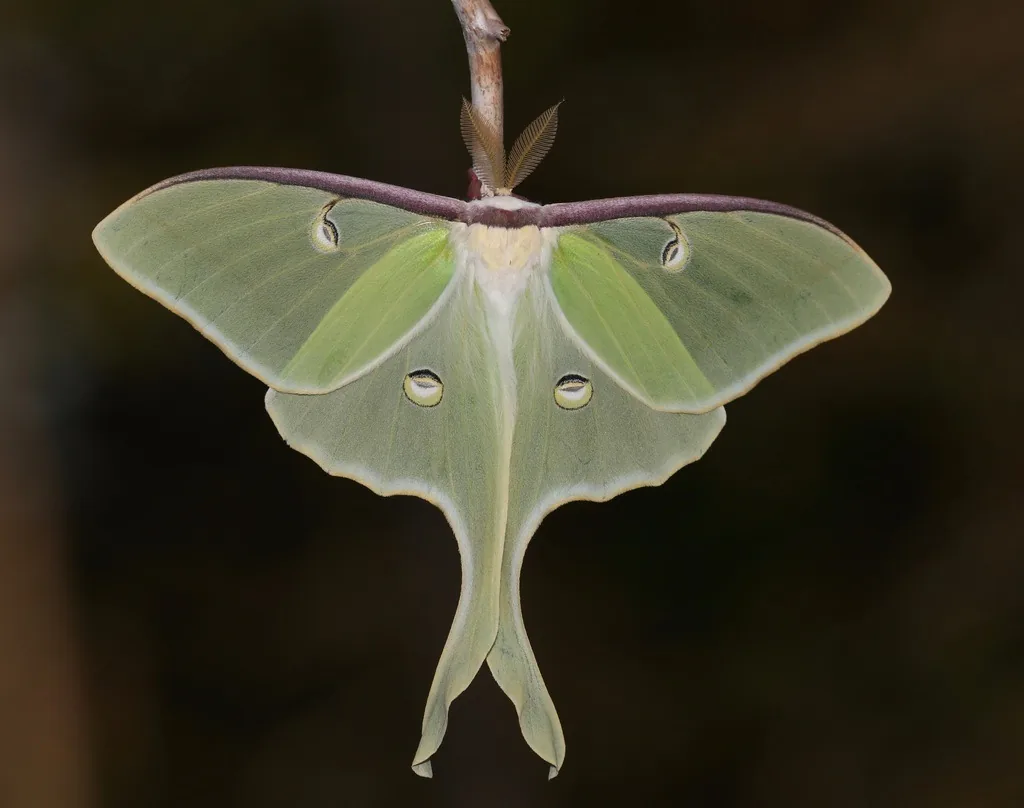
- Wings are pale or lime green (sea-foam green to yellowish), with a dark leading edge on the forewings, an eyespot on each of the four wings, and a long, tapering tail on each hindwing.[2][1][3]
- Wingspan is roughly 3 to 4 inches; see the disagreement note below for the exact ranges.[3][2][1]
- Males have feathery antennae; females' are slender and fuzzy. Males also tend to be lighter green and slightly smaller.[1][2]
- Where there is more than one brood, spring moths are vivid green with a pink to reddish-purple outer wing edge, and later broods are more yellow with a yellow edge. Northern moths have yellow edges.[1][3]
- Caterpillars are bright lime green with a narrow yellow band at the back of each segment, a yellowish stripe along each side below the breathing holes, rows of reddish tubercles and a brownish head. They grow up to about 3 1/2 inches.[2][1]
Look-alikes
| Look-alike | How to tell them apart |
|---|---|
| Polyphemus moth caterpillar | Very similar green caterpillar, but its yellow bands cross near the middle of each segment, close to the breathing holes, instead of at the back edge.[2] |
Where it lives
Deciduous forests of eastern North America: Nova Scotia west to Saskatchewan and eastern North Dakota, south to central Florida, the Gulf Coast and eastern Texas. It occurs statewide in Missouri and throughout South Carolina.[3][2][1]
Biology and life cycle
Brood numbers depend on latitude: one generation a year in Canada and the northern border states (May to July), two through the Ohio River Valley, and three in the Deep South (March to September). Missouri has three broods, with adults from early April through August.[1][3][2]
Adults have no working mouthparts and don't eat. They live about a week, long enough to mate and lay eggs.[1][2][3]
Around midnight females release a sex pheromone that males track with their feathery antennae. The main component, identified in 2016, attracted male moths in field trials in Ontario and Kentucky.[2][3][5]
Eggs are laid singly or in small groups on leaves and hatch in about a week (8 to 13 days in Missouri's account). Caterpillars feed alone and molt five times over 3 to 4 weeks.[3][2][1]
Caterpillars eat the leaves of walnut, hickory, pecan, persimmon, sweetgum, sumac and white birch, among others; Clemson's list also includes alder, beech, red maple, white oak, wild cherry and willow.[3][2][1]
The cocoon is thin and papery, made of silk and leaves, and ends up in the leaf litter, where it overwinters.[1][3][2]
The tails are an anti-bat device. In lab trials with big brown bats, moths with tails survived about 47 percent more often than moths with tails removed, and bats aimed at the spinning tails in 55 percent of attacks on intact moths.[4]
The tails don't seem to cost the moth by day: Carolina wrens offered models with real luna wings did not find or attack tailed models more often.[6]
Caterpillars defend themselves by rearing up, clicking their mandibles and regurgitating a distasteful fluid.[1][2]
Damage and signs
Health risk
Harmless. Adults cannot feed and the caterpillars eat only leaves.[1][2]
Control
Prevention
No control is needed. If you want to help them, turn off unneeded outdoor lights: Missouri and Clemson both point to bright night lighting, along with habitat loss, as a reason for local declines.[2][1]
Population concerns
Luna moths are secure overall (ranked G5) but can be rare at the edges of their range.[3]
Parasitic flies and wasps released in North America to fight the invasive spongy moth also attack luna, cecropia and promethea moths, and have reduced their populations in New England and elsewhere.[2]
Clemson adds pesticide buildup in the environment to the list of possible causes of fewer sightings.[1]
Where sources disagree
Wingspan: Butterflies and Moths of North America gives 2 15/16 to 4 1/8 inches (7.5 to 10.5 cm), Missouri 3 to 4 1/4 inches and Clemson 3 to 4.5 inches.[3][2][1]
Where the cocoon is spun: Butterflies and Moths of North America and Missouri describe cocoons spun in leaf litter under the host, while Clemson says the cocoon is usually spun in the tree and later falls to the ground.[3][2][1]
Common questions
- What is the big green moth with long tails?
- Almost certainly a luna moth. Its lime-green color and long tails set it apart from all other North American moths.[2][1]
- Do luna caterpillars damage trees?
- No significant damage is reported. They eat the leaves of trees such as walnut, hickory, sweetgum and persimmon, and no management is called for.[3][2]
- Why does a luna moth have tails?
- To fool bats. The spinning tails draw echolocating bats away from the body, and in lab trials tailed moths escaped far more often than moths without tails.[4][1]
Sources
- Clemson Cooperative Extension, Home & Garden Information Center, “Luna Moth.” hgic.clemson.edu/factsheet/luna-moth/ (accessed 2026-11-11)
- Missouri Department of Conservation, “Luna Moth (Field Guide).” mdc.mo.gov/discover-nature/field-guide/luna-moth (accessed 2026-11-11)
- Butterflies and Moths of North America (BAMONA), “Luna moth, Actias luna (species account).” www.butterfliesandmoths.org/species/Actias-luna (accessed 2026-11-11)
- Proceedings of the National Academy of Sciences, via PubMed, “Moth tails divert bat attack: evolution of acoustic deflection (Barber et al. 2015).” pubmed.ncbi.nlm.nih.gov/25730869/ (accessed 2026-11-11)
- Journal of Chemical Ecology, via PubMed, “Sex attractant pheromone of the luna moth, Actias luna (Millar et al. 2016).” pubmed.ncbi.nlm.nih.gov/27544534/ (accessed 2026-11-11)
- Biology Letters, via PubMed, “Testing bird-driven diurnal trade-offs of the moon moth's anti-bat tail (Rubin et al. 2023).” pubmed.ncbi.nlm.nih.gov/36722145/ (accessed 2026-11-11)
- iNaturalist, “Actias luna taxon page (order and family).” www.inaturalist.org/taxa/47916 (accessed 2026-11-11)