On this page
How to identify it
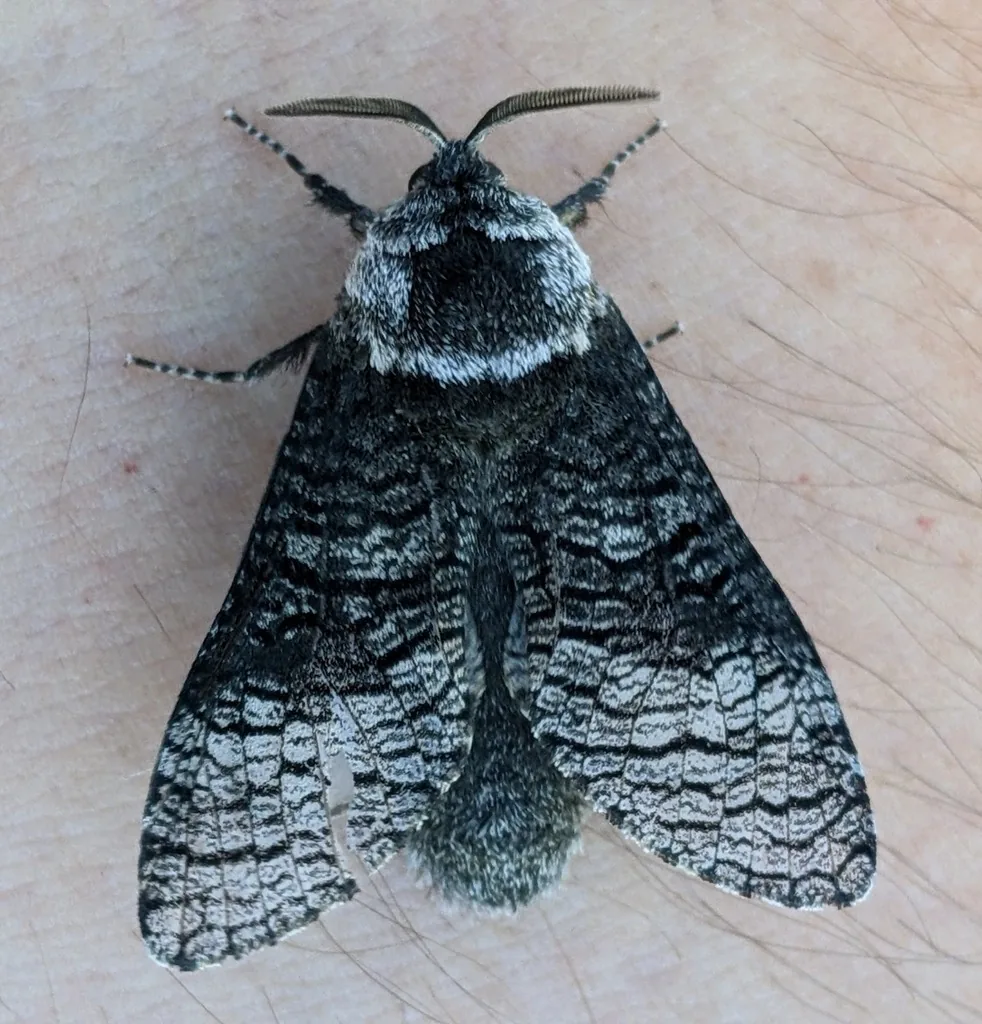
- The moth is moderately large and mottled black and gray, with a network of black lines over black-gray scaling on the forewings, darker toward the base, and rounded, translucent hindwings with blackish hairs at the base. Males span 40 to 50 mm and females 50 to 64 mm.[1]
- The sexes look more alike than in other cossid moths; the female has threadlike antennae and a slightly stouter body, the male feathery antennae.[1]
- The grown caterpillar is 32 to 45 mm long, creamy white with a dark brown head and strong black jaws, a thoracic shield that ranges from pale yellowish to blackish brown, dark brown spiracles and a yellowish shield at the rear.[1]
- Signs on the tree are small entry holes in the bark, often in and around old wounds, from which frass or debris is pushed out and sap may bleed. A heavily attacked tree has piles of frass at its base, and split wood is riddled with tunnels.[1]
Look-alikes
| Look-alike | How to tell them apart |
|---|---|
| Carpenterworm | Natural Resources Canada says poplar carpenterworm adults look similar to the carpenterworm, with mottled gray wings and bodies. Eastern Forest Insects describes the carpenterworm (Prionoxystus robiniae) as widely distributed in the United States and southern Canada, breeding in various hardwoods, while the poplar carpenterworm bores in poplars.[1][4] |
| Aspen carpenterworm | A sister species in the same genus, Acossus populi. Eastern Forest Insects says it is found in poplars and cottonwoods from coast to coast, while the poplar carpenterworm bores in poplars from New Jersey to Illinois.[4] |
Where it lives
A northern species: in the United States from New Jersey west to Illinois and North Dakota, and in Canada from Quebec and Ontario west to British Columbia. GBIF holds about 160 U.S. records since 1990 from 17 state-level areas, the most from Michigan (45), Minnesota (24), Maine (19) and Massachusetts (15). The USDA Forest Service's Eastern Forest Insects (1972) gives its eastern U.S. range as poplars from New Jersey to Illinois.[1][2][4]
Biology and life cycle
Quaking (trembling) aspen is the preferred host; balsam poplar has also been casually mentioned as a host.[1]
The caterpillar bores in the wood of the living tree and pupates inside it. The pupa is narrow, shiny, wrinkled, brownish black and about 30 mm long.[1]
Moths emerge in June and July. How long the life cycle takes is not known.[1]
Birds, especially woodpeckers, may take up to 75 percent of a wood-borer population and are probably the most effective natural control. Parasitic wasps also attack wood borers, and in the United States fast-growing decay fungi have been found trapping pupae in their tunnels.[1]
Damage and signs
- Wood borers in living hardwoods often go unnoticed until severe damage has been done. Tunneled trees are weakened structurally and prone to wind and snow breakage, especially when attacked repeatedly, and the stress leaves them more open to drought and disease.[1]
Health risk
It is a wood borer of poplars. Natural Resources Canada doesn't mention any risk to people or pets. Eastern Forest Insects likewise treats it only as a borer in poplars.[1][4]
Control
Prevention
Most wood borers lay eggs at wounds and scars, so avoid injuring ornamental poplars with careless cultivation, pruning or mowing. Healthy, well-growing trees resist attack best; water them during drought.[1]
Biological control
Woodpeckers and parasitic wasps are the main natural checks on wood borers, so leaving birds to work the trunk helps.[1]
Where the sources disagree
Wingspan: the Natural Resources Canada summary gives adult wingspans of 40 to 50 mm; its adult description gives 40 to 50 mm for males and 50 to 64 mm for females.[1]
Caterpillar color: the same factsheet describes the larva both as off-white with brown spots and as creamy white.[1]
Range: Eastern Forest Insects (1972) gives New Jersey to Illinois; Natural Resources Canada extends the U.S. range west to North Dakota.[4][1]
Common questions
- What is pushing sawdust-like frass out of holes in my aspen trunk?
- Frass extruded from small bark holes, often around old wounds and sometimes with bleeding sap, is the sign of a wood borer. In the northern states and Canada the poplar carpenterworm is one of the moths whose caterpillars tunnel living poplar and aspen wood.[1]
- How do I protect poplars from carpenterworms?
- Avoid wounding the bark, keep the trees vigorous and water them in drought. Wood borers prefer wounds and scars for egg laying and stressed trees for feeding.[1]
Sources
- Natural Resources Canada, Canadian Forest Service, “Poplar carpenterworm, Trees, insects and diseases of Canada's forests.” tidcf.nrcan.gc.ca/en/insects/factsheet/8245 (accessed 2026-11-13)
- Global Biodiversity Information Facility (GBIF), “Acossus centerensis: U.S. occurrence records since 1990 by state (GBIF occurrence API).” api.gbif.org/v1/occurrence/search?taxonKey=10469497&country=US&hasGeospatialIssue=false&occurrenceStatus=PRESENT&year=1990%2C2026&facet=stateProvince&facetLimit=400&limit=0 (accessed 2026-11-13). 162 records from 17 state-level areas; Michigan 45, Minnesota 24, Maine 19, Massachusetts 15; fetched 2026-11-13.
- Global Biodiversity Information Facility (GBIF), “Acossus centerensis Lintner, 1877 (GBIF Backbone Taxonomy).” api.gbif.org/v1/species/10469497 (accessed 2026-11-13). ACCEPTED; order Lepidoptera, family Cossidae; vernacular name Poplar Carpenterworm Moth
- USDA Forest Service (scan at Internet Archive), “Eastern Forest Insects, Miscellaneous Publication 1175 (W. L. Baker, 1972).” archive.org/details/easternforestins1175bake (accessed 2026-11-14)