On this page
How to identify it
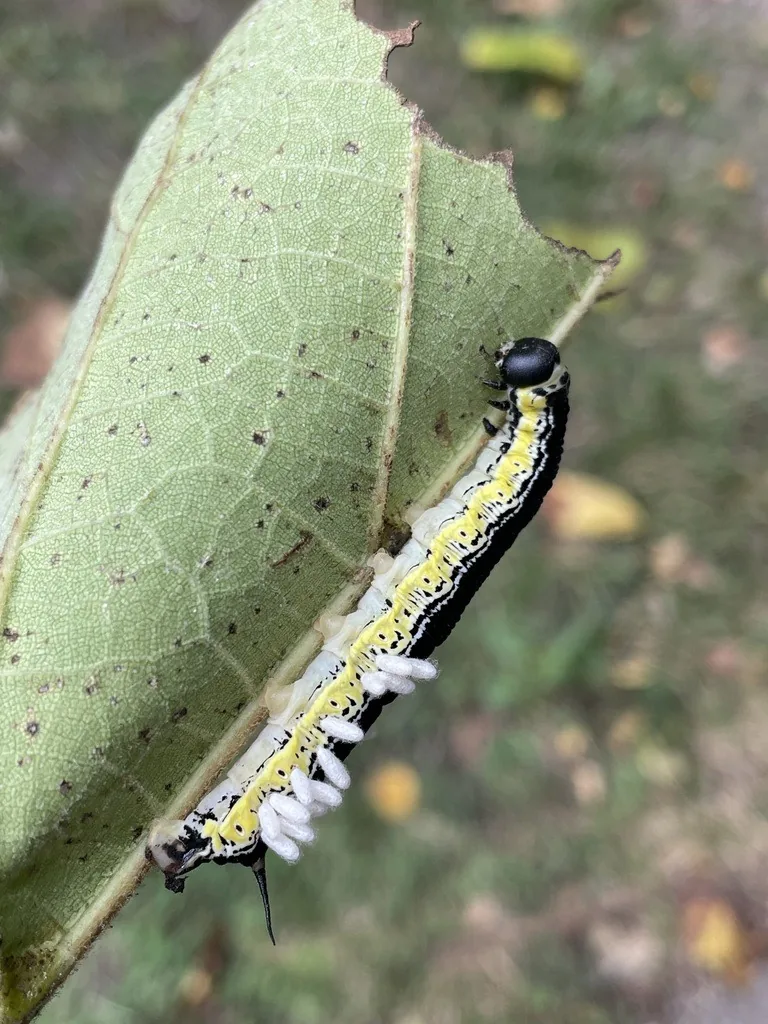
- Older caterpillars vary from yellow to nearly black, most black on the back with a broad yellow side stripe and a long straight black horn.[1]
- Adults are large brown sphinx moths with a gray, black-rimmed spot on each forewing and no yellow abdominal spots.[1]
- Young caterpillars are white with black spots; mature ones reach about 3 inches long. Wingspan of the moth is given as about 3 inches (NC State), 2.5 to 3.7 inches (K-State) and about 3 1/2 inches (Ohio State).[2][3][4]
Look-alikes
| Look-alike | How to tell them apart |
|---|---|
| Tomato hornworm | Its similarly colored adult has yellow spots on the abdomen; the catalpa sphinx doesn't.[1] |
Where it lives
Native to the eastern US, it occurs wherever catalpa grows from New Hampshire and Nebraska south to Florida and Texas. Penn State adds that it was historically found in Maine and northern New England but may now be absent there.[1]
Biology and life cycle
Pupae overwinter in soil; moths fly from spring through October (see where the sources disagree on when they start) and lay masses of 100 to 1,000 eggs under leaves.[1][2][3]
Generations are reported differently by region: one in Pennsylvania and up to five farther south (Penn State), usually two (Ohio State), up to three in Kansas (K-State) and several a year in North Carolina (NC State). It is a boom-and-bust insect: it can be scarce for one to a few years, then outbreak for one to a few years.[1][4][3][2]
Catalpa leaves contain bitter compounds called iridoid glycosides. The caterpillars store them in their blood, which makes them distasteful to predators.[3]
Damage and signs
Health risk
Penn State, NC State and K-State describe a defoliator of catalpa trees and don't mention any risk to people or pets.[1][2][3]
Control
Prevention
Keep trees healthy with proper water and fertilizer so they tolerate defoliation.[1]
If a tree keeps getting stripped and is declining, Penn State suggests replacing it with a catalpa of different genetics or another species, and K-State suggests replacing young catalpas that have been completely defoliated with a different kind of tree.[1][3]
Traps and physical control
Remove egg masses, trim out young groups, or hand-pick caterpillars into soapy water on small trees.[1]
Where the caterpillars have gone into the soil to pupate, tilling the soil around the tree in fall or early spring, before the moths emerge, can destroy pupae.[1]
Biological control
Parasitoid wasps, especially Cotesia, often control them; leave caterpillars covered in white cocoons on the tree.[1]
Pesticides
When caterpillars are young and small, products containing Bt (Bacillus thuringiensis) can be applied. Penn State advises against broad-spectrum insecticides because they kill the natural enemies and can make later outbreaks worse; see where the sources disagree on sprays.[1]
More from NC State Extension
NC State Extension notes that catalpas (northern, southern and Chinese) are its only known hosts, so the tree alone identifies the caterpillar, and that mature caterpillars pupate 2 to 3 inches down in the soil, the same depth K-State gives; people often mistake the white parasite cocoons on a caterpillar for its eggs.[2][3]
Where the sources disagree
Generations: Penn State reports one a year in northern areas such as Pennsylvania and up to five farther south; Ohio State says usually two, K-State up to three in Kansas, and NC State several a year in North Carolina.[1][4][3][2]
Moth size: NC State gives a wingspread of about 3 inches, K-State 2.5 to 3.7 inches and Ohio State about 3 1/2 inches.[2][3][4]
When moths appear: Penn State says adults begin to emerge in April; NC State says March or April.[1][2]
Sprays: Penn State recommends Bt on small caterpillars and advises against broad-spectrum insecticides; NC State says a Bt product or any insecticide labeled for landscape use should give adequate control while the worms are small; K-State recommends a contact or stomach-poison insecticide on young caterpillars in spring.[1][2][3]
Common questions
- What are the black and yellow caterpillars eating my catalpa?
- They're catalpa worms, the only sphinx moth caterpillars that feed on catalpa.[1]
- Will catalpa worms kill my tree?
- Healthy trees withstand complete defoliation; repeated outbreaks mainly threaten stressed trees.[1]
- Are catalpa worms good fishing bait?
- Yes. They are used as fishing bait, especially in the South, and are said to be excellent for largemouth bass and catfish. NC State says about half of its catalpa worm questions are about rearing them or protecting them from parasites, and the worms can even be frozen for later use.[1][2]
Sources
- Penn State Extension, “Catalpa Worm/Catalpa Sphinx Moth.” extension.psu.edu/catalpa-worm-catalpa-sphinx-moth (accessed 2026-11-13)
- NC State Extension, “Catalpa Worm or Catalpa Sphinx.” content.ces.ncsu.edu/catalpa-worm-or-catalpa-sphinx (accessed 2026-11-13)
- Kansas State University, Department of Entomology, “Catalpa Caterpillar/Catalpa Sphinx (Kansas Bugs).” www.k-state.edu/news/kansasbugs/articles/2025/09/catalpa-caterpillar-catalpa-sphinx.html (accessed 2026-11-13)
- Ohio State University Extension (Ohioline), “Giant Caterpillars (HYG-2015-11).” ohioline.osu.edu/factsheet/HYG-2015-11 (accessed 2026-11-13)
- Global Biodiversity Information Facility (GBIF), “Ceratomia catalpae Boisduval (GBIF Backbone Taxonomy).” api.gbif.org/v1/species/1861892 (accessed 2026-11-13)
- iNaturalist, “Ceratomia catalpae taxon page (order and family).” www.inaturalist.org/taxa/143440 (accessed 2026-10-06)