On this page
How to identify it
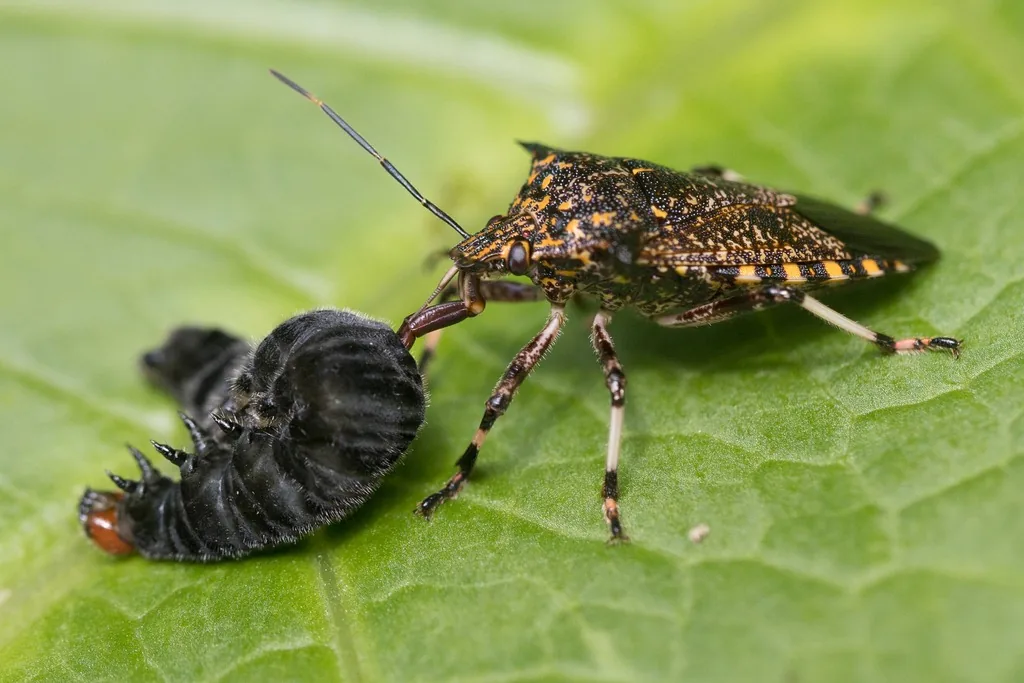
- NC State Extension calls it our largest stink bug, at 3/4 to 1 inch long. It is flat and speckled brown, with a double-pointed extension on each shoulder and a short stabbing beak. UF/IFAS gives adult males as 16 to 21 mm long and females as 18 to 25 mm, and calls them the largest predatory stink bugs in Florida, with dark bands on the legs and dark marks along the edges of the abdomen.[1][3]
- The ends of the front wings lack speckles; they are corrugated with veins, shinier and sometimes darker. The edge of the abdomen outside the wings is spotted.[1]
- Newly hatched nymphs are about 1/16 inch long and blue-black with red abdomens. Older nymphs are splotched blue-black and red and slowly develop wing buds, reaching up to 5/8 inch in the fifth stage.[1]
- Eggs are about 1 mm across, with short projections around the lid.[3]
Look-alikes
| Look-alike | How to tell them apart |
|---|---|
| Florida predatory stink bug | Another beneficial predatory stink bug, but adults are dark metallic blue with orange spots rather than speckled brown with two-pronged shoulders. Its nymphs also gather in groups. UF/IFAS says the first-stage nymphs of the two are hard to tell apart, since both have a blue-black head and thorax and a red abdomen; the Florida predatory stink bug's egg masses are loosely oval and hold 20 to 90 eggs.[4][1][3] |
| Spined soldier bug | Podisus maculiventris looks similar, but UF/IFAS says it is much smaller and has a single spine at each shoulder corner rather than a double one.[3] |
Where it lives
NC State Extension describes it in North Carolina, where it probably overwinters as adults and older nymphs. Texas A&M AgriLife holds a specimen taken at an ultraviolet light in Sabine County, East Texas, in July 2007, and Ribeiro and colleagues recorded it in oil palm plantations in Pará, Brazil. UF/IFAS lists Brazil, Colombia, Mexico and the southern United States, with Florida records from the entire peninsula and at least as far west and north as Jackson County.[1][5][2][3]
Biology and life cycle
Eggs are laid 100 to 200 at a time in masses usually arranged in four to five rows, and take 15 or 16 days to hatch. Development from egg to adult takes about 2 months. In laboratory rearing at temperatures averaging 26°C (78.8°F), UF/IFAS reports egg to adult took 59 to 60 days, with 15 to 16 days in the egg.[1][3]
Nymphs live in groups and pass through five stages. Every stage except the egg feeds on insects it meets, though without prey it may feed on plants.[1]
Between 2004 and 2006 in Pará, Brazil, it was recorded preying on the caterpillars of several oil palm defoliators and reducing their numbers in commercial plantations.[2]
UF/IFAS says nymphs begin capturing insect prey in the second stage. They grow from about 1.5 mm in the first stage to 10 to 14 mm in the fifth, which has distinct wing pads and very large red keels on the sides of the pronotum.[3]
Damage and signs
- It is generally considered beneficial because it feeds on plant pests. It is often found on soybeans, eggplants, shrubs and trees, usually near streams and marshes, where it preys on other insects, especially moth caterpillars. UF/IFAS cites reports of it as an important predator of soybean pests in Florida, and shows nymphs jointly attacking a bean leafroller caterpillar.[1][2][3]
- It has also been reported as a pest on eggplant, but UF/IFAS says damage to any crop by this species is probably exceptional.[3]
Health risk
It is a predator of insects; neither NC State Extension nor the other sources here report a risk to people or pets.[1][2]
Control
Traps and physical control
Where it is eating catalpa sphinx caterpillars kept as fish bait, pick the bugs off by hand and drop them into soapy water. An insecticide that kills the bugs is likely to kill the caterpillars too.[1]
Biological control
Leave it alone in gardens and landscapes; it is a natural enemy of plant-feeding insects.[1]
Where the sources disagree
Size of older nymphs: NC State Extension says nymphs reach up to 5/8 inch in the fifth stage, while UF/IFAS gives the fifth stage as 10 to 14 mm.[1][3]
Common questions
- Is this big spiny stink bug a pest?
- Usually not. It preys on caterpillars and other plant-feeding insects and is generally considered beneficial.[1][2]
- What are the clusters of blue-black and red bugs?
- Often giant strong-nosed stink bug nymphs, which are blue-black with red markings and stay together in groups.[1]
- How do I tell it from a spined soldier bug?
- Check size and shoulders. UF/IFAS says this species is much larger and has double spines at each shoulder corner, while the spined soldier bug has a single spine.[3]
Sources
- NC State Extension, “Giant Strong-Nosed Stink Bug (PDIC Factsheet).” content.ces.ncsu.edu/giant-strong-nosed-stink-bug (accessed 2026-11-11)
- Neotropical Entomology, via PubMed, “First occurrence of Alcaeorrhynchus grandis (Dallas) preying on defoliating caterpillars of oil palm in the State of Pará, Brazil (Ribeiro et al. 2010).” pubmed.ncbi.nlm.nih.gov/20305909/ (accessed 2026-11-11)
- University of Florida IFAS Extension (EDIS), “Predatory Stink Bug, Alcaeorrhynchus grandis (Dallas), EENY165/IN322 (D. B. Richman and F. W. Mead; Featured Creatures).” ask.ifas.ufl.edu/publication/IN322 (accessed 2026-11-14)
- NC State Extension, “Florida Predatory Stink Bug (PDIC Factsheet).” content.ces.ncsu.edu/florida-predatory-stink-bug (accessed 2026-11-11)
- Texas A&M AgriLife Extension Service, Urban Programs, El Paso County, “Alcaeorrhynchus grandis, giant strong-nosed stink bug (specimen record, Sabine County, Texas).” elp.tamu.edu/ipm/bugs/family-pentatomidae-stink-bugs/hemiptera-heteroptera-pentatomidae-alcaeorrhynchus-grandis-giant-strong-nosed-stink-bug-male-a/ (accessed 2026-11-11)
- iNaturalist, “Alcaeorrhynchus grandis taxon page (order and family).” www.inaturalist.org/taxa/296201 (accessed 2026-10-06)