On this page
How to identify it
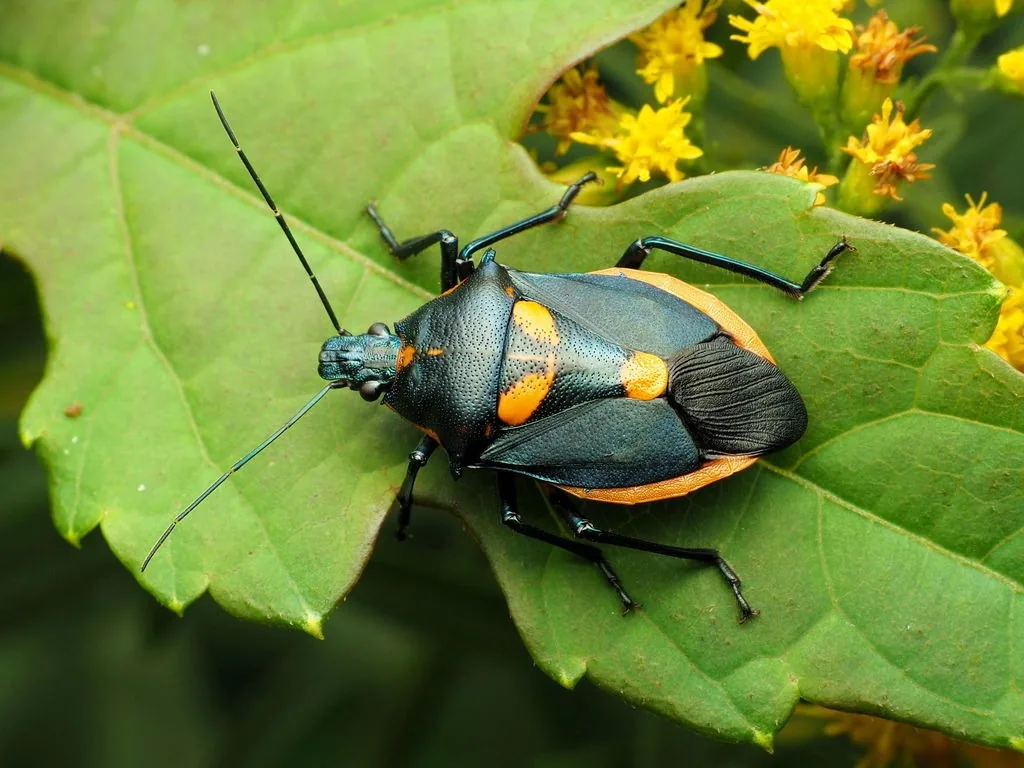
- Adults have orange spots on a dark, metallic blue background. UF/IFAS describes a reddish spot at each corner of the scutellum, the triangular plate on the back, against a blue-black to purplish-brown ground color, which normally sets it apart from all other stink bugs in the Southeast.[1][3]
- Its beak is much sturdier than a plant-feeding stink bug's, strong enough to pierce the hard outer shell of its prey. UF/IFAS explains that in predatory stink bugs the first beak segment is short, thick and free, while plant feeders have a slender first segment set between two wide, parallel plates.[2][3]
- Nymphs tend to cluster together, and adults sometimes join them. UF/IFAS describes nymphs with a blue-black or metallic green head and thorax and a red abdomen; mature nymphs measured 8 to 9 mm in one description and 10 to 12.5 mm in another. Nymphs start catching prey in the second of their five stages and are sometimes mistaken for beetles, but they have no wings and tube-like piercing-sucking mouthparts.[1][3]
- Males are about 12 mm (~1/2 in) long and females 12 to 17 mm (~1/2 to 2/3 in). Adults have a distinct spine on each shoulder.[3]
- Eggs are barrel-shaped, about 1 mm across with short projections around the cap, and are laid 20 to 90 at a time.[3]
Look-alikes
| Look-alike | How to tell them apart |
|---|---|
| Plant-feeding stink bugs | Plant-feeding stink bugs have slimmer mouthparts made for plant sap; a predatory stink bug's beak is much more robust because it has to punch through other insects.[2] |
| Spined soldier bug | Another predatory stink bug of the Southeast that hunts caterpillars. In lab tests the Florida predatory stink bug attacked and ate it, so releasing the two together may not work well.[4] |
| Anchor stink bug | The banded form is often confused with it, but UF/IFAS says the anchor stink bug is less than 10 mm long, rounder and more like a leaf beetle in shape, with a very large scutellum covering much of the abdomen, and it lacks the distinct shoulder spine.[3] |
Where it lives
A mainly Neotropical species found from Florida to Brazil; in the United States it is common in the Southeast. UF/IFAS calls it primarily Neotropical, ranging within the southeastern quarter of the United States. Florida State Collection of Arthropods records show it in every month of the year in Florida, with peaks in spring and fall.[5][4][3]
Biology and life cycle
Adults spend the winter in wood piles or other dry, sheltered spots, and eggs are laid the following spring.[1]
Eggs hatch in 19 to 33 days, and nymphs grow slowly through five stages over 40 to 67 days. New females wait 5 or 6 days before mating and lay eggs 23 to 67 days after that, so its development is much slower than that of plant-feeding stink bugs. UF/IFAS summarizes lab rearing: at 26 to 27°C, egg to adult took 58 days with an 18- to 19-day egg stage; South Carolina stock took about 89 days, and Missouri stock reared at 24°C on black cutworms took 100 days, with a 33-day egg stage.[1][3]
A 2022 lab study by Florida A&M University and USDA-ARS researchers noted that it needs at least 60 days to go from egg to adult, compared with as little as 28 days for the spined soldier bug.[4]
Groups of nymphs can gang up on prey too large for one nymph to subdue, and when food is short these bugs sometimes eat smaller members of their own kind. UF/IFAS adds that even adults tended to gather at night in lab cages, and that group feeding lets nymphs take large prey a single nymph could not.[1][3]
It stabs prey with its beak and injects a toxin that slowly immobilizes it, then sucks out the predigested insides. Clemson describes the injected fluid as digestive enzymes that liquefy the prey's tissues.[1][2]
It sometimes rocks its body from side to side while gripping the surface with its feet, a 'wagging' behavior thought to be defensive.[1]
During courtship and mating, males and females send low-frequency vibrations (127 to 180 Hz) through the surface they stand on.[5]
Of 140 Florida habitat records, 25% were on ornamentals, 17% on citrus, 8% in traps and 6% in weeds and turf, with the rest on various fruits, trees and other habitats, since its prey is so varied.[3]
Damage and signs
- It does not damage plants. It turns up occasionally on just about any landscape plant and may feed on plants now and then, but plant damage has never been noted.[1]
- Its prey includes a number of economically important pests, though it seldom plays more than a minor role in natural control. In lab tests it fed on fall armyworm caterpillars. UF/IFAS lists prey such as the velvetbean caterpillar, walnut caterpillar, diaprepes root weevil, alfalfa weevil, Colorado potato beetle, southern green stink bug and orangedog caterpillar.[1][4][3]
Health risk
It is a predator of insects. None of the sources describes it biting people or harming pets or plants.[1][2]
Control
Biological control
Leave it alone. NC State says treatment is not needed, since the bug does far more good than harm. UF/IFAS counts it as beneficial because most of its prey are plant-damaging insects.[1][3]
Researchers have looked at it for biological control of the fall armyworm, but it also preys on the spined soldier bug, so releasing both together may work only under certain conditions.[4]
Where the sources disagree
Egg to adult: Perier and colleagues say it needs at least 60 days; UF/IFAS cites a lab result of 58 days at 26 to 27°C, and about 89 and 100 days in other rearing studies.[4][3]
Common questions
- What is the shiny blue and orange stink bug?
- Possibly the Florida predatory stink bug, which has orange spots on a dark, metallic blue body and feeds on other insects rather than plants. UF/IFAS describes a reddish spot at each corner of the scutellum on a blue-black to purplish-brown body.[1][3]
- Is it harmful to plants?
- No. Plant damage has never been noted; it feeds mostly on plant-damaging bugs, beetles and caterpillars.[1][2]
- Is it the same as the anchor stink bug?
- No. UF/IFAS says the two are often confused, but the anchor stink bug is less than 10 mm long, rounder and more like a leaf beetle in shape, and it lacks the distinct shoulder spine.[3]
Sources
- NC State Extension, “Florida Predatory Stink Bug.” content.ces.ncsu.edu/florida-predatory-stink-bug (accessed 2026-11-14)
- Clemson Cooperative Extension Home & Garden Information Center, “What is It? Wednesday: Florida Predatory Stink Bug (Ballew 2022).” hgic.clemson.edu/what-is-it-wednesday-florida-predatory-stink-bug/ (accessed 2026-11-14)
- University of Florida/IFAS Extension (Featured Creatures), “Florida Predatory Stink Bug (unofficial common name), Euthyrhynchus floridanus (Linnaeus), EENY-157/IN314.” ask.ifas.ufl.edu/publication/IN314 (accessed 2026-11-14)
- Insects (MDPI), via PubMed Central, “Intraguild Interactions of Three Biological Control Agents of the Fall Armyworm Spodoptera frugiperda (JE Smith) in Florida (Perier et al. 2022).” pmc.ncbi.nlm.nih.gov/articles/PMC9503628/ (accessed 2026-11-14)
- Revista de Biología Tropical, via PubMed, “Characterization of the behavioral and vibrational signals in Euthyrhynchus floridanus during courtship and copulation (Briceño 2014; in Spanish, English abstract).” pubmed.ncbi.nlm.nih.gov/24912346/ (accessed 2026-11-14)
- iNaturalist, “Euthyrhynchus floridanus taxon page (order and family).” www.inaturalist.org/taxa/119873 (accessed 2026-11-14)