On this page
How to identify it
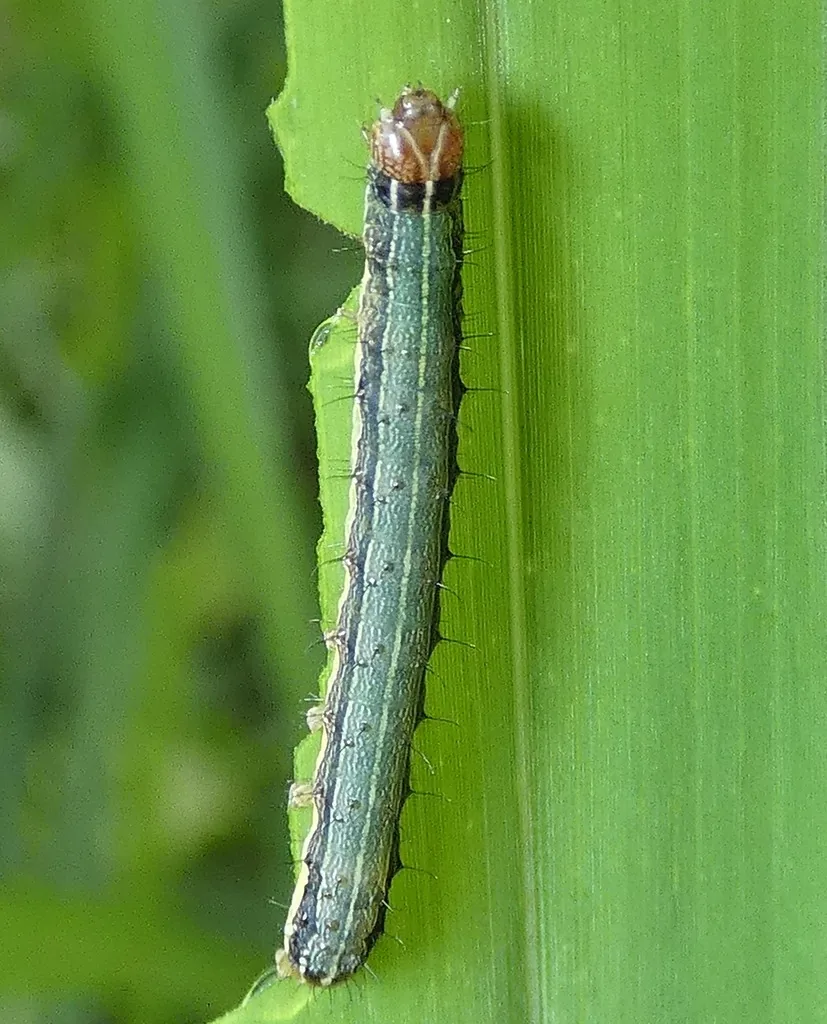
- Full-grown caterpillars are about 1 1/2 inches long (Iowa State says up to 2 inches) and range from green and yellow to brown, gray or nearly black, with pale stripes along the body.[1][3][4][2]
- The key mark is a pale, upside-down Y on the front of the head.[1][3][2]
- Up close, four black dots may show on the back of each abdominal segment, and the largest caterpillars have a reddish-brown head and raised dark spots. UF/IFAS says these raised spots are usually dark and bear spines, but on the mostly green form of the caterpillar they are pale.[3][5][6]
- Newly hatched caterpillars are only about 1/8 inch, greenish with a black head.[5][4]
- The moths are gray with white markings and a wingspan of about 1 to 1 1/2 inches; the forewing has a pale, drop-shaped mark or white spot near the center. UF/IFAS gives a wingspan of 32 to 40 mm (about 1 1/4 to 1 1/2 inches): males have triangular white spots at the tip and near the center of the forewing, females are less distinctly marked, and the hind wing is silvery white with a narrow dark border.[1][3][6]
- Egg masses are cream to tan with a fuzzy, moldy look and turn up on grass blades and on posts, siding, playground sets, bird feeders and golf carts. UF/IFAS says the furry look comes from a layer of grayish scales the female leaves between and over the eggs; each egg is only about 0.4 mm across.[1][4][5][6]
Look-alikes
| Look-alike | How to tell them apart |
|---|---|
| True armyworm | The true armyworm is the commonest lawn armyworm in Utah; its caterpillars are yellow or gray with black stripes, sometimes pinkish, and its moth is reddish-brown with a distinct white dot in the center of each wing. NC State says fall armyworms are harder to control.[7][3] |
| Cutworms | Cutworms clip leaf blades close to the crown and leave small, scattered pockets of damage, while armyworms feed in masses and leave larger irregular brown patches.[7] |
| Corn earworm | Both can bore into corn ears. UF/IFAS says fall armyworm skin looks rough or granular up close but doesn't feel rough, because it lacks the tiny spines that make corn earworm rough to the touch; in the ear, fall armyworm bores through the side of the husk, while corn earworm usually feeds down through the silk to the tip.[6] |
Where it lives
Native to the tropics and subtropics of the Western Hemisphere. In the United States it doesn't survive prolonged freezing and overwinters only in southern Texas and Florida; moths fly north each year and reach most of the country east of the Rocky Mountains and into eastern Canada. Since 2016 it has also invaded Africa, Asia and Oceania. UF/IFAS says it is native from the United States to Argentina and is recorded from virtually all states east of the Rocky Mountains, but as a regular, serious pest it is mostly a problem in the southeastern states.[8][9][10][11][12][6]
Biology and life cycle
Moths fly north from the Gulf states through spring and summer; NC State traces North Carolina's turf infestations to Florida, and storms can blow huge numbers of moths as far as Iowa in late August.[3][1][4][10]
A female can lay up to 1,000 eggs, Clemson says in a single night, in masses that Iowa State puts at 100 to 500 eggs. Eggs hatch in 2 to 10 days, and the young caterpillars spin silk threads that help them disperse. UF/IFAS gives often 100 to 200 eggs per mass and about 1500 per female on average, with a maximum of over 2000; in summer the eggs hatch in only two to three days.[1][3][4][6]
Caterpillars feed for 2 to 3 weeks (NC State) or 3 to 4 weeks (Iowa State), eating most of their food in the last larval stages, then pupate in the thatch or soil; moths emerge 10 to 20 days later. UF/IFAS puts the larval stage at about 14 days in summer and 30 days in cool weather, usually over six instars; pupation takes place 2 to 8 cm deep in the soil, and the pupal stage lasts about eight to nine days in summer.[3][5][1][6]
The whole cycle can take about a month, so there can be three or more generations a year in South Carolina and several in North Carolina. UF/IFAS says the cycle takes about 30 days in summer, 60 in spring and autumn and 80 to 90 in winter. The species cannot diapause, and the number of generations ranges from a single one in Minnesota and New York to four in Louisiana.[1][3][6]
Caterpillars can feed day or night but are most active in early morning and late afternoon or evening, hiding in the thatch in bright sun.[3][1][2]
Moths are nocturnal and most active on warm, humid evenings. UF/IFAS says a female lays most of her eggs in her first four to five days of life, and adults live about 10 days on average, with a range of about seven to 21 days.[6]
Damage and signs
- Early feeding on turf looks like drought stress; later feeding leaves a scorched or scalped look with only grass stems left, often with a sharp line between damaged and green turf that spreads out from posts or buildings where eggs were laid.[1][3]
- Bermudagrass and tall fescue are favored, and most grasses can be hit, along with corn, sorghum and small grains. New sod and new seedings under a year old suffer most. UF/IFAS counts over 80 recorded host plants but says it clearly prefers grasses: field and sweet corn, sorghum, bermudagrass and crabgrass are eaten most often, and sweet corn is the only vegetable it regularly damages.[1][3][4][6]
- Because the caterpillars eat blades rather than roots or crowns, lawns usually recover with watering, though thin areas may need reseeding.[2][4][7]
- In corn, UF/IFAS says larvae feed deep in the whorl, leaving rows of holes in the leaves, can destroy the growing point, and bore into the ear through the side of the husk; it calls fall armyworm the most important pest of corn in Florida.[6]
Health risk
The fall armyworm is a pest of grasses and crops; the extension sources here describe it only as a threat to lawns, turf and crops. UF/IFAS likewise treats it as a pest of grasses, corn and other crops.[1][3][6]
Control
Prevention
Check suspect areas with a soap flush: mix 1 to 2 tablespoons of lemon-scented dish detergent in 1 to 2 gallons of water and pour it over a square yard of healthy grass next to the damage. Armyworms come up within about 10 minutes.[1][7]
For sweet corn, UF/IFAS says the most important cultural practice is early planting or early-maturing varieties, so that many ears are harvested before the higher armyworm numbers that build later in the season.[6]
Traps and physical control
Scrape or brush egg masses off siding, posts and play sets, or scrub them with soapy water; spraying insecticide on egg masses does nothing.[4][5]
Biological control
Lady beetles, parasites and other natural enemies often keep fall armyworms in check, though cold, wet springs make them less effective and they can't stop a large outbreak. UF/IFAS lists parasitic wasps and flies, ground beetles, earwigs, birds, skunks and rodents among its enemies, but says few act effectively enough to prevent injury, partly because natural enemies are left behind once the moths disperse north, and disease typically appears too late.[3][6]
Pesticides
Treat only if caterpillars are still small; large ones are about to stop feeding and are hard to kill. Mow and water lightly first, spray early or late in the day, and avoid watering for 24 hours afterward. Bt and spinosad work best on small larvae. UF/IFAS says Bt works only if it is already on the foliage when the larvae first appear.[3][4][1][7][6]
Clemson lists bifenthrin, cyfluthrin, cypermethrin, lambda-cyhalothrin, permethrin or spinosad. Iowa State notes reports of pyrethroid resistance and suggests switching to chlorantraniliprole or tetraniliprole if a pyrethroid doesn't work quickly. UF/IFAS also notes some insecticide resistance, varying by region.[1][4][5][6]
The 2021 outbreak
In 2021 fall armyworms badly damaged turf from Oklahoma to Georgia and Indiana to Maryland between June and August, and storms carried moths into Iowa, where egg masses turned up on siding, posts and vehicles.[5][4]
Kentucky called it one of the worst years on record for fall armyworms in home lawns, unusual because they hit cool-season grasses that they normally leave alone. A frost ends the problem, since they don't overwinter that far north.[2][5]
A migrant pest worldwide
Genetic markers show two U.S. source populations: moths from Texas reach as far as Pennsylvania and eastern Canada, and Texas and Florida migrants mix routinely north of South Carolina.[10][11][9]
The fall armyworm was first reported in West Africa in 2016 and spread across Africa and most of Asia within two years. Genome studies find the invaders belong to the corn strain, which suggests limited potential to infest rice.[12][8][13]
Where sources disagree
Egg numbers: Clemson says a moth can lay up to 1,000 eggs in a single night and NC State gives as many as 1,000, while Iowa State describes masses of 100 to 500 eggs; UF/IFAS gives often 100 to 200 per mass and an average of about 1500 per female, with a maximum of over 2000.[1][3][4][6]
Grass preference: Utah State says armyworms prefer cool-season turfgrasses, Kentucky calls cool-season lawns an unusual target, and Clemson names bermudagrass and tall fescue as the usual hosts.[7][2][1]
Size: most sources give about 1 1/2 inches for a grown caterpillar, Iowa State 1 1/2 to 2 inches, and an Iowa State article and UF/IFAS 1 1/3 inches (34.2 mm).[1][3][4][5][6]
Common questions
- How do I tell armyworm damage from drought?
- Early armyworm damage looks like drought stress. Look for caterpillars feeding in early morning or late evening, or pour a soap flush beside the brown area to bring them up.[1]
- Why do armyworms show up in late summer?
- They don't survive winter in most of the country. Moths fly north from southern Texas and Florida each year, so numbers build as the summer goes on.[9][1][3]
- Will my lawn come back?
- Usually. The caterpillars eat blades, not roots, so keep the lawn watered; reseed thin spots, ideally in fall, and fertilize lightly to speed recovery.[2][4][7]
- Should I spray the fuzzy egg masses on my house?
- No. Insecticides don't control the eggs; scrape them off or scrub them with soapy water.[5][4]
- Is this the same caterpillar that damages sweet corn?
- Yes. UF/IFAS says field and sweet corn are among the plants it eats most often and calls it the most important pest of corn in Florida; larvae feed deep in the whorl and can bore into the ear through the side of the husk.[6]
Sources
- Clemson Cooperative Extension Home & Garden Information Center, “Armyworms: Identification, Damage, & Control in Turfgrass (HGIC 2159, updated July 15, 2025).” hgic.clemson.edu/factsheet/armyworms-identification-damage-control-in-turfgrass/ (accessed 2026-11-11)
- University of Kentucky Martin-Gatton College of Agriculture, Food and Environment, “Brown lawns could mean fall armyworm damage (2021).” exclusives.mgcafe.uky.edu/2021/hort/brown-lawns-could-mean-fall-armyworm-damage (accessed 2026-11-11)
- NC State Extension, “Fall Armyworms in Turf.” content.ces.ncsu.edu/fall-armyworm-in-turf (accessed 2026-11-11)
- Iowa State University Extension and Outreach, Yard and Garden, “Fall Armyworm Control in Home Lawns (Aug. 30, 2021).” yardandgarden.extension.iastate.edu/encyclopedia/fall-armyworm-control-home-lawns (accessed 2026-11-11)
- Iowa State University Extension and Outreach, Yard and Garden, “Fall Armyworms: The Surprise of 2021 (Sept. 10, 2021).” yardandgarden.extension.iastate.edu/article/2021/09/fall-armyworms-surprise-2021 (accessed 2026-11-11)
- University of Florida IFAS Extension (EDIS), “Fall Armyworm, Spodoptera frugiperda (J.E. Smith), EENY098/IN255 (J. L. Capinera; Featured Creatures).” ask.ifas.ufl.edu/publication/IN255 (accessed 2026-11-14)
- Utah State University Extension, “Armyworms and Cutworms in Turfgrass.” extension.usu.edu/planthealth/research/armyworms-and-cutworms-in-turfgrass (accessed 2026-11-11)
- Insects, via PubMed, “Genetic relationship of fall armyworm (Spodoptera frugiperda) populations that invaded Africa and Asia (2021).” pubmed.ncbi.nlm.nih.gov/34066149/ (accessed 2026-11-11)
- Ecology and Evolution, via PubMed, “Nagoshi, Meagher and Hay-Roe (2012), Inferring the annual migration patterns of fall armyworm in the United States from mitochondrial haplotypes.” pubmed.ncbi.nlm.nih.gov/22957154/ (accessed 2026-11-11)
- Environmental Entomology, via PubMed, “Nagoshi, Fleischer and Meagher (2009), Texas is the overwintering source of fall armyworm in central Pennsylvania.” pubmed.ncbi.nlm.nih.gov/20021748/ (accessed 2026-11-11)
- Frontiers in Insect Science, via PubMed, “Tessnow, Nagoshi, Meagher and Fleischer (2023), Revisiting fall armyworm population movement in the United States and Canada.” pubmed.ncbi.nlm.nih.gov/38469489/ (accessed 2026-11-11)
- Scientific Reports, via PubMed, “Yainna, Tay, Durand and others (2022), The evolutionary process of invasion in the fall armyworm (Spodoptera frugiperda).” pubmed.ncbi.nlm.nih.gov/36473923/ (accessed 2026-11-11)
- Scientific Reports, via PubMed, “Invasive fall armyworms are corn strain (2024).” pubmed.ncbi.nlm.nih.gov/38459145/ (accessed 2026-11-11)
- iNaturalist, “Spodoptera frugiperda taxon page (order and family).” www.inaturalist.org/taxa/132468 (accessed 2026-10-06)