On this page
How to identify it
- Larvae vary in color: Oregon State lists gray, cream or green and Oklahoma State gray to greenish, both with distinct yellow, white and brown stripes along the body. Oklahoma State notes a larger head relative to the body.[1][2]
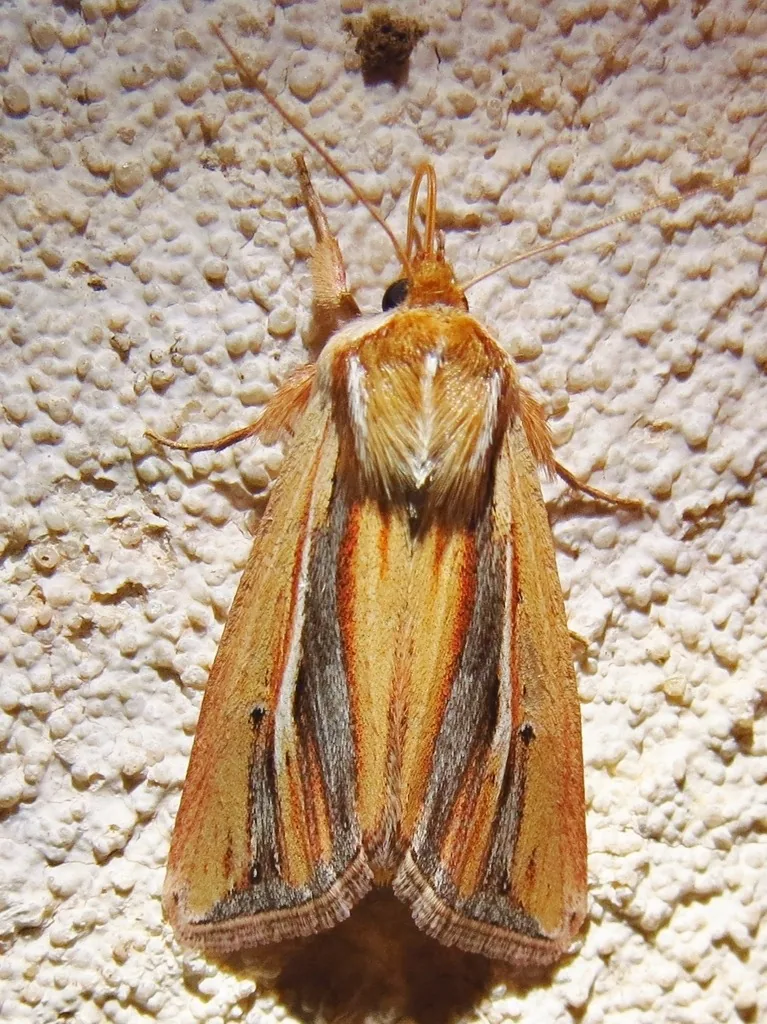
- The adult is a yellow-brown moth with a dark brown streak running the length of each forewing, interrupted near the middle; the wingspan is 1.2 to 1.5 inches. The 'false' wheat head armyworm, D. terrapictalis, has somewhat darker forewings and substantially darker hind wings.[1][2]
- Larvae feed on the heads mainly at night, hanging upside down from the awns, and move toward the base of the stalks on hot days. Damaged kernels are hollowed out, with a small hole bored into the base of the floret.[1][2]
Look-alikes
| Look-alike | How to tell them apart |
|---|---|
| Dargida terrapictalis ('false' wheat head armyworm) | A native western species whose larvae and moths look the same; it was trapped with D. diffusa in Oregon and Washington wheat areas, and the moths differ mainly in their darker forewings and much darker hind wings. Its host range and pest status are not known.[1] |
| True armyworm | Oklahoma State describes the true armyworm caterpillar as smooth-skinned and dark gray to greenish-black, with five stripes along the body (three on the back and one on each side) and a length of 1.5 inches; its moth has a white spot near the center of each forewing. Wheat head armyworm caterpillars are gray to greenish with yellow, white and brown stripes and a relatively larger head.[2] |
| Stored-grain weevils | Hollowed kernels with a small hole look very similar to weevil damage in stored grain, but wheat head armyworm damage is done on the heads in the field.[1] |
Where it lives
Found throughout the United States and Canada and more common in high-producing wheat areas such as Kansas, Nebraska, Oklahoma and Colorado; Dargida damage has been reported in Umatilla County, Oregon, since 2007, Lincoln County, Washington, in 2007 and 2008, and Bonneville County, Idaho, in 2005 and 2006. GBIF holds 1,372 U.S. records since 1990, led by Texas (334), Montana (133), Colorado (125) and Oklahoma (124).[1][3]
Biology and life cycle
The wheat head armyworm overwinters as a pupa in the soil. Moths emerge in spring and within a few days lay eggs on wheat or barley; larvae can be found in wheat from late May, with numbers rising into mid-June as the flag leaf develops. The larvae pass through five instars.[1][2]
Oklahoma State gives two generations each year, the second feeding on warm-season summer grasses. Oregon State says the first generation pupates in midsummer as the heads ripen and the second generation of moths usually lays eggs on warm-season grasses in the fall after harvest; Oregon and Washington trapping in 2009 and 2010 recorded two flights, the second substantially smaller.[2][1]
Larvae may feed on all parts of grass and cereal crops but seem to prefer the heads. Some entomologists suggest timothy grass rather than wheat is the preferred crop. Larvae and moths are typically active only at night.[1]
Damage and signs
- Larvae concentrate on the heads, boring a small hole into the base of the floret and hollowing out the kernels, damage that closely resembles weevil injury in stored grain. Oklahoma State says the major issue is grain grading, since the kernels count as insect-damaged kernels (IDK).[1][2]
- The first generation tends to cause undetected but significant damage, usually noticed only when damaged kernels turn up at harvest, and the pests are more likely to be found along field margins. WSU spring wheat trials near Davenport, Washington, recorded a 35 percent yield loss attributed to the insect in 2007 and 2008, though Oklahoma State says it rarely causes economic damage.[1][2]
Health risk
Oregon State and Oklahoma State treat the wheat head armyworm only as a pest of cereals and grasses and mention no effect on people.[1][2]
Control
Prevention
Oklahoma State says there is no established treatment threshold because the wheat head armyworm rarely causes economic damage. Oregon State and Washington State do not routinely recommend spraying at the first sign of the insect, and scouting is unlikely to be justified unless it is part of an integrated program or the area has had infestations before.[2][1]
The caterpillar's color blends with the developing head, so it is hard to see by casual observation; use a sweep net, starting at the field margins, where infestations usually start, then sweeping deeper into the field with a consistent number of sweeps. Sex-attractant pheromone traps placed in or beside the field from late April to midsummer and checked weekly also track the moths; OSU recommends changing lures and insecticidal strips every four weeks.[2][1]
At harvest, Oklahoma State suggests blending wheat harvested from the head rows with wheat from the rest of the field to dilute the share of insect-damaged kernels.[2]
Pesticides
No insecticides are specifically labeled for wheat head armyworm in the Pacific Northwest. Studies suggest pyrethroids may work well, but they affect natural enemies, so use them with restraint and spray early in the morning or late in the evening while larvae are exposed and feeding. Oklahoma State suggests a border spray when scouting shows larvae are restricted to field edges, and says treating at harvest is of little help because the damage is already done.[1][2]
Where the sources disagree
When to treat: Oklahoma State says to consider treating when wheat is at soft dough (Feekes 11.2), while Oregon State and Washington State do not routinely recommend spraying at the first sign of the insect and say no tested threshold exists.[2][1]
Preferred host: Oklahoma State describes eggs laid on wheat and larvae feeding on the heads, while Oregon State says the preferred crop is yet to be determined and some entomologists suggest timothy grass.[2][1]
Range: Oregon State says it is most common in Kansas, Nebraska, Oklahoma and Colorado, but GBIF's U.S. records since 1990 are led by Texas (334) and Montana (133).[1][3]
Common questions
- Why do my harvested wheat kernels look weevil-eaten?
- Wheat head armyworm larvae bore into the base of florets and hollow the kernels while the crop is still standing, which looks very much like stored-grain weevil damage; the first generation usually does this unnoticed from late May into June.[1][2]
- How is the wheat head armyworm different from other armyworms?
- Oklahoma State describes wheat head armyworm caterpillars as gray to greenish with yellow, white and brown stripes and a larger head relative to the body, while the true armyworm is dark gray to greenish-black with five stripes. The wheat head armyworm also prefers to feed on the heads.[2][1]
- Should I spray when I find a few larvae?
- Usually not. Oklahoma State says there is no established threshold because economic damage is rare, and Oregon State and Washington State do not routinely recommend spraying at the first sign; infestations are usually limited to field margins, where a border spray may be enough.[2][1]
Sources
- Oregon State University Extension Service, “Wheat Head Armyworm True or False: A Tale from the Pacific Northwest, EM 9000 (S. I. Rondon, M. K. Corp, D. Roberts, K. S. Pike, P. J. Landolt and D. Keys, May 2011).” extension.oregonstate.edu/catalog/pub/em-9000-wheat-head-armyworm-true-or-false-tale-pacific-northwest (accessed 2026-11-14)
- Oklahoma Cooperative Extension Service, Oklahoma State University, “Armyworms in Wheat (EPP-7094).” pods.okstate.edu/fact-sheets/EPP-7094pod.pdf (accessed 2026-11-14)
- Global Biodiversity Information Facility (GBIF), “Dargida diffusa: U.S. occurrence records since 1990 by state (GBIF occurrence search).” api.gbif.org/v1/occurrence/search?taxonKey=9539292&country=US&hasGeospatialIssue=false&occurrenceStatus=PRESENT&year=1990%2C2026&facet=stateProvince&facetLimit=400&limit=0 (accessed 2026-11-14)
- Global Biodiversity Information Facility (GBIF), “Dargida diffusa Walker, 1856 (GBIF Backbone Taxonomy).” api.gbif.org/v1/species/9539292 (accessed 2026-11-14)
- iNaturalist, “Dargida diffusa taxon page (order and family).” www.inaturalist.org/taxa/218139 (accessed 2026-11-10)