On this page
How to identify it
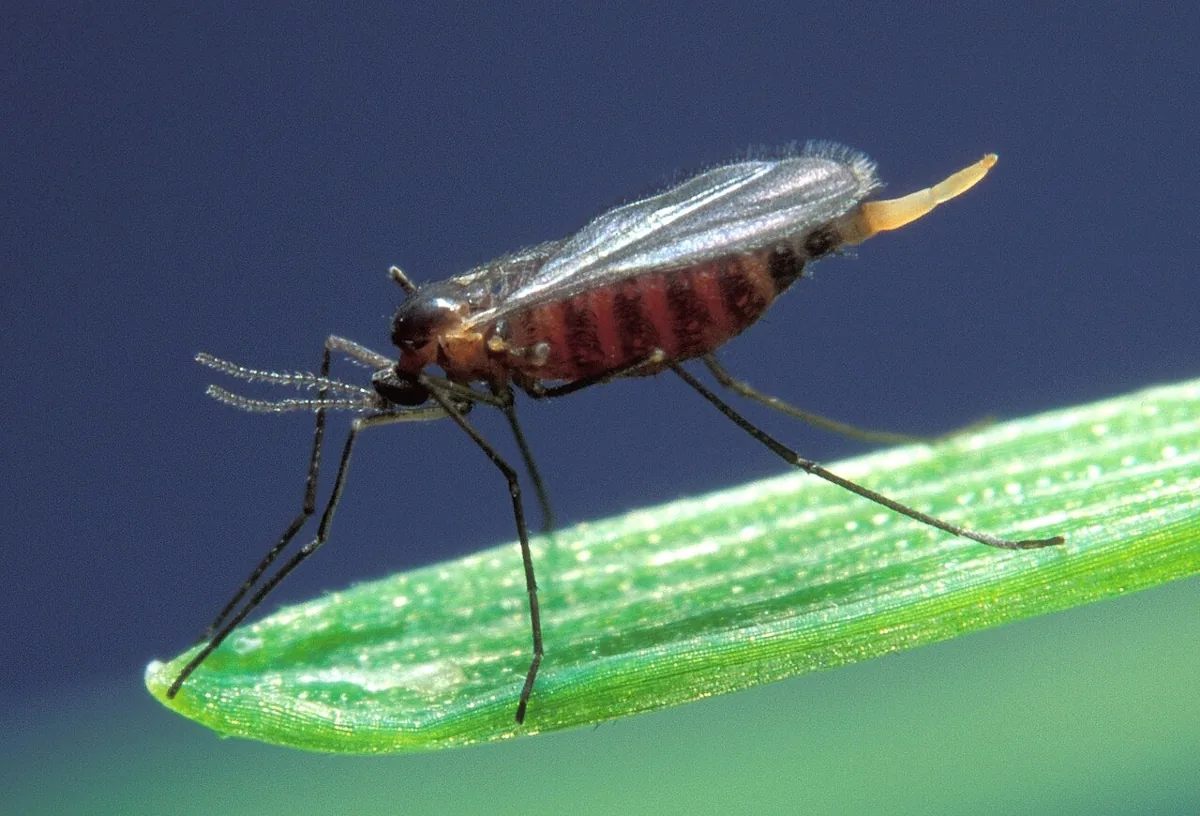
- Adults are fragile, dark flies about 1/8 inch long, smaller than a mosquito, with dark wings and long legs; females are reddish brown to black, and Kentucky notes their dull red abdomen.[3][2][1]
- The eggs are tiny, reddish and oblong, laid end to end in the grooves between the veins on the upper side of young leaves; they are visible to the naked eye and can be mistaken for early leaf rust.[3][2][1]
- The maggots are legless and headless, reaching about 3/16 inch, and they sit behind the leaf sheath near the base of the plant; South Dakota State says they are red at first and turn semi-translucent white with a pale green stripe. Full-grown maggots turn into brown, capsule-like cases, the 'flaxseed' stage most often seen (see where the sources disagree on their size).[1][2][3]
- Plants infested in fall are stunted, with an undeveloped central shoot and unusually broad, thick, erect bluish-green leaves.[1][2]
Look-alikes
| Look-alike | How to tell them apart |
|---|---|
| Hail or wind damage | Mild spring infestations are often blamed on hail or wind. Check behind the leaf sheath just below a broken stem for maggots or flaxseeds.[1] |
Where it lives
First noticed in New York in 1779 near a camp of Hessian soldiers, which gave it its name, it spread rapidly across the United States; Kentucky, South Dakota and Kansas extension all deal with it today.[1][3][2]
Biology and life cycle
There are two main generations a year, one in fall and one in spring.[3][2][1]
Fall adults emerge on warm days from August into November, often after a rain; they live only a few days, and each female lays about 300 eggs on young wheat leaves.[1][2][3]
Eggs hatch in 3 to 10 days, and the maggots crawl down between the leaf sheath and stem to just above the crown, where they stay put and feed on sap; Kansas State gives about 8 to 30 days of feeding, Kentucky about two weeks.[1][3]
The flaxseed stage carries the insect through the winter. Spring adults emerge from late March into May, peaking in April in Kansas.[1][3][2]
Spring-brood flaxseeds rest in the stubble through summer, and some stay dormant for weeks, months or even years. Volunteer wheat can support an extra summer brood, whose offspring can then infest the planted crop in fall.[1][3]
Damage and signs
Health risk
Kentucky, South Dakota State and Kansas State describe it only as a pest of wheat and related cereals and don't mention any risk to people or pets.[3][2][1]
Control
Prevention
Plant after the Hessian fly-free date (also called the best pest management planting date) for your area, so the fall flies emerge and die before the wheat comes up; adjust a few days for fall weather. Planting much later than that brings its own risk from the spring brood.[3][1][2]
Rotate crops: the fly has a limited host range and is not migratory, so avoid planting wheat back into infested stubble.[1][2]
Plant resistant varieties and rotate them, since the fly develops biotypes that overcome resistance; Kentucky still recommends resistant varieties where the local biotype can feed on them, because the fly reproduces less well on them.[3][2]
Sanitation
Destroy volunteer wheat at least two weeks before the planted crop germinates, and don't plant wheat or barley as an early cover crop before the fly-free date.[1][3][2]
Traps and physical control
Thoroughly burying infested stubble helps where tillage fits: in one Kansas study no flies emerged from stubble buried 4 inches deep. Burning, grazing, rolling and mowing reach few flaxseeds, because most sit at or below the soil line.[1][3]
Pesticides
No rescue treatment works once an infestation is in place. Insecticide-treated seed gives some control of the larvae for up to about 30 days after planting.[3][1]
Where the sources disagree
Flaxseed size: Kansas State says the capsule-like cases are 1/8 inch long; South Dakota State says about 3/8 inch.[1][2]
Larval feeding: Kentucky says the flaxseed forms after about two weeks of feeding; Kansas State gives 8 to 30 days.[3][1]
Fall flight: Kentucky says adults are out in September and early October; Kansas State says August into November, and its Sedgwick County traps caught adults until early December.[3][1]
Resistant wheat: Kentucky describes 16 biotypes and says no variety resisted biotype L, which made up 94.5% of flies in its 1988 survey, but still recommends resistant varieties; South Dakota State cites 34 resistance genes and advises rotating cultivars.[3][2]
Common questions
- What are the small brown 'flaxseeds' at the base of my wheat?
- They are the resting stage of the Hessian fly, formed after the maggots finish feeding behind the leaf sheath. Peel back the lower sheaths to find them.[3][1][2]
- Can I spray to save an infested wheat field?
- No. Kentucky and Kansas State both say no rescue treatment works once an infestation has developed, so the answer is prevention: planting date, volunteer wheat control, rotation and resistant varieties.[3][1]
- What is the Hessian fly-free date?
- It is the fall planting date after which the main brood of Hessian fly adults has emerged and died, so wheat planted later escapes fall egg-laying. Dates vary by location and fall weather.[1][3][2]
Sources
- Kansas State University Agricultural Experiment Station and Cooperative Extension Service, “Hessian Fly, MF2866 (R. J. Whitworth and others, May 2023).” bookstore.ksre.ksu.edu/pubs/hessian-fly-kansas-crop-pests_MF2866.pdf (accessed 2026-11-13)
- South Dakota State University Extension, “Hessian Fly: Preventing Outbreaks in Wheat (July 2022).” extension.sdstate.edu/hessian-fly-preventing-outbreaks-wheat (accessed 2026-11-13)
- University of Kentucky Entomology, “Hessian Fly in Kentucky, ENTFACT-101 (D. Johnson).” entomology.ca.uky.edu/ef101 (accessed 2026-11-13)
- Global Biodiversity Information Facility (GBIF), “Mayetiola destructor (Say, 1817) (GBIF Backbone Taxonomy).” api.gbif.org/v1/species/1594566 (accessed 2026-11-13)
- iNaturalist, “Mayetiola destructor taxon page (order and family).” www.inaturalist.org/taxa/392218 (accessed 2026-11-08)