On this page
How to identify it
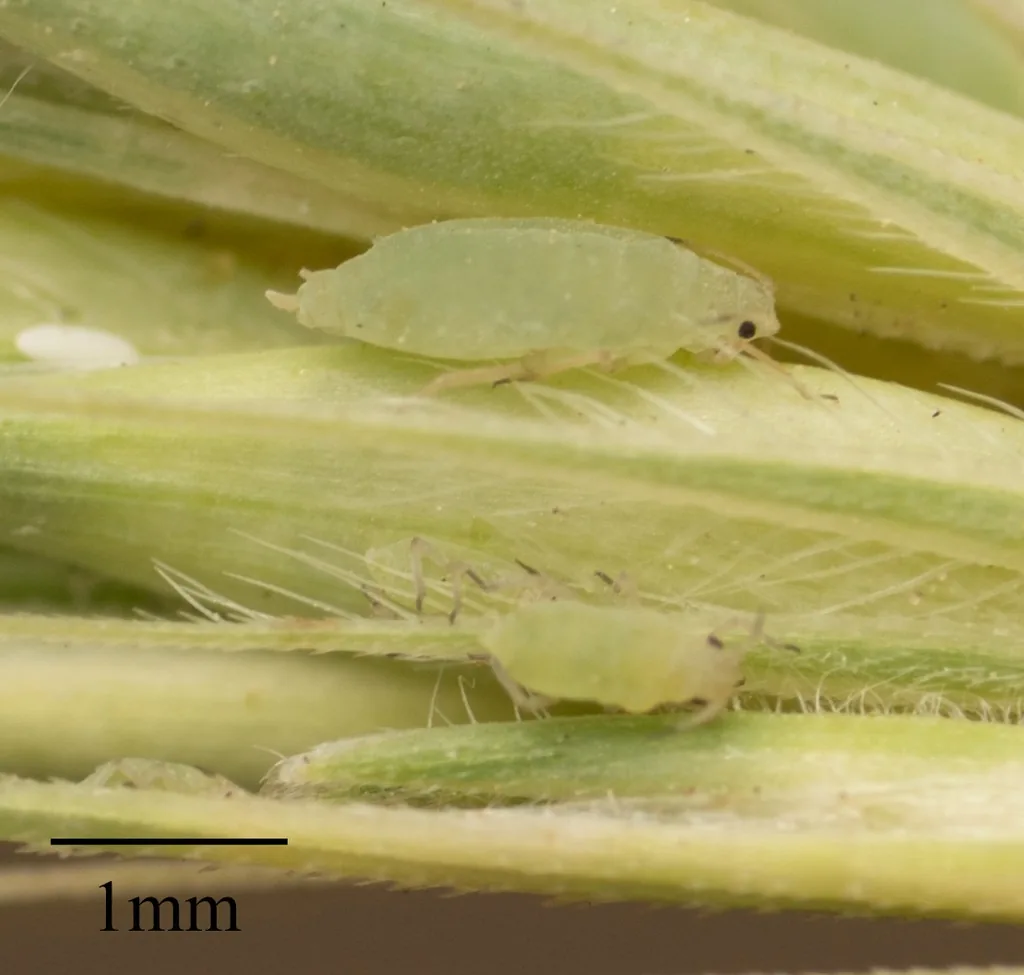
- It is small and lime green, with a spindle- or football-shaped body and very short antennae, legs and cornicles (the tailpipes on the abdomen).[1][2]
- Seen from the side it looks double-tailed, because a projection rises above the cauda at the tip of the abdomen.[2]
- Infested leaves stay tightly rolled and show white, yellow or purple streaks running lengthwise along the leaves and sheaths.[1][2]
Look-alikes
| Look-alike | How to tell them apart |
|---|---|
| Western wheat aphid | A close relative (Diuraphis tritici) that lacks the projection above the cauda, so it looks single-tailed from the side. It is of no economic concern in Nebraska and occurs mainly at the highest elevations in the western part of the state.[2] |
Where it lives
It arrived in the Great Plains in 1986; Utah State says it is found in 16 western states and was first detected in Utah in San Juan County in 1987. Nebraska Extension calls it the most serious insect pest of wheat and barley in the arid areas west of the 100th meridian. Significant infestations in Kansas have generally been limited to counties near the Colorado border and, K-State's pest page adds, the southwest corner of the state.[1][2][3][4]
Biology and life cycle
It feeds on the newest growth inside the whorl of the upper leaves, keeping them rolled. Later leaves can be trapped by the rolled ones, and the aphids keep moving to the whorl to feed on the youngest leaves.[1][2]
Fall infestations begin when aphids move from alternate grass hosts and volunteer wheat into newly emerging wheat. Aphids that overwinter in the field build up early and cause the most severe spring damage in Nebraska, and spring barley is at severe risk from spring movement because it is infested young.[2]
During heading, substantial rain knocks the aphids off the plants, and populations then don't build up in the heads.[2]
Biotypes that overcome resistant varieties have appeared. Nebraska Extension says biotype 2, which overcomes the Dn4 resistance gene used in older resistant winter wheats, was identified beginning in 2002 and is widespread in western Nebraska; Utah State dates the detection of a virulent biotype to 2003. K-State's 2026 wheat guide says new biotypes in western Kansas are virulent to all commercial wheat varieties.[2][3][4]
It has not been found to transmit any plant viruses.[2]
Utah State says adults are small, 1.6 to 2.1 mm, that females give birth to live young without mating, and that it seems more cold-tolerant than other grain aphids, surviving exposure to -13°F.[3]
Damage and signs
- Severely damaged plants look stunted and stressed, with tillers lying nearly flat. Leaves still rolled when heads emerge trap the awns and produce curved, fishhook-shaped heads.[2][1]
- The worst yield losses come from damage to the flag leaf and incomplete seed set on curved heads, and heavy infestations during heading can sharply cut test weight. Severe fall infestations leave plants more vulnerable to winter kill.[2]
- Risk of yield loss is highest when infestations develop in early spring. In Kansas, weather and predators usually keep populations below damaging levels.[1]
Health risk
It is a plant-feeding aphid. Kansas State, Nebraska Extension and Utah State describe it only as a crop pest; none of them mentions bites or any effect on people or pets.[1][2][3]
Control
Prevention
Control volunteer wheat, avoid planting winter wheat early, plant spring barley as early as possible, and keep the crop healthy. Check fields in fall and spring and follow treatment guidelines.[2]
Resistant varieties have helped where the aphid has a history of problems, and on resistant plants the leaves roll less, leaving the aphids more exposed to predators and parasites. But newer biotypes have broken older sources of resistance, and K-State's 2026 guide says new biotypes in western Kansas are virulent to all commercial wheat varieties.[1][2][4]
Biological control
After about 10 years of serious losses on the High Plains, the aphid receded in importance as biological controls, aided by resistant cultivars, became more effective; predators and weather usually keep it below damaging levels in Kansas.[1]
Pesticides
Kansas State thresholds: in fall, a 20 to 30 percent infestation of plants or tillers may warrant treatment. In spring, consider treating when 20 percent of tillers show symptoms and most have live aphids if yield potential is at least 20 bushels per acre, or at as few as 10 percent of tillers where yield potential is 40 bushels or more. Between flowering and soft dough, treatment may be advisable when 30 to 40 percent of primary tillers are infested.[1]
Neonicotinoid seed treatments protect seedlings from Russian wheat aphid and other wheat aphids. K-State's 2026 wheat guide names imidacloprid and thiamethoxam, which, depending on the rate, give activity against aphids for at least two weeks after emergence; K-State warns that some seed treatments carry a label warning not to graze or feed livestock on treated areas for 45 days after planting. Sprays have trouble reaching aphids sealed inside rolled leaves.[1][4][2]
Utah State's guide for winter wheat says fields with more than 10% infested tillers will generally benefit from an insecticide, and in spring suggests treating at 10% infested plants up to flowering, 10% infested tillers at the start of flowering, or 20% infested tillers at early milk.[3]
Where the sources disagree
When the resistance-breaking biotype appeared: Nebraska Extension says beginning in 2002; Utah State says 2003.[2][3]
Value of resistant varieties: Nebraska Extension (2005) says they still provide some value; K-State's 2026 guide says new biotypes in western Kansas are virulent to all commercial wheat varieties.[2][4]
Spring thresholds: Kansas State suggests treating at 20% symptomatic tillers where yield potential is at least 20 bushels per acre, or as few as 10% at 40 bushels or more; Utah State uses 10% infested plants or tillers up to and at flowering and 20% at early milk.[1][4][3]
Pest status: Nebraska Extension calls it the most serious insect pest of wheat and barley west of the 100th meridian; Kansas State says weather and predators normally keep it below damaging levels in Kansas.[2][1][4]
Common questions
- What causes white and purple streaks on wheat leaves that stay rolled up?
- That is typical Russian wheat aphid damage: the aphids feed inside the rolled whorl, and the leaves show white, yellow or purple lengthwise streaks.[1][2]
- Why is it hard to reach Russian wheat aphids with insecticides?
- They feed enclosed in tightly rolled leaves, where they are out of reach of natural enemies and direct contact with insecticides.[2]
- Do resistant wheat varieties still work?
- Less than they did. Nebraska Extension says current resistant varieties still provide some value in reducing risk, but K-State's 2026 guide says new biotypes in western Kansas are virulent to all commercial wheat varieties, so management also relies on cultural steps such as controlling volunteer wheat and avoiding early planting.[2][4][1]
Sources
- Kansas State University Department of Entomology, “Russian Wheat Aphid, Facts and Information on Crop Pests (J. P. Michaud, updated June 2024).” entomology.k-state.edu/extension/crop-protection/wheat/russian.html (accessed 2026-11-13)
- University of Nebraska-Lincoln Extension, “Cereal Aphids, NebGuide G1284 (G. L. Hein, J. A. Kalisch and J. Thomas; revised August 2005).” extensionpublications.unl.edu/assets/html/g1284/build/g1284.htm (accessed 2026-11-13)
- Utah State University Extension, “Russian Wheat Aphid (D. Hodgson and J. Karren, January 2008).” extension.usu.edu/planthealth/research/russian-wheat-aphid.php (accessed 2026-11-13)
- Kansas State University Research and Extension, “Wheat Insect Pest Management 2026 (MF745).” bookstore.ksre.ksu.edu/pubs/MF745.pdf (accessed 2026-11-13)
- Global Biodiversity Information Facility (GBIF), “Diuraphis noxia (Kurdjumov, 1913) (GBIF Backbone Taxonomy).” api.gbif.org/v1/species/2070133 (accessed 2026-11-13)
- iNaturalist, “Diuraphis noxia taxon page (order and family).” www.inaturalist.org/taxa/430146 (accessed 2026-11-08)