On this page
How to identify it
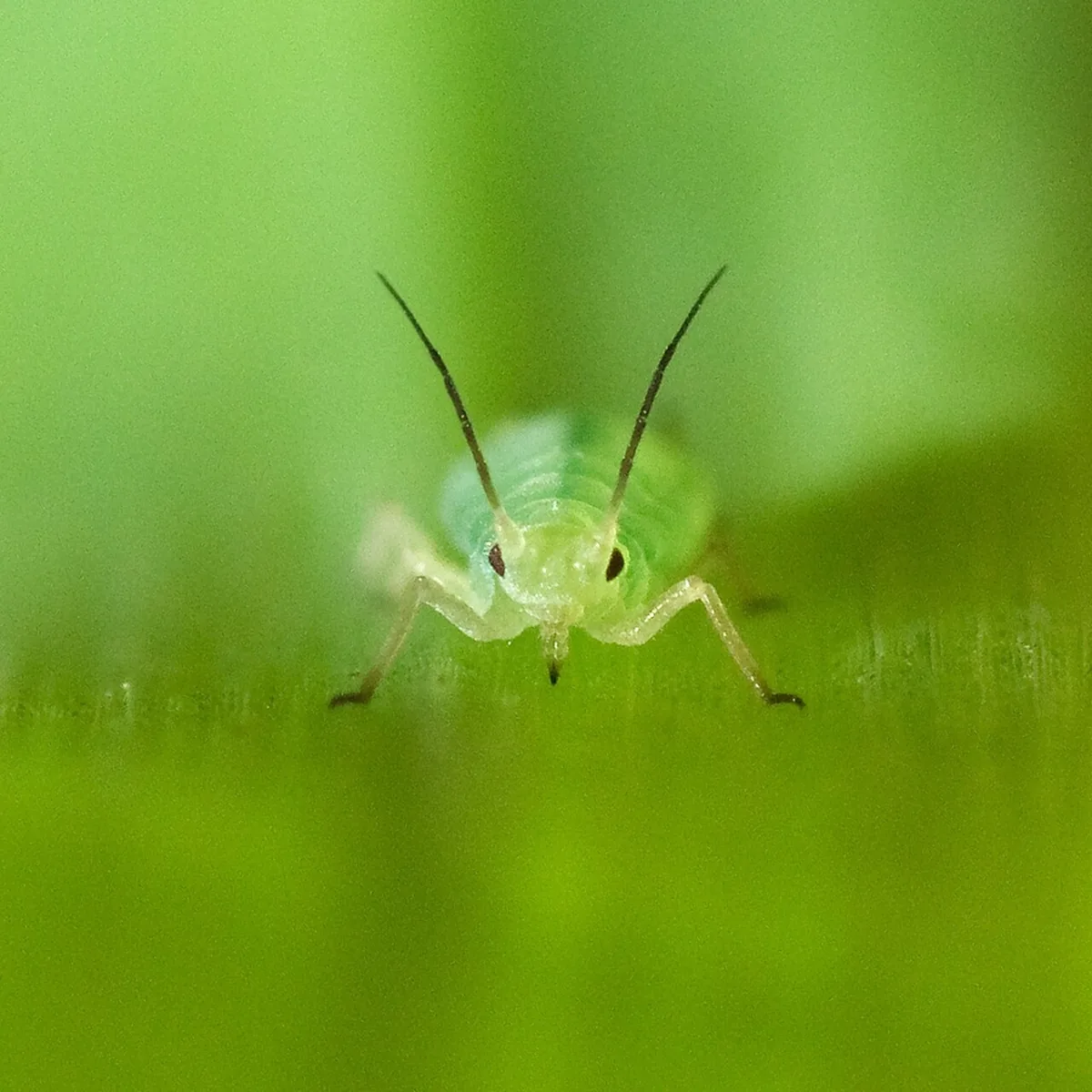
- It is about 1/16 inch long, soft and pear-shaped, pale yellow to pale green, with dark eyes, long antennae and short dark-tipped cornicles. UF/IFAS gives 1.3 to 2.1 mm, with the head and front of the thorax straw to pale green, a light to medium green abdomen with a darker green stripe down the middle (clearest on older nymphs and adults), uniformly dusky antennae, and pale cornicles with slightly flared, darkened tips.[1][8]
- UC IPM describes it as green to yellow-green with a dark green stripe down the middle of the back, long antennae that are uniformly dark, and long, tube-shaped cornicles.[2]
- Heavily infested blades can carry 30 or more aphids each, several thousand per square foot.[1]
Look-alikes
| Look-alike | How to tell them apart |
|---|---|
| Rose-grain aphid | The greenbug's antennae are uniformly dark, while the rose-grain aphid's are darker only at each joint. The rose-grain aphid also has eight or more hairs on the tail (cauda) to the greenbug's four, which takes a microscope to see.[2] |
| Russian wheat aphid | The greenbug has longer antennae, long tube-shaped cornicles and no extra tail-like projection above the cauda.[2] |
Where it lives
Recognized as a pest of grasses since the 1880s. It overwinters as eggs in the South and is carried north on spring winds; most of Wisconsin's greenbugs arrive this way each summer. GBIF has only about 120 U.S. records since 1990, half from Illinois, and more from Canada. UF/IFAS says it is thought to be Palearctic in origin and now occurs in the Americas, Europe, Africa, the Middle East and Asia. The first North American report was on wheat and barley in Virginia about 1882. In Florida, winged greenbugs have been caught regularly in suction traps across the peninsula since 1998, and it was found damaging 'SeaDwarf' seashore paspalum turf in Belle Glade in November 2003; it has since been found on that grass from Avon Park south into Miami-Dade County.[1][3][4][8]
Biology and life cycle
Spring and summer females give birth to live young without mating; newborns can mature in 7 to 10 days, so there are several generations a year.[1]
While some greenbugs may overwinter in Wisconsin, most of the population migrates into the state each summer on winds from the South, where they overwinter as eggs.[1]
Greenbug populations differ in which resistant crop varieties they can attack; these strains are called biotypes, and new ones keep appearing in the field. Biotype TX1 has overcome most known wheat resistance genes.[5]
In warm or mild climates it reproduces without mating; where winters are cold, females mate with winged males and lay overwintering eggs, mostly on Kentucky bluegrass (Poa pratensis). Nymphs pass through three stages to the adult, with no pupa, in seven to nine days at 60 to 80°F, and on seashore paspalum each adult produces one to five nymphs a day.[8]
UF/IFAS puts its host range at 70 grass species, including wheatgrass, oat, barley, fescue, rice, sorghum, wheat and maize, plus grasses in Bromus, Lolium, Paspalum and Poa.[8]
UF/IFAS counts nine biotypes that damage small grains. One that severely damaged grain sorghum became common in Nebraska in 1968, and greenbug was first found feeding on and damaging Kentucky bluegrass in 1970.[8]
Long stretches above 85°F hurt its reproduction and survival, but it develops and reproduces faster at cool temperatures than its natural enemies do, which lets it reach damaging levels early in the season.[8]
Damage and signs
- Feeding injects saliva that kills grass tissue. Damage starts as faint yellowing and can spread to orange patches, often first as round patches around the trunks of shade trees, but also in sun. In the South continuous feeding can kill the grass so that reseeding or resodding is needed; that is uncommon in Wisconsin.[1]
- It has injured wheat, oats and barley and is a destructive pest of sorghum and wheat. In grain it causes yellow, reddish or brown spots and patches on leaves and spreads barley yellow dwarf virus.[1][2][6][5]
- On seashore paspalum it prefers the midrib on the upper leaf surface. Each feeding site starts as a small yellow spot ringed within 24 hours by water-soaked tissue; spots enlarge and merge, leaf tips turn brown above bright yellow bands, and badly hit patches look thin. It makes little noticeable honeydew there, so the grass doesn't get sticky or grow sooty mold.[8]
- UF/IFAS says greenbugs transmit barley yellow dwarf, sugarcane mosaic and maize dwarf mosaic viruses. On susceptible grain, feeding causes yellow or red leaf spots, then general yellowing and reddening, leaf and root death and sometimes plant death.[8]
Health risk
None of the sources mentions any effect on people or pets; they treat it only as a pest of grasses and grain crops.[1][2]
Control
Prevention
Check pale turf with a 10x hand lens or a sweep net. Where turf is already dead, look at the healthier edge of the patch, and if you find greenbugs in early summer, check the whole lawn to see how far they have spread.[1]
UF/IFAS says close-mown greens, tees and fairways aren't favored; watch roughs and less often mowed turf around buildings and landscaping from late fall through spring. Yellowing is often mistaken for irrigation or fertilizer problems, and it is easiest to see before mid-morning or after mid-afternoon with the sun at your back. To find the aphids, wet your hand and press it into the turf in several spots: greenbugs show up as straw to green specks on your palm. Check the edges of damaged spots, since they move onto greener grass.[8]
Biological control
Lady beetles, lacewings, bigeyed bugs, ground beetles and spiders feed on greenbugs and can suppress outbreaks, though at other times they make little difference. In grain fields UC IPM also points to parasitized aphid mummies and syrphid fly larvae. UF/IFAS adds flower fly larvae, parasitic wasps and fungal diseases. In grain, it says an insecticide application can be postponed if more than 20% of the greenbugs are swollen, light brown and papery from parasitism.[1][2][8]
Pesticides
Treat only infested patches plus a 6-foot band around them, using a liquid spray that covers the grass blades; granular insecticides don't control greenbug well. Don't mow or irrigate for 24 to 48 hours after spraying. UF/IFAS agrees that liquid turf insecticides work while granules sink into the thatch away from the aphids on the blades, and says to treat at least six feet beyond the visible damage, since greenbugs have likely spread nearby by the time they're found.[1][8]
Greenbugs have become resistant to some broad-spectrum organophosphate insecticides in some states, so check current labels or ask your county Extension office before treating.[1]
Where the sources disagree
Development time: UW-Madison says newborns can mature in 7 to 10 days; UF/IFAS gives seven to nine days at 60 to 80°F.[1][8]
Natural enemies: UW-Madison says predators can suppress outbreaks, though at other times they make little difference; UF/IFAS stresses that greenbugs outpace their enemies at cool temperatures and often reach damaging levels early in the season.[1][8]
Common questions
- Why are yellow patches spreading under my shade trees?
- Greenbug feeding is one cause, and its damage often shows first around the trunks of shade trees. Check the grass blades at the green edge of the patch with a 10x lens.[1]
- Do I have to treat the whole lawn for greenbugs?
- Usually not. Infestations are often spotty, so treat only the infested areas plus a 6-foot band around them, which also spares natural predators in the rest of the lawn.[1]
- Why is my seashore paspalum turning yellow when watering and fertilizer look fine?
- In South Florida, greenbugs are one possibility. UF/IFAS says their damage is often mistaken for irrigation or fertilization problems; press a wet hand into the turf and look for small green aphids on your palm.[8]
Sources
- University of Wisconsin-Madison Extension, “Turfgrass Disorder: Greenbug (A3179; P.J. Pellitteri and D.L. Mahr).” hort.extension.wisc.edu/files/2014/11/A3179-1.pdf (accessed 2026-11-11)
- University of California Statewide IPM Program, “Greenbug (Small Grains Pest Management Guidelines).” ipm.ucanr.edu/agriculture/small-grains/greenbug/ (accessed 2026-11-11)
- Global Biodiversity Information Facility (GBIF), “Schizaphis graminum: U.S. occurrence records since 1990 by state (GBIF occurrence search).” api.gbif.org/v1/occurrence/search?taxonKey=2075936&country=US&hasGeospatialIssue=false&occurrenceStatus=PRESENT&year=1990%2C2026&facet=stateProvince&facetLimit=400&limit=0 (accessed 2026-11-11). Exact count at access: 120 U.S. records since 1990 (Illinois 61; California 26; Oklahoma 7).
- Global Biodiversity Information Facility (GBIF), “Schizaphis graminum: occurrence records since 1990 by country (GBIF occurrence search).” api.gbif.org/v1/occurrence/search?taxonKey=2075936&hasGeospatialIssue=false&occurrenceStatus=PRESENT&year=1990%2C2026&facet=country&limit=0 (accessed 2026-11-11). Exact counts at access: 1,009 records since 1990; Canada 344, United Kingdom 142, Pakistan 132, United States 120.
- Theoretical and Applied Genetics, via PubMed, “Characterization of a new greenbug resistance gene Gb9 in a synthetic hexaploid wheat (Xu et al. 2024, USDA-ARS).” pubmed.ncbi.nlm.nih.gov/38780770/ (accessed 2026-11-11)
- International Journal of Molecular Sciences, via PubMed, “SgR1, Encoding a Leucine-Rich Repeat Containing Receptor-like Protein, Is a Major Aphid (Schizaphis graminum) Resistance Gene in Sorghum (2024).” pubmed.ncbi.nlm.nih.gov/39795877/ (accessed 2026-11-11)
- iNaturalist, “Schizaphis graminum taxon page (order and family).” www.inaturalist.org/taxa/326911 (accessed 2026-10-06)
- University of Florida IFAS Extension, EDIS (Featured Creatures), “Greenbug, Schizaphis graminum (Rondani), EENY-353/IN634 (Featured Creatures).” ask.ifas.ufl.edu/publication/IN634 (accessed 2026-11-14)