On this page
How to identify it
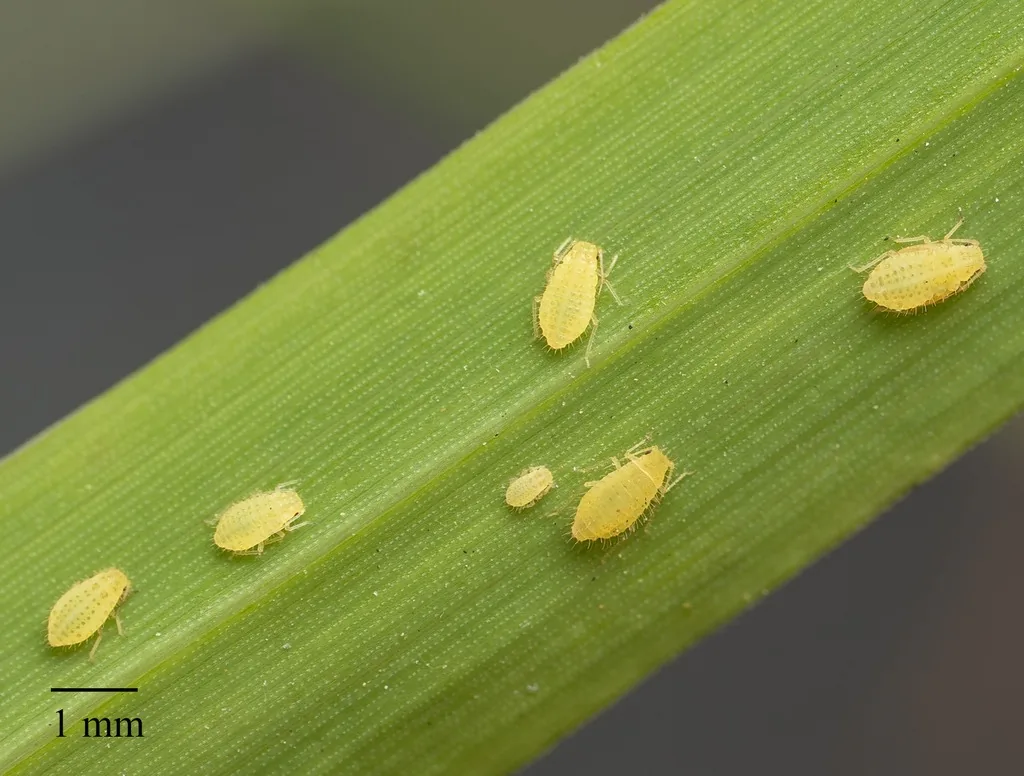
- Winged and wingless adults are 1.3 to 2.0 mm long. Wingless adults and nymphs are straw to bright yellow or light green, and UF/IFAS says they are yellow on sugarcane.[3][2][1]
- Two double rows of dusky spots run down the top of the abdomen, with more rows along its sides.[3][1]
- The body is covered with short, stiff hairs, and the cornicles (the paired 'tailpipes') are reduced to slightly raised pores.[3][1][2]
- Winged adults keep the bright yellow abdomen, but the head and thorax are darker.[2]
- The aphids feed on the undersides of leaves; in sugarcane they mostly attack young plants.[2]
- Colonies line up along the parallel veins on the lower leaf surface, and honeydew dripping onto lower leaves supports sooty mold.[3]
Look-alikes
| Look-alike | How to tell them apart |
|---|---|
| Sugarcane aphid | Pale yellow, gray or tan with black feet, antennae and cornicles.[1] |
| Greenbug | Light green with a dark green stripe down the back rather than bright yellow with spots.[1] |
| Corn leaf aphid | Dark green and usually feeds in the whorl of the plant.[1] |
Where it lives
Thought to be a North American native, it was described from Illinois in 1884. It occurs throughout the contiguous United States and the Hawaiian Islands, as far north as New York and Washington State, and in Mexico, Central and South America and the Caribbean. It has more recently become established as an invasive pest in parts of Africa.[3][2]
Biology and life cycle
In warmer parts of its range it reproduces without mating all year; where cold winters set in, sexual forms appear. Development to adult takes 8 to 15 days, depending on temperature and host plant, and is faster on sorghum than on sugarcane.[2]
Crop hosts include sorghum, sugarcane, rice and wheat, and it also feeds on many non-crop grasses, including species of Digitaria, Hordeum, Panicum, Paspalum and Pennisetum.[2][1]
Many predators feed on it, but parasitic wasps rarely attack it. How much natural enemies hold it back in sugarcane has not been well studied.[1][2]
Dry weather is linked to outbreaks, while heavy rain washes aphids off plants and humid, rainy weather favors disease-causing fungi. In Louisiana sugarcane, infestations are common from April to June; in Florida they occur on newly planted cane in fall and on new growth in spring.[2]
In warm climates females reproduce without mating and give birth to live young; where winters are cold, females mate with wingless males. Nymphs pass through four instars with no pupal stage. Development to a reproducing adult takes about 8 days on sorghum but 18 to 22 days on sugarcane, and females produce one to five nymphs a day for about 22 days on average.[3]
It tolerates crowding and usually moves to other leaves only after its leaf has turned mostly yellow and begun to die. White sugarcane aphids (Melanaphis sacchari) often live among it on sugarcane; it makes no alarm pheromone of its own but drops from the plant in response to theirs.[3]
UF/IFAS lists corn, rice, sorghum and sugarcane as crop hosts, records it from grass genera including Hordeum, Oryza, Saccharum, Sorghum, Triticum and Zea, and also from sedges in the genera Carex and Cyperus.[3]
Earwigs, 10 species of lady beetles, flower flies, predatory ants such as the red imported fire ant, and young spiders can greatly reduce populations, but not always before damage is done. Parasitic wasps rarely attack it and none are known in Florida; a wasp from France, Adialytus ambiguus, established in Hawaii in 1991. Temperatures above 95°F and heavy summer rain also cut populations.[3]
Damage and signs
- The aphid injects a toxin as it feeds. Leaves turn yellow or red; on sorghum seedlings they turn purple and growth is stunted.[1][2]
- Feeding can make leaves yellow and die early. In sorghum, damage often delays maturity and leads to lodging, which stalk rots can make worse.[2][1]
- Seedlings are most vulnerable: an infestation of a week or less can badly damage sorghum with one to three true leaves, and in sugarcane, yellowing of two or three leaves early in the season has been reported to cut sugar yields by up to 6 percent.[1][2]
- It also transmits sugarcane mosaic virus.[2][3]
- In sugarcane, the aphid-induced death of as few as two of the lower leaves within the first three months can reduce yield by 6%, and loss of three pairs of those leaves can mean a 19% yield loss. Most damage in Florida occurs in spring and mid to late fall.[3]
Health risk
It is a crop and grass pest; neither source describes any risk to people or pets.[1][2]
Control
Prevention
Resistant varieties help. On resistant sugarcane cultivars the aphid grows and develops 1.5 to 3 times more slowly than on susceptible ones, and growing susceptible cultivars in Florida led to severe infestations. Many sorghum varieties are susceptible, but resistant sorghum and sudangrass hybrids are grown in Florida for grazing and silage.[2][3]
Monitor populations to see whether natural enemies are keeping numbers low enough to prevent early leaf yellowing and death. In sugarcane, UF/IFAS uses leaf damage rather than aphid counts: an infestation that leaves just four live leaves below the top visible dewlap leaf with more than 50% green tissue can still reduce sugar at harvest by up to 6%.[3]
Traps and physical control
Scout sorghum from the first week after emergence, twice a week, until plants have at least five true leaves. Purple seedlings can signal an infestation, but root injury, phosphorus deficiency and cold, wet or compacted soil can also turn leaves purple, so look for the aphids.[1]
Biological control
In sugarcane, sprays are not consistently recommended: there is little evidence they improve yields, and they can kill natural enemies and lead to resurgence or outbreaks of other pests.[2]
Pesticides
For sorghum, Texas A&M lists neonicotinoid seed treatments (clothianidin, imidacloprid, thiamethoxam) and labeled foliar insecticides, with treatment thresholds for seedlings based on the percentage of plants infested. Timing is critical, because by the time discoloration shows the plants are already significantly injured.[1]
Where the sources disagree
Development time: a peer-reviewed review gives 8 to 15 days to adulthood depending on temperature and host; UF/IFAS gives about 8 days on sorghum and 18 to 22 days on sugarcane.[2][3]
Spraying sugarcane: UF/IFAS says effective insecticides are available should natural enemies or weather fail and that timing is critical; a peer-reviewed review says sprays in sugarcane are not consistently recommended because there is little evidence they improve yields.[3][2]
Common questions
- Why are my sorghum seedlings turning purple?
- Yellow sugarcane aphids are one cause: their toxic saliva turns seedling leaves purple and stunts them. Root injury, phosphorus deficiency and cold, wet or compacted soil can do the same, so check leaf undersides for small, spotted yellow aphids.[1]
- How is the yellow sugarcane aphid different from the sugarcane aphid?
- The yellow sugarcane aphid is bright yellow with rows of dark spots and short cornicles; the sugarcane aphid is pale yellow, gray or tan with black feet, antennae and cornicles.[1]
- Does it feed only on crops?
- No. Besides sorghum, sugarcane, corn, rice and wheat, it reproduces on lawn and pasture grasses, including species of Digitaria, Panicum, Paspalum and Pennisetum.[2][3]
Sources
- Texas A&M AgriLife Extension Service, Department of Entomology, “Sorghum management guide: Stem- and Leaf-Feeding Insects.” extensionentomology.tamu.edu/resources/management-guides/sorghum/stem-and-leaf-feeding-insects/ (accessed 2026-11-12)
- Insects 2019;10(4):107, via PubMed Central, “Hemipteran Pests of Sugarcane in North America (2019).” pmc.ncbi.nlm.nih.gov/articles/PMC6523691/ (accessed 2026-11-12). PMID 31013987
- University of Florida IFAS Extension (EDIS), “Yellow Sugarcane Aphid, Sipha flava (Forbes), EENY354/IN635 (Featured Creatures; reviewed January 2019).” ask.ifas.ufl.edu/publication/IN635 (accessed 2026-11-14)
- iNaturalist, “Sipha flava taxon page (order and family).” www.inaturalist.org/taxa/454650 (accessed 2026-11-09)