On this page
How to identify it
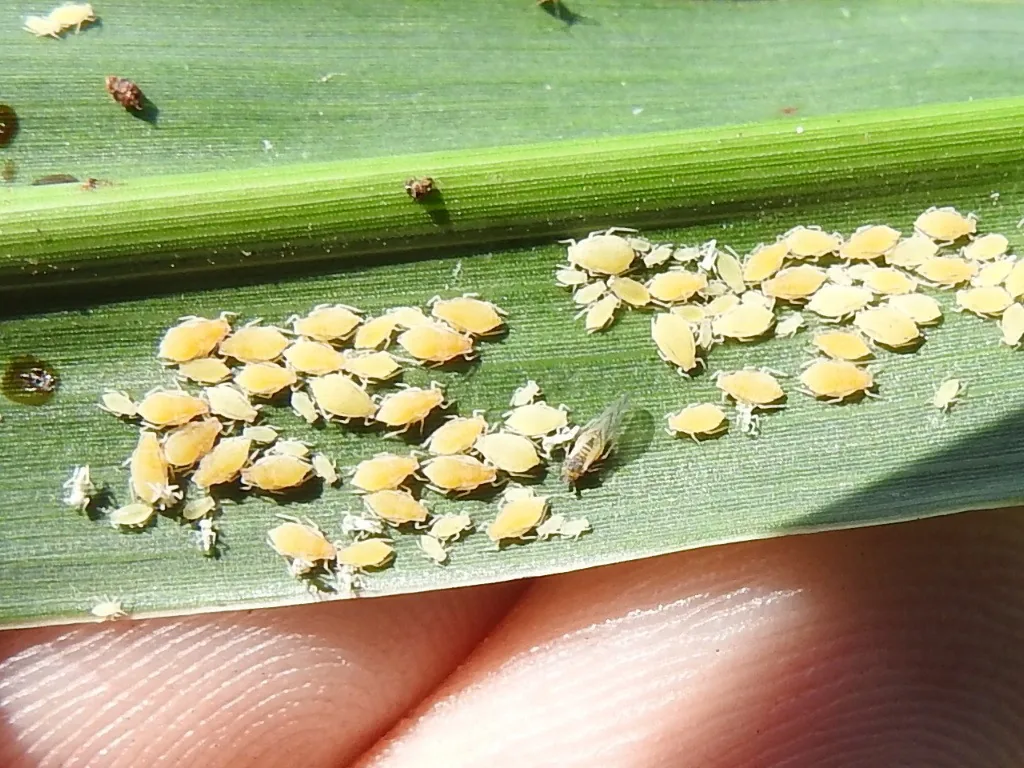
- A small pale aphid, yellowish, white, gray, tan or slightly peach, with black feet, black antennae and black cornicles (the tailpipes on the rear).[1][3][2]
- Colonies sit on the undersides of the leaves and can spread until they cover much of the lower leaf surface; they can also move into the grain head.[1][3]
- Leaves below a colony turn sticky and shiny with honeydew, but small colonies make too little to notice.[1]
- Aphids that look like they have shoulder pads will become winged adults at their next molt.[3]
Look-alikes
| Look-alike | How to tell them apart |
|---|---|
| Greenbug | Greenbugs are light green with a dark green stripe down the back, not pale with black feet and tailpipes.[1] |
| Yellow sugarcane aphid | Bright yellow with rows of dark spots and short cornicles, and it produces no honeydew.[1] |
| Corn leaf aphid | Dark green and usually found feeding in the whorl of the sorghum plant.[1] |
Where it lives
First confirmed on U.S. sorghum in Texas in 2013, it had reached nineteen states and all of Mexico's sorghum regions by the time of Arizona's 2022 report, including Alabama (2014) and Arizona (2016).[2][1][3]
Biology and life cycle
Colonies are all females that give birth to live young. The young become adults in about 5 days and live about 4 weeks, so populations can double every 4 to 8 days, fastest in warm, dry weather.[1][3]
It lives mainly on sorghum, sugarcane, sudangrass and johnsongrass, and Alabama Extension also lists sweet sorghum, sorghum-sudan hybrids and millet.[2][3]
It survives the winter on living host grasses and spreads by wind, and winged aphids can migrate long distances. Field infestations often begin on edges next to johnsongrass, ditch banks or volunteer sorghum.[2][3][1]
Damage and signs
- Feeding turns leaves yellow, purple and eventually brown and reduces yields; untreated sorghum in Arizona field trials lost 30 percent of its yield.[3][2]
- Infestations during the preboot, boot and head-emergence stages do the most damage; once grain reaches the hard dough stage, yield loss is small.[1]
- Honeydew grows sooty mold, and sticky leaves and stalks can clog combines, cause lodging and delay harvest, especially when aphids move into the heads late in the season.[3][1]
Health risk
It is a sap-feeding aphid of sorghum and related grasses. Texas A&M, Alabama Extension and the University of Arizona describe it only as a crop pest; none of them mentions bites or any effect on people or pets.[1][3][2]
Control
Prevention
Plant early in the normal planting window or choose an early-maturing hybrid, so the crop is past its most sensitive stages before aphids peak. Resistant or tolerant hybrids slow aphid buildup, but none are immune and they still need scouting.[1][3]
Use a seeding rate that gives a thick stand, soil-test and avoid over-fertilizing, which may make the aphid worse.[3]
Sanitation
Control johnsongrass and volunteer sorghum around fields; they harbor the aphids that often start an infestation.[1][3]
Traps and physical control
Scout weekly from emergence, checking the undersides of upper and lower leaves on plants in several parts of the field and near johnsongrass, and twice a week once you find aphids. Don't wait for honeydew; small colonies make little of it.[1][3]
Biological control
Lady beetles, lacewings, syrphid flies and parasitic wasps help suppress the aphid. Texas A&M says many insecticides labeled for midge, headworms and stinkbugs in sorghum are toxic to these natural enemies, and Alabama Extension says the problem is much worse when they are eliminated and advises avoiding broad-spectrum insecticides.[1][3]
Pesticides
Seed treatments with clothianidin (Poncho), imidacloprid (Gaucho) or thiamethoxam (Cruiser) are labeled for sugarcane aphids and other seedling pests; EPA's product system lists Poncho 600, Gaucho 600 Flowable and Cruiser as active registrations with sorghum seed treatment among their uses. Texas A&M says they protect seedlings for about 4 to 6 weeks after planting and are most valuable in southern areas and for late plantings. When scouting reaches an action threshold, a foliar insecticide labeled for sugarcane aphid on sorghum may be needed; follow the label and its preharvest interval.[1][3][5][6][7]
Where the sources disagree
Scientific name: Texas A&M, Alabama Extension and the University of Arizona call it Melanaphis sacchari. A 2021 morphometric and molecular study says the two names were commonly treated as synonyms and concludes that the invasive genotype damaging sorghum in the US, Mexico and the Caribbean since 2013 is M. sorghi; a 2025 review describes a M. sacchari/sorghi complex in which some research treats the sorghum-feeding genotype as M. sorghi. GBIF lists both names as accepted species.[1][3][2][4][8][9][10]
How long seed treatments protect: Texas A&M says about 4 to 6 weeks after planting; Alabama Extension's 2015 guide says approximately 30 days.[1][3]
Color: Texas A&M describes them as pale yellow, gray or tan; Alabama Extension adds white and peach.[1][3]
Common questions
- Why are my sorghum leaves sticky and shiny?
- It may be honeydew from sugarcane aphids feeding on the undersides of the leaves above. Turn those leaves over to confirm.[1]
- Does johnsongrass near my field matter?
- Yes. The aphid lives and overwinters on johnsongrass, and infestations often start on field edges next to it, so scout and control it.[2][1][3]
- Is the aphid still a problem late in the season?
- Yield losses are small after the hard dough stage, but heavy honeydew in the heads can still interfere with harvest, so scout 2 to 3 weeks before harvest.[1]
Sources
- Texas A&M AgriLife Extension Service, Extension Entomology, “Managing Insect and Mite Pests of Texas Sorghum: Stem- and Leaf-Feeding Insects.” extensionentomology.tamu.edu/resources/management-guides/sorghum/stem-and-leaf-feeding-insects/ (accessed 2026-11-13)
- University of Arizona Cooperative Extension, “Sugarcane Aphid, Melanaphis sacchari (Zehntner) (Hemiptera: Aphididae): A New Invasive Pest of Arizona Sorghum, AZ2005 (A. Mostafa, K. Harrington and W. Burayu, October 2022), publication summary.” extension.arizona.edu/publication/sugarcane-aphid-melanaphis-sacchari-zehntner-hemiptera-aphididae-arizona-sorghum (accessed 2026-11-13)
- Alabama Cooperative Extension System, Auburn University, “IPM Strategies for Managing Sugarcane Aphid in Alabama Sorghum (K. Flanders and A. Jacobson, May 15, 2015).” ssl.acesag.auburn.edu/agriculture/livestock-poultry/beef/documents/SugarCaneAphid.pdf (accessed 2026-11-13)
- PLoS One 2021;16(3):e0241881, via PubMed, “Morphometric and molecular discrimination of the sugarcane aphid, Melanaphis sacchari, (Zehntner, 1897) and the sorghum aphid Melanaphis sorghi (Theobald, 1904) (Nibouche et al. 2021).” pubmed.ncbi.nlm.nih.gov/33764987/ (accessed 2026-11-13). Cited from the PubMed abstract.
- U.S. EPA Pesticide Product and Label System, “Poncho 600 (clothianidin), EPA Reg. No. 7969-458 (product record: status, sites and pests).” ordspub.epa.gov/ords/pesticides/cswu/ppls/7969-458 (accessed 2026-11-13)
- U.S. EPA Pesticide Product and Label System, “Gaucho 600 Flowable (imidacloprid), EPA Reg. No. 264-968 (product record: status, sites and pests).” ordspub.epa.gov/ords/pesticides/cswu/ppls/264-968 (accessed 2026-11-13)
- U.S. EPA Pesticide Product and Label System, “Cruiser Insecticide (thiamethoxam), EPA Reg. No. 100-941 (product record: status, sites and pests).” ordspub.epa.gov/ords/pesticides/cswu/ppls/100-941 (accessed 2026-11-13)
- Pest Manag Sci 2025;81(5):2427-2441, via PubMed, “Melanaphis sacchari/sorghi complex: current status, challenges and integrated strategies for managing the invasive sap-feeding insect pest of sorghum (Vasquez et al. 2025).” pubmed.ncbi.nlm.nih.gov/39001705/ (accessed 2026-11-13). Cited from the PubMed abstract.
- Global Biodiversity Information Facility (GBIF), “Melanaphis sacchari (Zehntner, 1897) (GBIF Backbone Taxonomy).” api.gbif.org/v1/species/2076279 (accessed 2026-11-13)
- Global Biodiversity Information Facility (GBIF), “Melanaphis sorghi (Theobald, 1904) (GBIF Backbone Taxonomy).” api.gbif.org/v1/species/4385709 (accessed 2026-11-13)
- iNaturalist, “Melanaphis sacchari taxon page (order and family).” www.inaturalist.org/taxa/1604167 (accessed 2026-11-08)