On this page
How to identify it
- Young caterpillars are creamy white and marked with brown to black spots; more mature caterpillars that overwinter have no spots, or fainter ones.[4]
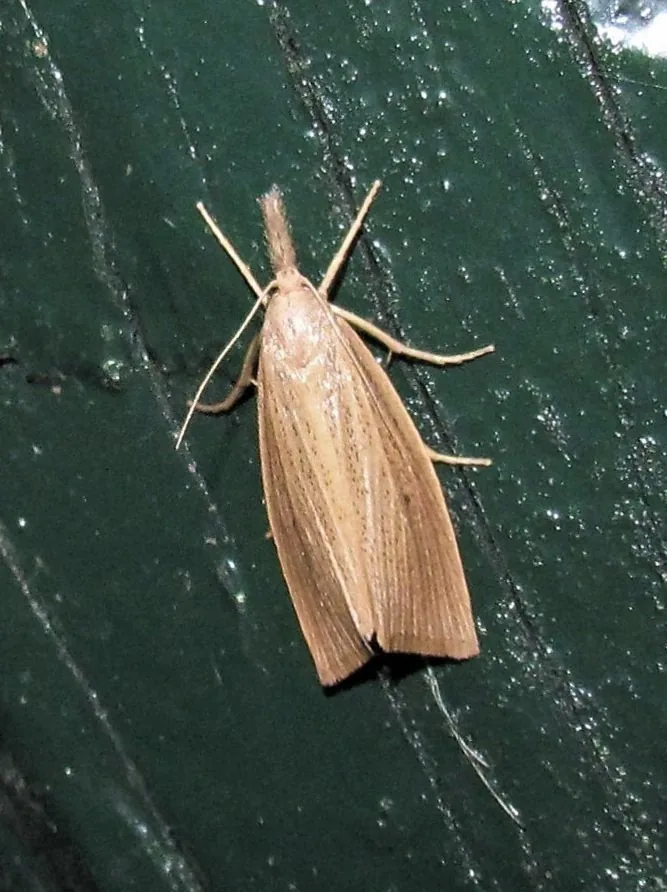
- The moth is buff-colored, flies at night and has few distinctive markings.[4][1]
- Eggs are laid in clusters, overlapping like shingles, on leaves and stalks.[4][5]
- UF/IFAS describes the caterpillar as whitish with a brown head. The summer form has a large brown spot on each body segment, each bearing a stout hair; the winter form lacks the spots. Larvae grow to about 20 to 30 mm (3/4 to 1 1/8 in) in the fifth instar, and a full-grown larva is about an inch long.[6][3]
- The moth is yellowish or yellowish brown with numerous narrow brown lines running the length of the forewing; UF/IFAS also describes black dots in a V-shaped design. Females are larger: the wingspan is 18 to 28 mm in males and 27 to 39 mm in females. The moths are nocturnal and seldom seen.[6][3]
- Eggs are flattened ovals about 1.16 mm long, laid in clusters of two to 50 that overlap like fish scales on both leaf surfaces. They are white at first, turn orange, and go blackish just before hatching.[6]
- Signs in sugarcane: a row of small pin-holes straight across a leaf when it unfurls, tiny holes into midribs, and holes in the stalk with fresh light-brown fibrous frass.[3]
Look-alikes
| Look-alike | How to tell them apart |
|---|---|
| Southwestern corn borer (Diatraea grandiosella) | Young caterpillars of both species are creamy white with brown to black spots, so the two are hard to tell apart in the field.[4] |
| Mexican rice borer (Eoreuma loftini) | Its caterpillar has broken, dashed lines along the body instead of spots.[4] |
| Southern cornstalk borer (Diatraea crambidoides) | Its caterpillars are easily confused with sugarcane borer and can be separated reliably only by examining the mouthparts under a microscope. In corn, the southern cornstalk borer is much more likely to be the one you find.[6] |
Where it lives
EPPO lists it in Florida, Louisiana, Mississippi and Texas, and through the Caribbean, Central America and South America as far as Argentina and Uruguay. Its native range is uncertain; one review gives the West Indies and Central and South America. It was first reported as a pest in Louisiana around 1854, probably arriving with imported sugarcane.[7][1][5]
Biology and life cycle
Hosts include sugarcane, corn, sorghum and rice, and the moth also lays eggs on other grasses.[1][5]
Newly hatched caterpillars feed inside the leaf sheaths. After about 10 days they bore into the stalk, keep growing there and pupate inside their tunnels.[5][4]
Caterpillars overwinter in stalks, root crowns or other crop debris, and pupate there.[4]
UF/IFAS lists sugarcane as the main host and also corn, rice, sorghum and sudangrass, plus wild and weedy grasses such as Johnsongrass and species of Paspalum, Panicum, Holcus and Andropogon.[6]
Eggs hatch in four to six days. Mean fecundity is about 700 eggs for borers reared on corn and sugarcane but about 425 on Johnsongrass; the Florida guide estimates 200 to 300 eggs per female, laid in clusters of 25 to 30, usually on the underside of leaves in the upper half of the canopy.[6][3]
Young caterpillars move into the whorl or feed into a midrib or leaf sheath, and burrow into the stalk after the first or second molt. Five to six instars is normal. Larval development takes 25 to 30 days in warm weather and 30 to 35 days in cool weather, and the pupa, inside the tunnel, lasts usually eight to nine days. Before pupating, the larva leaves only a thin layer of plant tissue for the moth to break through.[6][3]
It overwinters as a larva, mainly in sugarcane and the stalks of large grasses, and pupates in spring. In Louisiana and Texas moths are active by April or May and generations overlap until autumn. Adults live three to eight days.[6]
Heavy rain, especially winter flooding of stalks holding overwintering larvae, depresses survival, and cold winters reduce larval survival in Louisiana.[6]
Damage and signs
- Tunnels inside the stalk disrupt the flow of sugars and nutrients, lower sucrose content and weaken the stalk, which can fall over. The feeding holes also let plant pathogens in.[8][1]
- Feeding can kill the leaves inside the whorl, a condition called dead heart.[5][4]
- In sorghum and corn, infested stalks are smaller, often lodge and are more prone to stalk rots.[4]
- In mature cane the tops weaken or die and sometimes break off, and juice yield and purity fall. UF/IFAS reports sucrose yield may drop 10 to 20%, and the Florida guide says plants with bored internodes can produce 45% less sugar. Tunnels also let in fungal, bacterial and viral disease organisms, and attacked seed cane becomes prone to fungal infection.[6][3]
- In corn, early-season larvae feed in the whorl, leaving a series of holes across the leaf blade or killing the growing point, and later tunnel into the stalk, which may break; they sometimes enter ears. UF/IFAS calls it a minor pest of sweet corn, even in Florida.[6]
Health risk
It is a crop pest only; none of the Texas A&M, UF/IFAS or Louisiana sources cited here mentions any risk to people.[4][5][6][3]
Control
Prevention
Louisiana relies on growers and consultants scouting fields by hand for borer infestations, because trap catches are hard to relate to larval infestations and damage.[5]
Resistant sugarcane cultivars make it harder for caterpillars to bore into the stalk, which leaves them exposed longer to natural enemies and insecticides. Planting seed cane free of borers has been a key measure in Louisiana.[5]
UF/IFAS advises scouting sugarcane every two or three weeks from March through November: check leaves, the whorl and behind leaf sheaths, and split stalks. Detecting 2 to 3 live larvae per 100 sampled stalks is generally thought to be the economic threshold.[3]
All sugarcane varieties grown in Florida are susceptible but vary in damage; UF/IFAS advises using varieties with at least moderate resistance, destroying infested cane trash and stubble, and planting seed pieces free of borer damage. Burning does not always kill borers deep in stalks. Resistant grain corn varieties and Bt corn are also used.[3][6]
Sanitation
Cultural tactics recommended in Louisiana have included better field hygiene, burning cane before harvest, adjusting planting dates and flooding fields.[5]
Biological control
The parasitic wasp Cotesia flavipes established in Texas and Florida but failed to establish in Louisiana.[1][5]
Fire ants and other ants are important predators in cane fields. In Florida the wasps Alabagrus stigmatera and Cotesia flavipes parasitize the larvae, Cotesia being the most important; if 50% or more of dissected larvae are parasitized, UF/IFAS does not recommend insecticides, and augmentative releases of Cotesia have been highly effective in Florida.[6][3]
Pesticides
Treatments have to reach caterpillars before they bore in, since they are largely protected once inside the stalk. In Louisiana, integrated pest management has reduced the borer's economic impact.[5][2]
UF/IFAS says insecticides should supplement other methods and work best on young larvae before they enter the stalk, though some borers inside are hit as they clean their tunnels. Follow the label.[6][3]
Where the sources disagree
Arrival date: UF/IFAS says it apparently was introduced into Louisiana about 1855; other research gives first reports as a pest in Louisiana around 1854.[6][1][5]
Generations: Featured Creatures says four to five generations are possible but moths are abundant only in spring and autumn, so perhaps there are fewer, and a summer generation may take only 25 days; the Florida guide says there may be as many as six generations, averaging around 40 to 45 days each in summer.[6][3]
Parasitoids: Featured Creatures says effective parasitoids are not established in the United States, though Cotesia flavipes is an important late-season parasitoid in Florida; the Florida guide calls Cotesia the most important parasitoid there; other research says it established in Texas and Florida but not Louisiana.[6][3][1][5]
Moth size: the Florida guide gives a one inch wingspan; Featured Creatures gives 18 to 28 mm for males and 27 to 39 mm for females.[3][6]
Common questions
- What is a dead heart in sugarcane or sorghum?
- It is a dead whorl: the borer's feeding kills the innermost leaves, so the centre of the plant dies.[5][4]
- Which crops does the sugarcane borer attack?
- Sugarcane, corn, sorghum and rice, along with other grasses.[1][5]
- What causes a row of pin-holes across sugarcane leaves?
- Young sugarcane borer caterpillars tunneling across the rolled leaves in the whorl leave a row of pin-holes that shows when the leaf unfurls. Borer-infested stalks are usually nearby.[3]
- Is the sugarcane borer a problem in sweet corn?
- Rarely. UF/IFAS calls it a minor pest of sweet corn even in Florida; in corn the southern cornstalk borer is much more likely.[6]
Sources
- PLoS ONE (via NCBI PubMed), “Geographic population structure of the sugarcane borer, Diatraea saccharalis, in the southern United States (A. L. Joyce et al.; PLoS ONE 9(10): e110036, 2014; abstract).” pubmed.ncbi.nlm.nih.gov/25337705/ (accessed 2026-11-12)
- Journal of Economic Entomology (via NCBI PubMed), “Successful Integrated Pest Management Minimizes the Economic Impact of Diatraea saccharalis on the Louisiana Sugarcane Industry (B. E. Wilson et al.; Journal of Economic Entomology 114(1), 2021; abstract).” pubmed.ncbi.nlm.nih.gov/33247296/ (accessed 2026-11-12)
- University of Florida IFAS Extension (EDIS archive, journals.flvc.org), “Sugarcane Borer in Florida, ENY-666/SC011 (D. G. Hall, G. S. Nuessly and R. A. Gilbert; revised February 2007; archival copy).” journals.flvc.org/edis/article/view/116569 (accessed 2026-11-14). Retired from the live EDIS site (ask.ifas.ufl.edu/publication/SC011 returns 410); archival PDF read 2026-11-14.
- Texas Agricultural Extension Service, Texas A&M University System, “Field Guide to Pests & Beneficials in Texas Grain Sorghum (B-6094).” legacy.research.agrilife.org/wp-content/uploads/sites/3/2011/10/SorgFieldGuidePests_2.pdf (accessed 2026-11-12)
- Insects, via PubMed, “Interaction of Cultural, Biological, and Varietal Controls for Management of Stalk Borers in Louisiana Sugarcane.” pubmed.ncbi.nlm.nih.gov/31546775/ (accessed 2026-11-12)
- University of Florida IFAS Extension (EDIS), “Sugarcane Borer, Diatraea saccharalis (Fabricius), EENY217/IN374 (J. Capinera; Featured Creatures).” ask.ifas.ufl.edu/publication/IN374 (accessed 2026-11-14)
- EPPO Global Database, “Diatraea saccharalis (DIATSA) datasheet: geographical distribution.” gd.eppo.int/taxon/DIATSA/datasheet (accessed 2026-11-12)
- Frontiers in Plant Science, via PubMed Central, “Phenotype-genotype association for the identification of resistance to stem borers (Diatraea spp., Lepidoptera: Crambidae) in sugarcane.” pmc.ncbi.nlm.nih.gov/articles/PMC13638524/ (accessed 2026-11-12)
- iNaturalist, “Diatraea saccharalis taxon page (order and family).” www.inaturalist.org/taxa/330449 (accessed 2026-11-09)