On this page
How to identify it
- Caterpillars are pale yellowish to whitish with a dark head and rows of small dark brown or black spots, growing to about 3/4 to 1 inch long.[1][2]
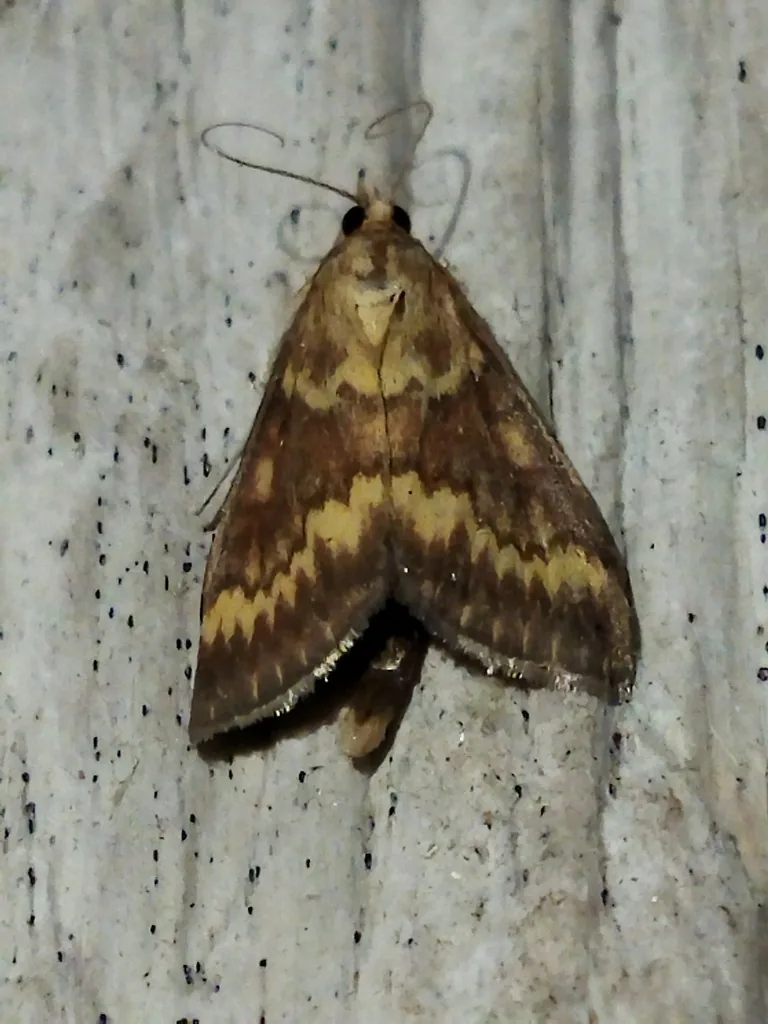
- The adult is a yellowish brown moth patterned in brown and tan, about 1/2 inch long; females have a wingspan of about 1 inch, and males are smaller and more slender.[1][2]
- Eggs are laid in flat masses of about 15 to 20 that overlap like fish scales, usually on the underside of leaves; they start white and darken with age.[2][1]
- Signs of the caterpillar are small entrance holes with frass (droppings) and silk on stems, pepper fruit or corn stalks. In whorl-stage sweet corn, Illinois tells growers to look for shot-hole feeding on the leaves and for larvae in the whorl.[2][1]
Where it lives
Extension services in Kentucky, Illinois and North Carolina all treat it as a pest of corn, peppers and other garden crops in their states, and EPA names it as one of the main target pests of Bt corn.[3][1][2][4]
Biology and life cycle
It spends the winter as a full-grown caterpillar inside corn stubble or the stems of other plants, and pupates there when warm weather returns in spring.[3][1][2]
Moths lay more eggs on warm, calm nights, and each female can lay up to about 600; the eggs hatch in about a week.[1][2]
Young caterpillars feed on the leaf surface for a few days, then bore into stalks, stems, ears or fruit to finish growing, and they pupate inside the plant.[2][1]
The caterpillars are cannibalistic, which is why only one or two may turn up in a pot of mums even though the moth laid dozens of eggs.[2]
Illinois reports two to three generations a year, with the first in May and June and the second emerging in July. Kentucky has tables for two generations and says a third occurs in some years; NC State reports four in North Carolina.[1][3][2]
Development stops below 50 degrees F and slows sharply above 85 degrees F, and Kentucky uses degree-day predictions to tell growers when to watch pheromone traps and scout.[3]
Damage and signs
- In sweet corn, caterpillars tunnel through the stalk, lowering yield and sometimes breaking the stalk, and they also tunnel into the cobs.[1]
- In peppers they bore into stems and fruit, leaving a pinhole entry covered with frass, and Illinois notes they damage bell peppers more than hot peppers. They also tunnel into bean pods and tomato fruit and feed on potato leaves and stems.[1]
- Flowers are hosts too: NC State lists chrysanthemums, asters, cosmos, dahlias, gladioli, hollyhocks, roses and zinnias among the more than 200 plants it bores into, and slender infested stalks eventually fall over.[2]
Health risk
It is a plant-feeding caterpillar. Kentucky, Illinois and NC State describe it only as a crop and garden pest and don't mention any risk to people or pets.[3][1][2]
Control
Prevention
Field corn growers mostly plant Bt corn. EPA requires every registered Bt corn product to be used with a refuge of non-Bt corn, either planted as a separate block, border or rows or blended into the seed bag, so that susceptible borers survive to mate with any resistant ones. In the Corn Belt, EPA's table calls for a 20 percent structured refuge within half a mile for single-toxin corn aimed at caterpillar pests, and 5 percent for pyramided products with two or more Bt proteins.[4]
Sanitation
The caterpillars spend the winter in stalks, so remove or destroy crop debris after harvest, including the stalks of corn, dahlias, mums and weeds nearby, to cut next year's population.[1][2]
Traps and physical control
Once caterpillars are inside a stem it is essentially too late to spray; cut out and destroy the infested stems.[2]
Pesticides
Sprays only work before the caterpillars bore in. Illinois tells gardeners to treat when larvae begin to appear, and for ornamentals NC State suggests a pyrethroid such as permethrin or bifenthrin, kept away from pools, ponds and streams because pyrethroids are toxic to fish.[1][2]
Commercial sweet corn growers in Illinois scout whorl-stage corn for shot-hole feeding and treat in late whorl if more than 15 percent of plants show larval feeding, before the larvae bore from the whorl into the stalk.[1]
Where the sources disagree
Host range: EPA lists the European corn borer among Bt target pests that feed almost exclusively on corn or cotton, which it says raises the risk of resistance; Illinois and NC State say it feeds on more than 200 kinds of plants, including peppers, beans, potatoes and garden flowers.[4][1][2]
Generations: Illinois says two to three a year and Kentucky two, with a third in some years; NC State says four in North Carolina.[1][3][2]
When to spray in a garden: Illinois says to treat when larvae begin to appear; NC State suggests a pyrethroid about once a month as field crops harden off in mid to late summer; Kentucky recommends degree-day predictions together with scouting or pheromone traps to decide when to act.[1][2][3]
Common questions
- What is boring into my bell peppers?
- The European corn borer is one possibility. Its caterpillars enter pepper fruit through a pinhole covered with frass, and Illinois notes they damage bell peppers more than hot peppers.[1]
- Why do I find only one or two borers in a plant?
- The caterpillars are cannibalistic. NC State points to this as the reason only one or two borers turn up in a pot of mums even when the moth laid dozens of eggs.[2]
- Can I spray once the borers are inside the stalk?
- No. Sprays cannot reach caterpillars that have tunneled in. Cut out and destroy infested stems, and clean up stalks and crop debris in the fall, since that is where the borers spend the winter.[2][1]
Sources
- University of Illinois Extension, “European Corn Borer (Insects).” extension.illinois.edu/insects/european-corn-borer (accessed 2026-11-13)
- NC State Extension, “European Corn Borer on Ornamentals (J. Baker).” content.ces.ncsu.edu/european-corn-borer (accessed 2026-11-13)
- University of Kentucky Entomology, “Predicting European Corn Borer Development, ENTFACT-106 (R. Bessin).” entomology.ca.uky.edu/ef106 (accessed 2026-11-13)
- U.S. Environmental Protection Agency, “Insect Resistance Management for Bt Plant-Incorporated Protectants.” www.epa.gov/regulation-biotechnology-under-tsca-and-fifra/insect-resistance-management-bt-plant-incorporated (accessed 2026-11-13)
- Global Biodiversity Information Facility (GBIF), “Ostrinia nubilalis Hübner, 1796 (GBIF Backbone Taxonomy).” api.gbif.org/v1/species/8223165 (accessed 2026-11-13)
- iNaturalist, “Ostrinia nubilalis taxon page (order and family).” www.inaturalist.org/taxa/1523240 (accessed 2026-11-08)