On this page
How to identify it
- Larvae reach nearly 1/2 inch. Kentucky describes mature larvae as light yellow, pointed at the head end and blunt at the rear; UMass calls them white maggots with no distinct head capsule.[1][2]
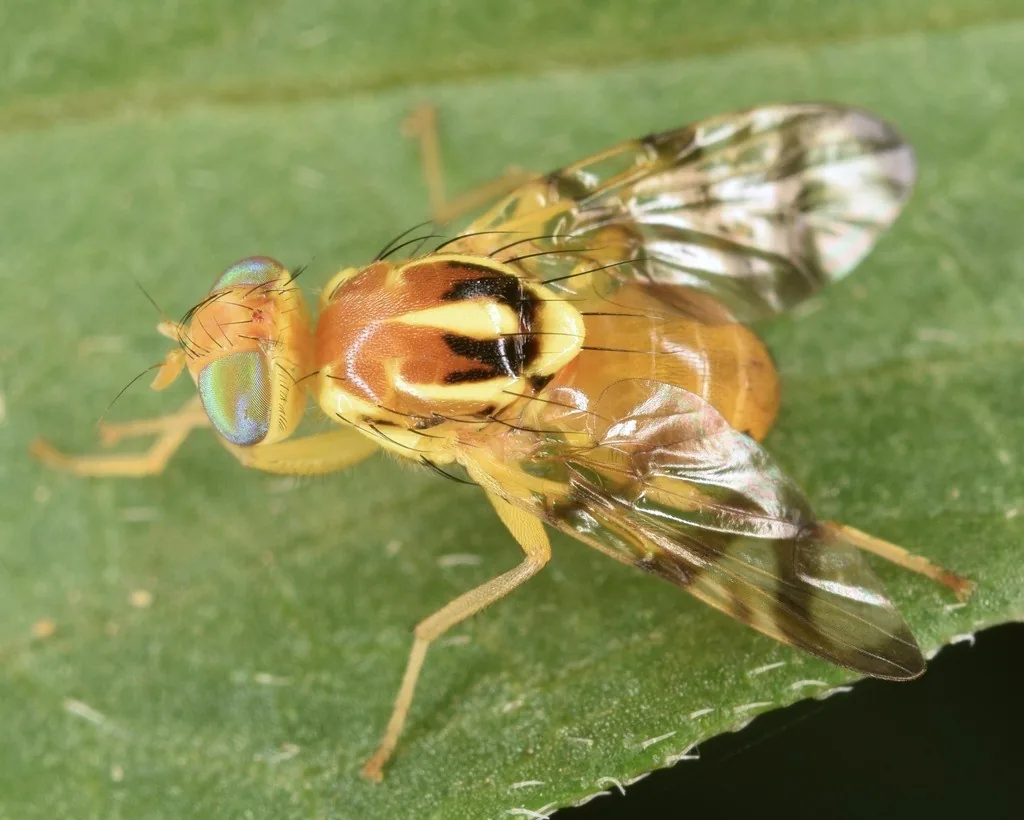
- Adults are bright yellow flies, smaller than a house fly, with green eyes and clear wings with brown bands. UMass notes three yellow stripes on the thorax; Kentucky describes a tan thorax and pale yellow head and abdomen.[1][2]
- Each egg goes into the fruit through a small dimple, the oviposition sting or scar, and one fruit can have several. The eggs are light colored, about 2 mm long and hard to find.[1][2]
- Grown maggots leave through tiny round exit holes at the blossom end, usually in late August or early September.[2]
Look-alikes
| Look-alike | How to tell them apart |
|---|---|
| European corn borer | Corn borer larvae have a brown head capsule and leave some outside evidence on the pepper. Pepper maggots have no distinct head capsule and leave almost none.[1][2] |
| Small maggots in rotting peppers | Tiny fly maggots often feed on decaying peppers already hit by disease or corn borer, and they don't injure sound fruit. Pepper maggot is a larger larva feeding in otherwise sound fruit.[1] |
Where it lives
Kentucky calls it a sporadic pest along the Atlantic coast, Indiana and Missouri, first found in Kentucky in 2002. UMass says it occurs throughout eastern North America, is most common along the East Coast, and seems to be expanding its range.[1][2]
Biology and life cycle
Eggs hatch in about 10 days. Larvae tunnel in the fruit, especially the spongy tissue the seeds attach to, for about two to three weeks, then drop to the soil; Kentucky says they pupate two to four inches deep.[2][1]
There is one generation a year, overwintering as pupae in the soil. Sources differ on emergence: Kentucky says adults emerge from early summer through mid-August, UMass in mid-July.[1][2]
Larvae feed only on nightshade-family plants, including ground cherry, horsenettle, tomato, pepper and eggplant. Pepper is preferred, and cherry, bull's horn and green bell peppers are especially susceptible.[2][1]
Flies gather in wooded field edges to mate and enter the field by day to lay eggs. UConn trapping caught more flies high in the canopy of edge trees than lower down, and more in sugar maples than in chokecherries.[2][5]
Damage and signs
- Infested fruit shows internal tunneling, soft spots and brown mines, often colors early, and the cap may separate at harvest. Exit holes let in soft rot bacteria, and fruit can fill with water through them during washing.[1][2]
- Activity is very local and varies by farm and year; many farms never have a problem. A population left to build for several years can infest close to all the fruit of preferred varieties.[2]
Health risk
It feeds on peppers and related plants. None of the cited sources describes any risk to people or pets.[1][2]
Control
Prevention
Rotate: avoid planting peppers in or near fields with a history of pepper maggot. The flies emerge in the same field where they pupated, so the pest builds up on particular farms rather than spreading widely.[1][2]
Scout for stings, which are easiest to see on cherry peppers. Kentucky monitors with yellow sticky cards around field margins, checked weekly; UMass says trapping the flies works but is largely impractical, since baited traps go about 20 feet up in maple trees along hedgerows.[1][2][5]
A border row of hot cherry peppers draws flies away from bell peppers. In UConn trials, a sprayed or unsprayed trap-crop border cut main-crop infestation to 1.7% of fruit, against 15.4% in unprotected plots, and a sprayed trap-crop border gave over 98% clean fruit.[2][4]
Sanitation
Remove rotting fruit, which attracts egg-laying flies, and destroy infested fruit and cull piles. Destroy nearby horsenettle, an alternate host, and disc or plow pepper residue right after harvest.[1][2]
Traps and physical control
Cover peppers with insect netting during egg laying, starting in mid-July, and use plastic mulch or weed mat so larvae can't reach the soil to pupate.[2]
Pesticides
Sprays must target the adult flies, since eggs and larvae are protected in the fruit, and UMass says farms without a history of the pest generally don't need them. Spinosad works only in a bait form the flies eat. Timing advice differs: Kentucky says sprays must go on before egg laying, while a UConn study found the first systemic spray could wait up to a week after egg laying starts and still keep damage low.[2][1][3]
Common questions
- Why do my peppers rot inside with no holes?
- Pepper maggots feed inside while leaving only a small dimple outside.[1]
- Are the tiny maggots in rotten peppers pepper maggots?
- Not necessarily. Small maggots feeding on decaying material don't injure sound peppers; the pepper maggot is a larger larva in otherwise sound fruit.[1]
- How do I find pepper maggot early?
- Look for egg-laying stings on the fruit. They are easiest to spot on cherry peppers, which work well as indicator plants in border rows.[2]
Sources
- University of Kentucky Entomology (ENTFACT), “Pepper Maggot in Kentucky (ENTFACT-316).” entomology.mgcafe.uky.edu/ef316 (accessed 2026-11-13)
- UMass Amherst Center for Agriculture, Food, and the Environment, “Pepper Maggot (Vegetable Program fact sheet).” www.umass.edu/agriculture-food-environment/vegetable/fact-sheets/pepper-maggot (accessed 2026-11-13)
- Journal of Economic Entomology (via PubMed), “Quantifying pepper maggot (Diptera: Tephritidae) oviposition and infestation over time (Boucher et al., 2005) (abstract).” pubmed.ncbi.nlm.nih.gov/15889723/ (accessed 2026-11-13)
- Journal of Economic Entomology (via PubMed), “Managing the pepper maggot (Diptera: Tephritidae) using perimeter trap cropping (Boucher et al., 2003) (abstract).” pubmed.ncbi.nlm.nih.gov/14994810/ (accessed 2026-11-13)
- Journal of Economic Entomology (via PubMed), “Effect of trap position, habitat, and height on the capture of pepper maggot flies (Boucher et al., 2001) (abstract).” pubmed.ncbi.nlm.nih.gov/11332839/ (accessed 2026-11-13)
- Global Biodiversity Information Facility (GBIF), “Zonosemata electa (Say, 1830) (GBIF Backbone Taxonomy).” api.gbif.org/v1/species/1627704 (accessed 2026-11-13)