On this page
How to identify it
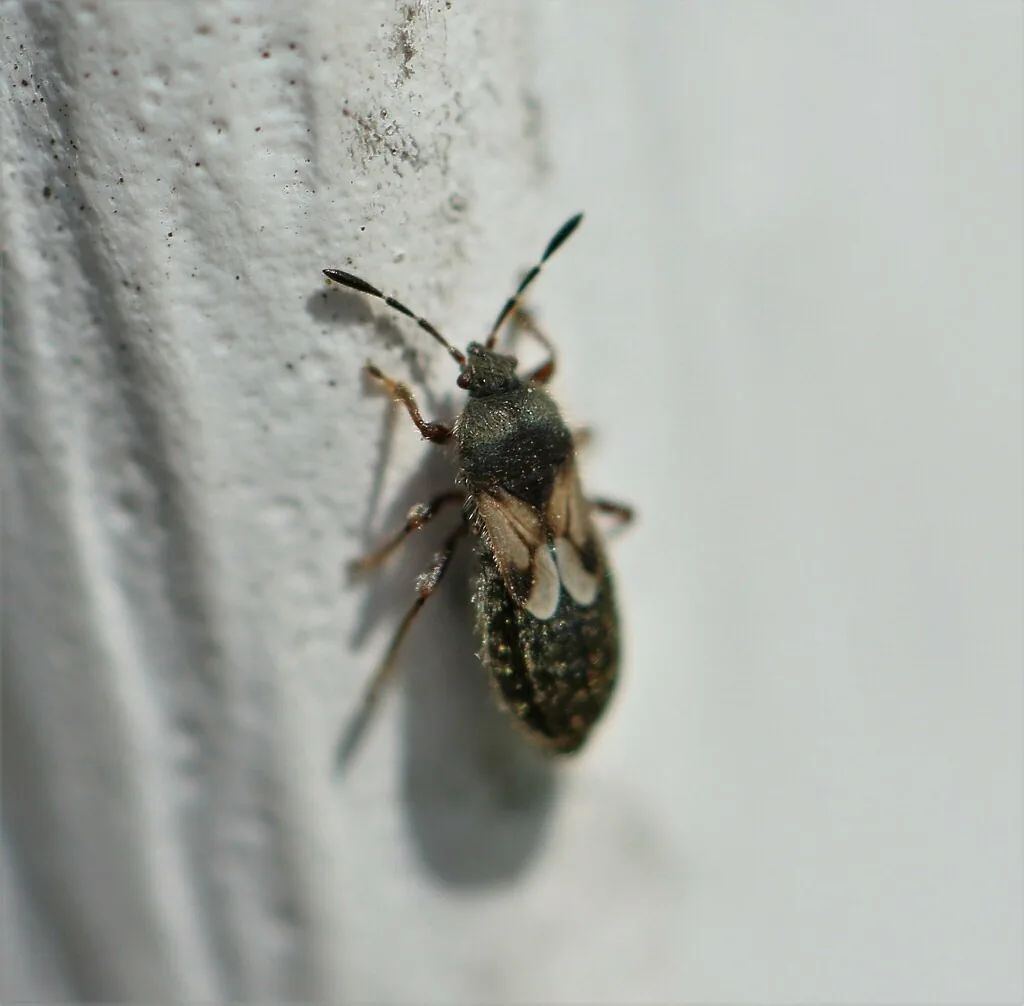
- Adults are small and slender with black bodies and white wings, each wing bearing a black triangular mark. Texas A&M puts them at almost 1/4 inch long, Mississippi State at about 1/8 to 3/16 inch. UF/IFAS gives about 6 mm (1/4 in) and describes white wings with a black spot on the margins of the forewings.[2][3][1][7]
- Some adults have full-length wings and can fly; others have short wings and can't. UF/IFAS says the long-winged form's wings reach almost to the end of the abdomen, while the short-winged form's reach about halfway.[2][1][7]
- Young nymphs are bright orange to pinkish red with a pale band across the abdomen. They turn darker red and then black as they grow, and before the last molt they have a white spot and two small wing pads. UF/IFAS says the first-instar nymph is yellow. The eggs are small and oval, with four small projections at the blunt end, and turn from pale white to amber and then red before hatching.[1][2][7]
Look-alikes
| Look-alike | How to tell them apart |
|---|---|
| Bigeyed bugs | Similar in size and often mistaken for chinch bugs, but bigeyed bugs have a head as wide as or wider than the thorax, large bulging eyes and no black-and-white wings. They are predators that kill chinch bugs. UF/IFAS names the bigeyed bug Geocoris uliginosus as the most numerous predator of the southern chinch bug in St. Augustinegrass.[2][7] |
Where it lives
EFSA reports it from the southern continental US, Hawaii, Guam, Mexico, Central and South America and across the Caribbean, and in Portugal since 2019. In Texas it does the most damage in the Gulf Coast region and the southern half of the state, and Clemson calls it a common turfgrass pest in the Southeast. UF/IFAS says the first reports of it as an economic pest came from Orange County, North Carolina, in 1783, and that in Florida the most severe damage is in the central and southern counties.[5][2][1][7]
Biology and life cycle
A mated female can lay up to 250 eggs over her lifetime, and the eggs hatch in about 2 weeks.[2]
Nymphs pass through five instars in less than 30 days in warm weather, and the whole life cycle takes 7 to 8 weeks. Texas A&M gives three to five generations a year, Clemson two or three in South Carolina. Generations overlap, so all stages can be found together.[2][1]
The winter is spent as an adult or late-stage nymph. In Florida, UF/IFAS says it usually stays active through winter, sheltered around the roots and base of the grass (sometimes going briefly dormant in north Florida), so spring infestations often start where the previous season's damage stopped.[1][7]
Adults and nymphs gather to feed at the base of the grass.[5]
UF/IFAS says a female lays over 250 eggs on average, sometimes as few as four a day but for many weeks, on the grass close to where it meets the soil. In summer the eggs hatch in six to 13 days, 11 on average; in winter it can take a month or more.[7]
Infestations thrive in warm, damp summer months and peak in early July, according to UF/IFAS. Studies of adult life span vary widely, from 10 to 70 days, with a mean of around 49 days under controlled conditions.[7]
Populations usually stay in the same area all year. They can fly, but UF/IFAS says few do; groups mostly walk from heavily infested grass to fresh grass and can cover over 400 feet in under an hour, moving from lawn to lawn through a neighborhood.[7]
In the turf they live from the thatch down into the upper organic soil layer, usually to 38 mm (1½ in) below the surface. When numbers are high they can be seen running over the grass blades.[7]
Damage and signs
- Nymphs and adults suck sap through a slender beak and inject toxic saliva, turning the grass yellow and then brown until it dies. UF/IFAS says large numbers gather at the base of one plant, and once they have killed one section of stolons they move as a unit to the next.[1][2][3][7]
- Damage shows as expanding, irregular patches of dead grass ringed by yellowing grass, often first next to driveways, sidewalks and brick walls or where irrigation is lacking. The patches grow and merge as numbers rise.[2][1]
- Hot, dry weather and full sun favor outbreaks, and lush, heavily fertilized grass with a thick thatch layer is most at risk. It also feeds on zoysiagrass, centipedegrass, bahiagrass and bermudagrass, but is a serious pest only on St. Augustinegrass. UF/IFAS adds that St. Augustinegrass on high, dry, sandy or shell soil is especially vulnerable.[3][1][2][7]
- Brown patch disease, drought, white grubs and other problems can look similar, though brown patch usually forms circles or half-circles. Damage normally appears at about 20 to 25 chinch bugs per square foot, so if you can't find the bugs, look for another cause. UF/IFAS also lists dehydration, root rot and other diseases, and nematodes as causes of similar yellow or brownish spots.[2][3][1][7]
Health risk
Chinch bugs feed on grass sap; none of these sources reports bites or other harm to people or pets.[1][2]
Control
Prevention
Mow often enough that no more than one-third of the grass height comes off at a time. When thatch is more than 1 inch thick, dethatch by vertical mowing, or aerate and top-dress, while the grass is actively growing. UF/IFAS recommends keeping St. Augustinegrass at 3 to 4 inches for a strong root system, mowing with a sharp blade to reduce stress, and removing thick thatch by vertical mowing or power raking.[2][7]
Don't over-fertilize; slow-release fertilizers lower the risk. Water deeply when the grass shows drought stress (blade edges curling, footprints that don't spring back, or a dull bluish-gray color) and let the soil dry between waterings. UF/IFAS warns that large applications of inorganic nitrogen raise susceptibility and suggests water-insoluble, time-release or split applications. It advises watering only after wilting begins, when leaf edges start to curl, and says less than an inch of water usually rewets the top 8 to 12 inches of the root zone.[2][1][7]
Resistant St. Augustinegrass cultivars such as Floratam and Floralawn have helped, but chinch bugs in Florida and Texas have now overcome Floratam's resistance. UF/IFAS says the University of Florida and Texas A&M released Floratam in 1973, and isolated chinch bug populations had adapted to it within twelve years.[1][4][7]
Biological control
Bigeyed bugs, minute pirate bugs, spiders, wasps and ants attack chinch bugs, and repeated broad insecticide use can kill these predators and lead to more chinch bugs. The fungus Beauveria bassiana may help in humid conditions; beneficial nematodes have given inconsistent results. UF/IFAS adds the striped earwig, two anthocorid bugs and fire ants to the list of predators, but says natural enemies alone did not significantly reduce populations.[2][7]
Pesticides
Treat only when the bugs are confirmed in damaging numbers, and only the infested area plus a few feet around it; inspect again at 5 and 12 days. In many areas of Florida chinch bugs resist the older organophosphate and carbamate insecticides, and Mississippi State notes populations resistant to pyrethroids. UF/IFAS says resistant populations can need many applications, which makes this an extremely difficult pest to manage.[2][1][3][7]
The can float test
Cut both ends out of a large can (Clemson suggests a one-gallon can; Texas A&M says at least 4 inches across and 6 inches tall) and twist it several inches into the turf at the edge of a yellowing, not yet dead, patch. UF/IFAS describes a metal coffee can with the bottom removed, worked 3 inches into the soil.[1][2][3][7]
Fill it with water and keep it topped up. Clemson says chinch bugs float up within five minutes; Texas A&M says to check after 10 minutes. UF/IFAS says to keep filling it for five minutes.[1][2][7]
Texas A&M counts an average of more than 2 bugs per sample in a 4-inch can, or more than 4 to 5 in a 6-inch can, as damaging. Take samples in several spots. UF/IFAS says to repeat the test at least four times around the discolored area, concentrating on the edges of the injured spots.[2][7]
You can also kneel, part the grass at the edge of the patch until the soil surface shows, and watch for adults and nymphs.[1][3]
Where sources disagree
Size: almost 1/4 inch according to Texas A&M, about 1/8 to 3/16 inch according to Mississippi State. UF/IFAS gives about 6 mm (1/4 in).[2][3][7]
Generations: three to five a year in Texas, two or three in South Carolina.[2][1]
Watering after a spray: Mississippi State suggests at most 1/8 to ¼ inch of water to carry a liquid insecticide into the thatch, while Texas A&M advises against irrigating after liquid insecticides. Both suggest watering beforehand.[3][2]
Eggs: Texas A&M says a female can lay up to 250 eggs, which hatch in about 2 weeks; UF/IFAS says she lays over 250 on average and that summer eggs hatch in six to 13 days.[2][7]
Patch shape: Texas A&M describes irregular patches and contrasts them with the circles of brown patch disease, while UF/IFAS says chinch bug patches are usually circular.[2][7]
Common questions
- Why is my St. Augustinegrass dying in patches near the driveway?
- Chinch bug damage is often worse in heat-stressed areas next to driveways, sidewalks and roadways, so check the edges of those patches first.[1][2]
- Do chinch bugs bite people?
- None of these sources reports chinch bugs biting people; they feed on grass sap.[1][2]
- Is it chinch bugs or brown patch?
- Brown patch usually makes circular or half-circle patches, while chinch bugs leave irregular patches ringed by yellowing grass. A float test settles it.[2][1]
- How fast can chinch bugs spread across a lawn?
- Mostly on foot. UF/IFAS says only a small share fly; groups walk from heavily infested grass to fresh grass, sometimes covering over 400 feet in under an hour, and move from lawn to lawn within a neighborhood.[7]
- Are chinch bugs active in winter?
- In Florida, usually yes. UF/IFAS says they shelter around the roots and base of St. Augustinegrass through winter, so spring damage often starts where last season's ended. Clemson says they spend the winter as adults or late-stage nymphs.[7][1]
Sources
- Clemson Cooperative Extension Home & Garden Information Center, “Chinch Bugs (HGIC 2487).” hgic.clemson.edu/factsheet/chinch-bugs/ (accessed 2026-11-11)
- Texas A&M AgriLife Extension, “Chinch Bug Management in Lawns (ENTO-PU-044, W. Brown and M. Keck, November 2024).” extensionentomology.tamu.edu/wp-content/uploads/2025/03/chinch-bug-management-in-lawns.pdf (accessed 2026-11-11)
- Mississippi State University Extension, “Southern Chinch Bugs, Bug's Eye View Vol. 7, No. 17 (B. Layton, 2021).” extension.msstate.edu/taxonomy/term/4171/2021/southern-chinch-bugs-vol-7-no-17 (accessed 2026-11-11)
- Journal of Economic Entomology, via PubMed, “Youngs, Milla-Lewis, Brandenburg and Cardoza (2014), St. Augustine grass germplasm resistant to Blissus insularis.” pubmed.ncbi.nlm.nih.gov/25195463/ (accessed 2026-11-11)
- EFSA Journal, via PubMed, “EFSA Panel on Plant Health (2023), Pest categorisation of Blissus insularis.” pubmed.ncbi.nlm.nih.gov/37496697/ (accessed 2026-11-11)
- iNaturalist, “Blissus insularis taxon page (order and family).” www.inaturalist.org/taxa/1121348 (accessed 2026-10-06)
- University of Florida IFAS Extension, EDIS, “Southern Chinch Bug, Blissus insularis Barber, EENY-226/IN383 (Featured Creatures).” ask.ifas.ufl.edu/publication/IN383 (accessed 2026-11-14)