On this page
How to identify it
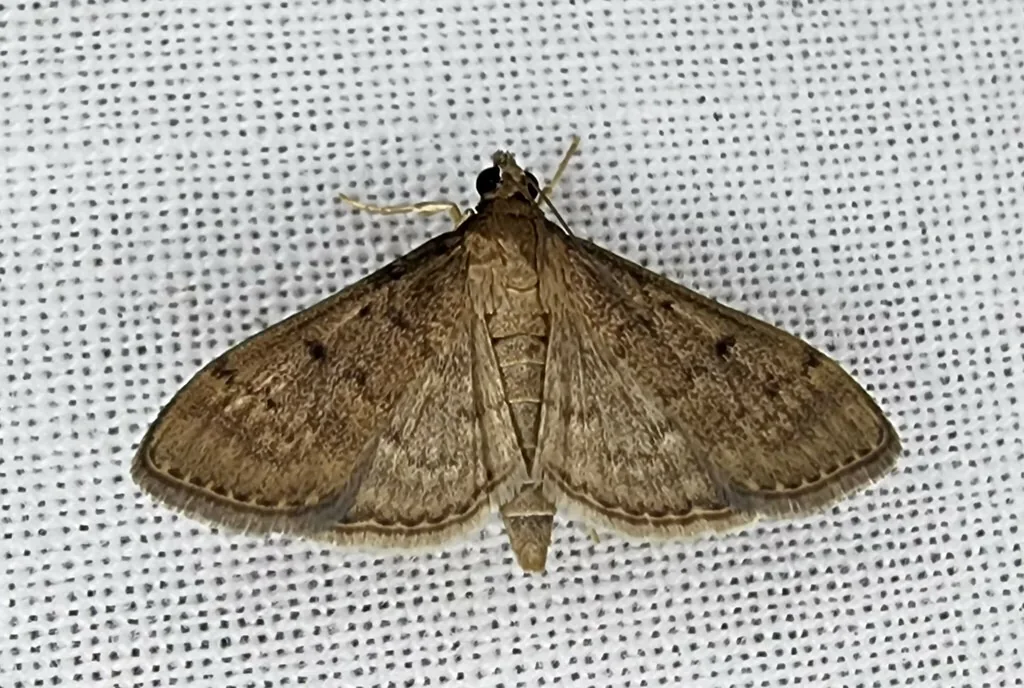
- Moths are dingy brown to dull gray with a wingspan of about 3/4 inch and fly low over the grass in a zigzag at dusk. Unlike most other North American sod webworm moths, the tropical species holds its wings flat over its body.[1]
- Caterpillars start out whitish and turn light green, then yellowish brown, with a dark brown head and brown spots on each segment that grow more distinct as they mature.[1]
- The first four larval stages feed on the upper leaf surface and are easy to overlook; the fifth and sixth stages chew off whole leaf blades.[1]
Look-alikes
| Look-alike | How to tell them apart |
|---|---|
| Other sod webworms | Other North American webworm moths partly fold their wings when resting, which gives them a narrow, tube-like look; the tropical sod webworm moth rests with its wings flat.[1] |
Where it lives
A pest of warm-season turf across the southern US, from South Carolina through Georgia and Florida west to Texas, and in the Caribbean and Central America. It turned up as a new outbreak pest in southern Brazil in 2024.[1][3][4]
Biology and life cycle
Females scatter eggs in clusters of 10 to 35 over the turf while flying in the evening. Caterpillars pass through five or six stages, then web grass bits and debris into a cocoon in the upper thatch to pupate.[1]
Heat speeds development. On St. Augustinegrass in the lab, egg to adult took about 48 days at 20°C (68°F) and about 21 days at 30°C (86°F); larvae could not finish developing at 15°C (59°F) or 35°C (95°F). UGA gives 21 to 47 days depending on temperature.[2][1]
Larvae feed only after sunset and hide in the thatch by day. In Georgia they overwinter in thatch and start feeding again when spring warms up.[1]
Damage and signs
- It attacks all warm-season turfgrasses, including bermudagrass, St. Augustinegrass, centipedegrass, seashore paspalum, zoysiagrass and bahiagrass, with a preference for bermudagrass and St. Augustinegrass.[1]
- Damage starts as small yellow-brown patches that merge into large dry patches in dry weather and are easy to mistake for drought. Hot, dry spots such as banks and slopes suffer most, and birds feeding more than usual on the lawn can be a clue.[1]
- Grass can recover from a light infestation if it has been well cared for.[1]
Health risk
It feeds on grass; none of the sources describes any harm to people or pets.[1][3]
Control
Prevention
Well-kept turf resists webworms. Mow regularly at the recommended height and don't overdo nitrogen, which builds lush growth and thatch that favor them. St. Augustinegrass cultivars such as Palmetto and Raleigh are susceptible.[1]
Traps and physical control
Confirm before treating with a soap flush: mix 1 ounce of dish detergent in 1 gallon of water and pour it over a 1-square-yard patch, then count the caterpillars that come up. On a mild infestation the soap itself can serve as a spot treatment.[1]
Biological control
Insect-killing nematodes (Steinernema carpocapsae), the fungus Beauveria bassiana and Bacillus thuringiensis products may help with less harm to the minute pirate bugs and big-eyed bugs that eat webworm larvae.[1]
Pesticides
Insecticides work best on young larvae, which hatch within 7 to 14 days of the moths' zigzag evening flights, so check the turf then, use liquids rather than granules, apply in the evening, and repeat at two- to three-week intervals while moths keep flying. In a Florida field test, residues of chlorantraniliprole kept working for the full five weeks, while bifenthrin and clothianidin lost detectable activity after three and four weeks. Follow the label.[1][3]
Spreading south
In 2024 caterpillars stripped native pasture grasses (Axonopus) in the highlands of Santa Catarina, Brazil, the first record of this webworm there; DNA placed the Brazilian moths closest to a Peruvian sample and apart from US and Japanese ones.[4]
Where sources disagree
Where it occurs: UGA places it across the southern US from South Carolina through Georgia and Florida west to Texas; a 2015 Florida study describes it as a pest in the Gulf Coast states, the Caribbean and Central America.[1][3]
Common questions
- What's chewing my St. Augustine or zoysia lawn in fall?
- Tropical sod webworms are a likely cause in warm-season lawns, especially in fall. A soap flush over a suspect patch will bring the caterpillars up where you can see them.[1]
- When do they feed?
- Only after sunset and at night; by day they hide in the thatch.[1]
Sources
- University of Georgia Cooperative Extension, “Sod Webworms: Biology and Management in Turfgrass (Circular 1156, W. G. Hudson and S. V. Joseph, 2022).” fieldreport.caes.uga.edu/publications/C1156/ (accessed 2026-11-11)
- Peer-reviewed literature (PubMed), “Thermal requirements and development of Herpetogramma phaeopteralis (Lepidoptera: Crambidae: Spilomelinae) (Tofangsazi N et al., Journal of economic entomology, 2012).” pubmed.ncbi.nlm.nih.gov/23156152/ (accessed 2026-11-11)
- Journal of Economic Entomology, via PubMed, “Concentration-Response and Residual Activity of Insecticides to Control Herpetogramma phaeopteralis in St. Augustinegrass (Tofangsazi et al. 2015).” pubmed.ncbi.nlm.nih.gov/26470184/ (accessed 2026-11-11)
- Neotropical Entomology, via PubMed, “First Record of Tropical Sod Webworm on Turfgrass in Brazil (do Prado Ribeiro et al. 2024).” pubmed.ncbi.nlm.nih.gov/39738933/ (accessed 2026-11-11)
- iNaturalist, “Herpetogramma phaeopteralis taxon page (order and family).” www.inaturalist.org/taxa/330489 (accessed 2026-11-11)