On this page
How to identify it
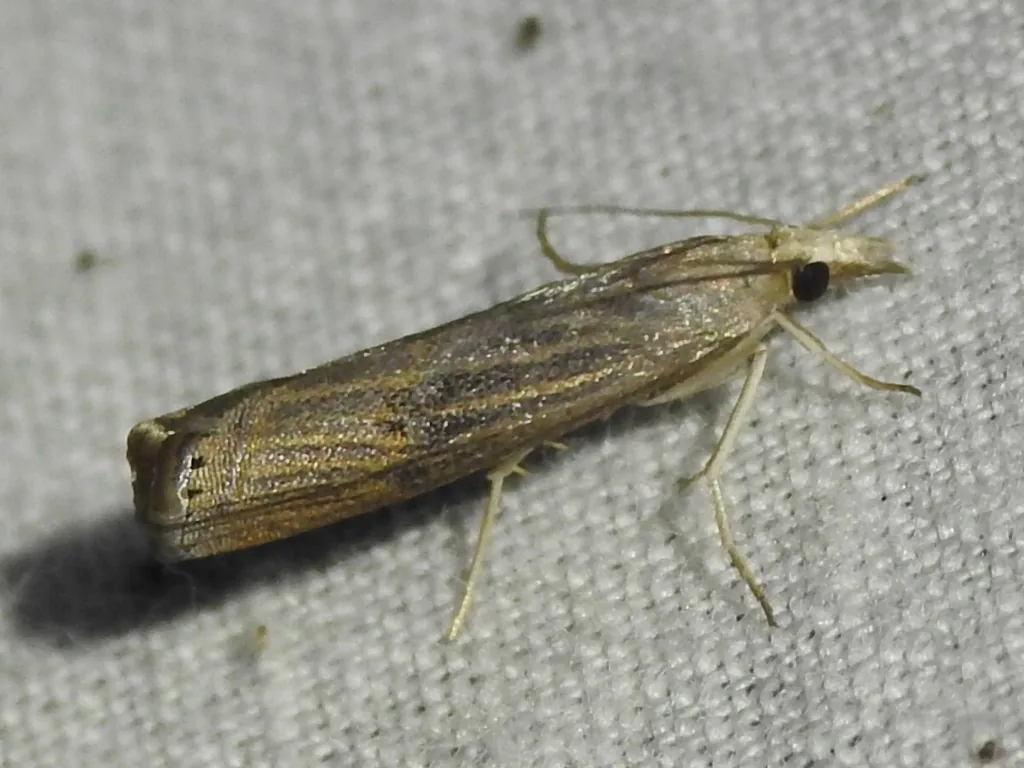
- Adults are dull whitish, gray or tan moths with a wingspan of about 3/4 to 1 inch and a pair of projections sticking forward from the head like a snout.[1][4]
- At rest the moth wraps its wings close around its body, so it looks narrow and tube-shaped, often facing down on a grass stem.[1][2][4]
- Disturbed moths make short, jerky, zigzag flights just above the grass, especially at dusk, and they come to lights at night.[1][2][3]
- Full-grown larvae are usually about 3/4 inch long (5/8 to 1 inch), beige, brownish, greenish or grayish, with rows of dark spots that each carry a long bristle. They curl up or writhe when disturbed.[1][4][5][3]
Look-alikes
| Look-alike | How to tell them apart |
|---|---|
| Tropical sod webworm | A different moth, Herpetogramma phaeopteralis, that is a major turfgrass pest in the southeastern United States; its larvae develop on St. Augustinegrass and feed at night.[7][8] |
| Cutworms | Sod webworm larvae carry rows of dark spots with long bristles and live in silk-lined tunnels in the thatch, where you'll often find fresh green droppings.[1][3] |
| Dog urine spots | Urine spots turn yellow first and keep a ring of dark green grass around them; webworm spots have clipped blades, no green border and don't yellow first.[1] |
Where it lives
Sod webworms occur across the United States, though which species live in a given area varies; Penn State, Minnesota, California and Utah each report lawn infestations. In the Southeast the tropical sod webworm, a related moth, is a major turfgrass pest.[4][5][1][2][3][7]
Biology and life cycle
Larvae overwinter in silk-lined tunnels in the thatch, resume feeding in spring and pupate from late May into June in Pennsylvania.[1][4]
Females drop eggs onto the turf while flying at night, and the eggs hatch in 7 to 10 days.[1][3][5]
Two generations a year are common in the North, with larvae feeding in early summer and again from late July into September; NC State says most species have two or three.[1][2][5]
Larvae stay in silk-lined burrows at the soil surface during the day and come out at night to feed.[2][3]
The moths are weak fliers that live only a few days and feed only on dew.[5]
The name covers a complex of more than twenty grass-feeding species; Utah alone has at least seven.[4]
Damage and signs
- Young larvae skeletonize grass blades; older ones notch or clip them off just above the crown and pull them into the burrow.[3][1][5]
- Early damage shows as ragged brown spots about the size of a quarter or a baseball that grow and join into large dead areas.[2][1]
- The worst damage usually comes in July and August, on drought-stressed slopes and other spots that are hard to water.[1][5]
- Because they feed above ground, roots stay intact: webworm-damaged sod doesn't loosen or peel up the way it does after white grubs.[4]
- Birds probing for the larvae can leave pencil-sized holes in the brown patches.[1]
Health risk
Sod webworm moths only sip dew through straw-like mouthparts, and the caterpillars feed on grass, so the harm is to the lawn.[1][5]
Control
Prevention
Plant endophyte-enhanced perennial ryegrass, tall fescue or fine fescue where they suit your site; the fungi inside these grasses repel sod webworms. Keep endophyte seed away from livestock pasture.[1][3][4]
Mowing above 2.5 inches makes damage hard to notice, and removing heavy thatch takes away some of the larvae's shelter.[3]
Water and fertilize to recommendations but not beyond them: healthy turf outgrows light feeding, while overly pampered turf can attract egg-laying moths.[4][1]
Traps and physical control
Check before treating: soak a square yard of turf with 2 tablespoons of dish detergent in 2 gallons of water and count the larvae that crawl up.[1][2]
Biological control
Insect-parasitic nematodes such as Steinernema carpocapsae and products containing Bacillus thuringiensis kurstaki can suppress young larvae; Bt breaks down quickly in sunlight. In a New Jersey golf course trial, S. carpocapsae cut sod webworm larvae by 75 percent in fairways and 100 percent in roughs.[3][1][6][4]
Pesticides
Treat only if counts pass about 10 to 15 larvae per square yard, using a product labeled for sod webworms applied in late afternoon or evening, when larvae feed.[1][3][4][5]
When to scout
In Minnesota, scout in June and again in early August to catch both generations of larvae; UC IPM monitors from June to early October.[2][3]
Look for dew sparkling on small webs in early morning, and for fresh green droppings and silk tunnels in the thatch of brown spots.[2][1]
Moths flying low over the lawn at sunset are a cue to start checking for larvae.[4][5]
Where sources disagree
Treatment threshold: Penn State and Utah State say 10 to 15 larvae per square yard, UC IPM says 15 (5 on stressed greens), while NC State says three or four per square foot, and Penn State also cites 4 to 6 per square foot.[1][4][3][5]
Overwintering stage: Penn State says mature larvae; NC State and Utah State say young or immature larvae.[1][5][4]
Eggs per female: Penn State says up to 200; Utah State says about 60 a day for 14 days.[1][4]
Generations: Minnesota says two a year; Utah State says most species have two but some have one and others up to four.[2][4]
Common questions
- What are the little tan moths flying over my lawn at dusk?
- Most likely lawn moths, the adults of sod webworms. The moths only sip dew; the caterpillars do the damage, so check for larvae with a soapy-water drench first.[1][2][5]
- Do lawn moths always mean lawn damage?
- No. In Minnesota the moths are common but larval damage is uncommon, so count larvae first; healthy, well-watered turf often hides light feeding.[2][1][4]
Sources
- Penn State Extension, “Sod Webworms in Home Lawns.” extension.psu.edu/sod-webworms-in-home-lawns (accessed 2026-11-11)
- University of Minnesota Extension, “Sod webworms (reviewed 2018).” extension.umn.edu/yard-and-garden-insects/sod-webworms (accessed 2026-11-11)
- University of California Statewide IPM Program, “Sod Webworms (UC IPM Pest Management Guidelines: Turfgrass, UC ANR Publication 3365-T).” ipm.ucanr.edu/agriculture/turfgrass/sod-webworms/ (accessed 2026-11-11)
- Utah State University Extension, “Sod Webworms (Hodgson and Roe).” extension.usu.edu/planthealth/research/sod-webworm (accessed 2026-11-11)
- NC State Extension, “Sod Webworms in Turf.” content.ces.ncsu.edu/sod-webworm-in-turf (accessed 2026-11-11)
- Journal of Invertebrate Pathology, via PubMed, “Long-term suppression of turfgrass insect pests with native persistent entomopathogenic nematodes (Koppenhöfer and Sousa 2024).” pubmed.ncbi.nlm.nih.gov/38705354/ (accessed 2026-11-11)
- Journal of Economic Entomology, via PubMed, “Thermal requirements and development of Herpetogramma phaeopteralis (Tofangsazi et al. 2012).” pubmed.ncbi.nlm.nih.gov/23156152/ (accessed 2026-11-11)
- Neotropical Entomology, via PubMed, “First record of tropical sod webworm on turfgrass in Brazil (do Prado Ribeiro et al. 2024).” pubmed.ncbi.nlm.nih.gov/39738933/ (accessed 2026-11-11)
- iNaturalist, “Parapediasia teterrellus taxon page (order and family).” www.inaturalist.org/taxa/553984 (accessed 2026-11-11)